
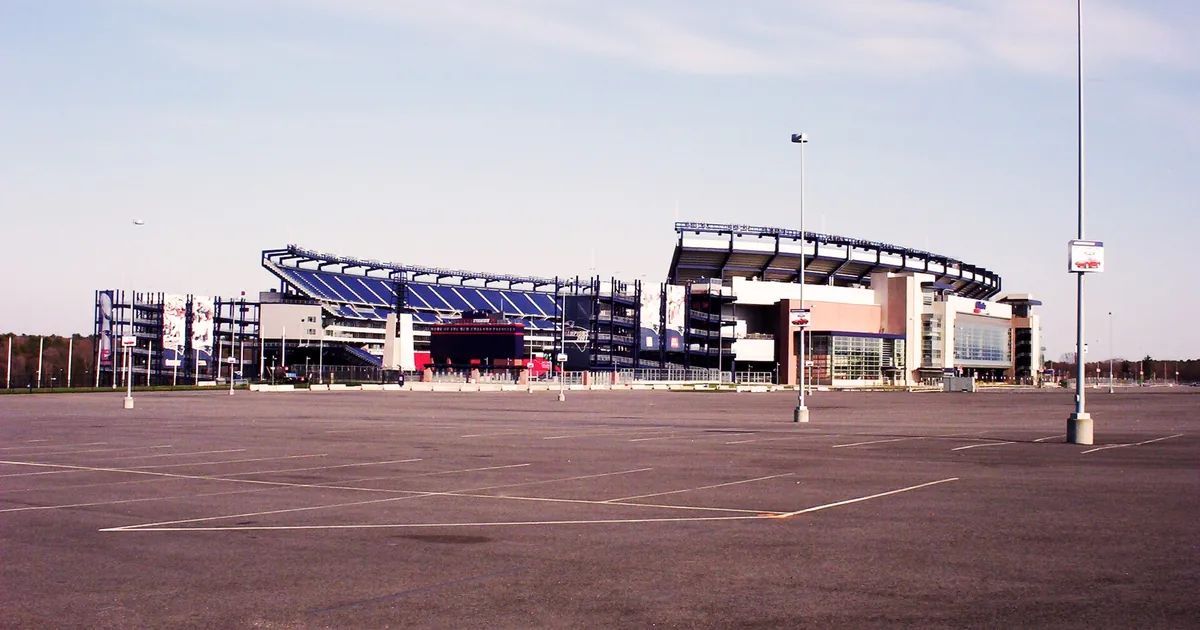
Gillette Stadium, Foxborough. Photo: Max P / Wikimedia Commons, CC BY 2.0
5 min read · 1,010 words
If you are trying to work out how to get to Gillette Stadium for the World Cup 2026 start with the fact the tournament’s branding would rather you didn’t dwell on: “Boston Stadium” is not in Boston. It sits in Foxborough, roughly 22 miles southwest of the city, ringed by Route 1 and very little else. Boston hosts seven matches beginning June 13 with Haiti against Scotland, and for every one of them more than 60,000 people will need to reach a venue built for cars on a day when most of the parking has been taken away. This is the honest version of getting there.
How to get to Gillette Stadium for the World Cup 2026: the train is the only direct route
According to the MBTA’s official World Cup guide, the transit authority will run a dedicated Boston Stadium Train between South Station and Foxboro Station, which sits next to the stadium. It is, in the MBTA’s own words, the only service going directly to the venue on a match day. There is no subway, no standard commuter line, and no walk-up option that drops you at the gate.
The specifics, all from the MBTA’s published guidance, matter because the margins are tight:
- Fourteen express trains run per match, non-stop, taking about an hour each way.
- A round trip costs $80 sold only through the MBTA’s mTicket app.
- You must hold a same-day World Cup match ticket to buy a train ticket, and so must every passenger, including children 11 and under.
- Train tickets cannot be refunded, exchanged, transferred, or resold and supply is capped.
- Return trains start leaving Foxboro 30 minutes after the final whistle, roughly every 15 minutes.
Fourteen trains is the number to sit with, and it is worth doing the arithmetic the official guide does not. A standard MBTA commuter-rail consist seats on the order of 1,500 passengers when fully loaded. Fourteen express round-trips therefore move, very generously, somewhere around 20,000 people each way, against a Gillette crowd that for the World Cup runs above 60,000. On that estimate, the only direct public-transport link carries at most a third of the building. The train is the cleanest way in; it was never built to be the only way in, and on match days it is close to being exactly that.
The parking math has quietly halved
Gillette normally parks around 20,000 cars. For the World Cup, as Boston 25 News reported from the host committee’s briefing, FIFA’s expanded security perimeter cuts that to roughly 5,000 reservation-only spaces all gated behind a same-day match ticket. Turn up without one and you are turned away; tailgating, a New England stadium ritual, is permitted only for ticket holders inside the paid lots. Organisers point to a further 5,000-plus spaces in independent satellite lots strung along Route 1.
Add it up and the structural squeeze becomes obvious. A venue that once absorbed 20,000 cars now offers about 10,000 parking spots total, split between official and satellite operators, to serve a sold-out international fixture. The gap between demand and supply does not vanish; it gets redistributed onto whatever fans can improvise.
Original analysis: the overflow has nowhere official to go
This is the part the official guides skip. Put the two numbers together as one-way arrivals: roughly 20,000 inbound train seats, plus the day’s roughly 10,000 parking spaces, the 5,000 reserved plus 5,000-odd satellite, at, say, 2.5 people per car, around 25,000 more, get you to about 45,000 of a 60,000-plus crowd. That leaves on the order of 15,000 people per match with no sanctioned way in at all: no train seat, no reserved space. The shortfall is not a rounding error; it is a structural gap baked into a high-security perimeter laid over a car-built suburban stadium. And the market has already found the release valve. As the Boston Globe reported, Foxborough homeowners have started renting out their front lawns for parking, an informal economy that springs up precisely because the sanctioned options are deliberately constrained.
That informal overflow is the real story of Foxborough’s World Cup. The closed-loop model, ticket-gated trains, ticket-gated lots, no walk-up, is excellent for security and crowd control, and genuinely worse for the average fan’s flexibility. Miss the cap on train tickets and your fallback is a satellite lot plus a long walk, a rideshare into a road network that organisers warn will be congested for up to five hours before kickoff and five hours after, or a stranger’s lawn. None of those are emergencies. All of them are the consequence of a venue designed for tailgating crowds being retrofitted into a high-security perimeter.
The practical takeaway: treat the $80 train as the first thing you buy, not the last. It sells in a fixed quantity, it is non-transferable, and once it is gone the alternatives are slower, dearer, or improvised. The fans who have the easiest day at Gillette will be the ones who booked the train the moment they had a match ticket in hand, and who built five hours of slack into both ends of their plans.
The match days you are planning around
Boston’s seven fixtures begin June 13 with Haiti versus Scotland, followed by Norway against the inter-confederation playoff winner on June 16 and Scotland versus Morocco on June 19, with further matches through the tournament. Every one runs on the same access logic: ticket-gated train, ticket-gated parking, congested roads on either side. The opponents change. The Foxborough problem does not.
Foxborough was cleared to host, and it will host well, the stadium is modern and the security planning is serious. But “how to get to Gillette Stadium for the World Cup 2026” has a blunter answer than the marketing suggests: book the train first, build in hours of margin, and accept that for one month a car-built venue 22 miles from the city it is named after has been turned into one of the harder grounds in the tournament to simply walk up to.
More World Cup 2026 fan guides from FootyGazette: our complete guide to the tournament the closed-loop plan for MetLife Stadium the honest version for Levi’s Stadium and Kansas City’s disappearing transit system at Arrowhead.
Sources: MBTA World Cup Guide; Boston 25 News; The Boston Globe; Mass.gov.
