
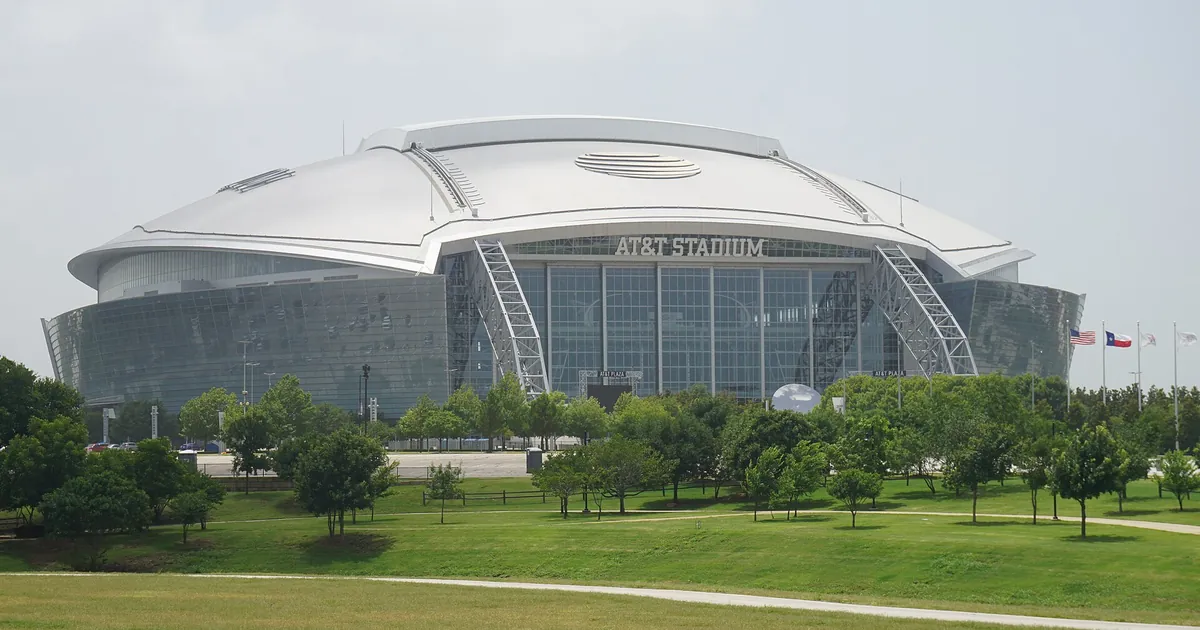
AT&T Stadium, Arlington, Texas. Photo: Michael Barera / Wikimedia Commons, CC BY-SA 4.0
6 min read · 1,314 words
There’s a concise way to describe the central challenge of World Cup transport at AT&T Stadium in Arlington, Texas. The Dallas–Fort Worth metroplex has seven million people, two major rail networks, and an urban core with genuine transit culture. AT&T Stadium holds 80,000 fans, hosts nine matches (more than any other venue in the tournament), and stages a semi-final on July 14.
Arlington, the city that surrounds it, has no bus service, no rail line, and no fixed-route public transit of any kind.
Arlington is the largest US city without a public transit system. It has a population of roughly 400,000 and has rejected transit proposals three separate times: in 1980, 1995, and 2002, per Fort Worth Report coverage of the city’s transit history and Arlington city council records. Texas state law limits how cities can deploy local sales tax for transit authority formation, which has prevented Arlington from funding one even when city leadership wanted it. A city-contracted on-demand rideshare scheme replaced the Metro Arlington Xpress bus pilot after that service was cancelled in 2017 for low ridership. There is no bus you can take from your Arlington hotel to the World Cup.
For 51 weeks of the year, this is a planning curiosity and a practical hardship for car-free residents. For nine World Cup matches, it is the central logistical challenge of the tournament’s busiest venue.
The CentrePort Workaround
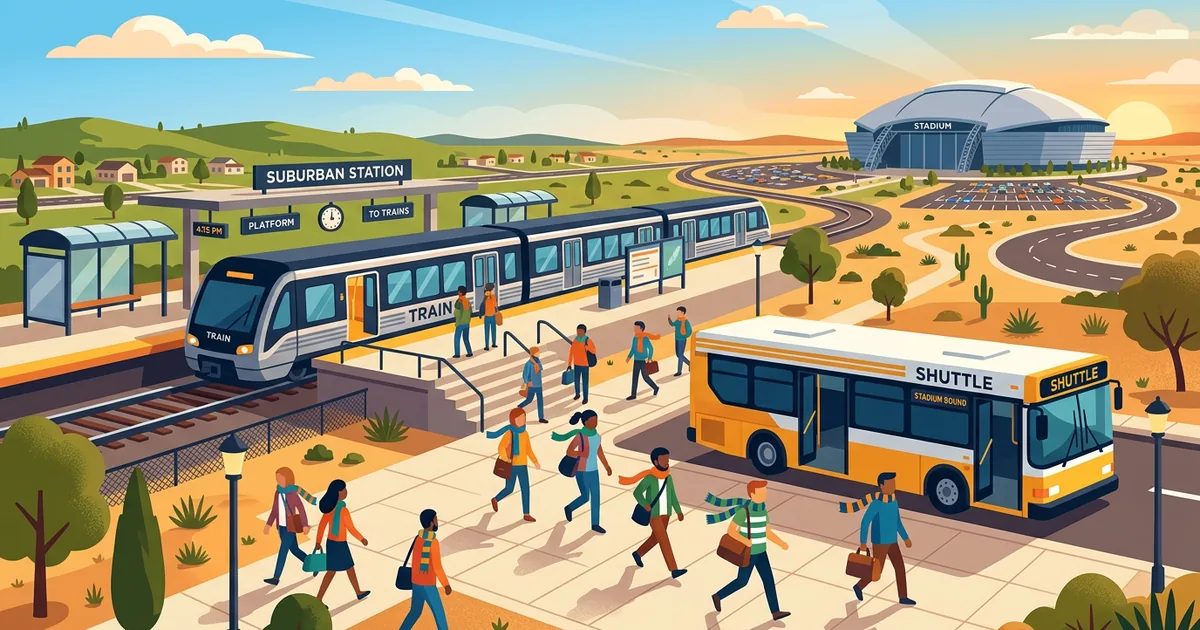
The Trinity Railway Express (TRE) commuter rail connects downtown Dallas at Victory Station to downtown Fort Worth’s Central Station, with a stop at CentrePort, at DFW Airport, approximately eight miles from AT&T Stadium. CentrePort is not in Arlington, and there is no rail connecting it to the venue. On match days, TRE deploys extra trains on 30-minute intervals; from CentrePort, free charter buses complete the journey to the stadium.
The total capacity of this system is around 10,000 to 12,000 passengers per match, according to KERA News coverage of the pre-tournament planning (June 9, 2026). Up to 125 charter buses operate on peak match days. The GoPass app handles integrated ticketing, and a regional one-day pass covering the TRE, the stadium shuttle, and unlimited same-day DART and Trinity Metro use costs $9. From downtown Dallas, the end-to-end trip runs to about 90 minutes each way.
The inbound journey is generally manageable. The return is the problem.
What Actually Happens: The Five-Hour Round Trip
Dallas Observer journalists attended two of the first group stage matches at AT&T Stadium in June and tracked the full experience firsthand. Inbound from Carrollton: described as “hassle-free, wait-free.” The return told a different story. CentrePort handles thousands of departing fans simultaneously, trains run on their scheduled 30-minute intervals, and the cumulative waits pushed the total round-trip time to approximately five hours. “We’re not sure it was worth five hours of our time,” the Observer’s reporter concluded.
The outbound direction obscures the problem. The return makes it visible.
This is not a system that fails. It is a system that succeeds slowly.
Driving and Parking
AT&T Stadium has 12,000-plus official parking spaces across 15 lots, with additional capacity at the Rangers ballpark and private lots in the Arlington Entertainment District. All official spaces require advance purchase through JustPark, FIFA’s official parking partner. There are no on-site sales on match days.
Group stage pricing has run from $75 to $175 per space. The Round of 16 baseline is $100. The semi-final on July 14 starts at $200, with premium lots climbing above $275. NBC 5 Dallas reported individual lots listed on secondary and private-market sites at $1,000 or above on peak group stage match days (official JustPark advance pricing starts from $75 per space).
Rideshare fans are directed to the Arlington Esports Stadium lot on Ballpark Way, a 10-minute walk from the stadium gates. Post-match surge pricing has reached three to five times base rates, with fares of $80 to $120 reported for journeys that normally cost under $25, per Dallas Observer match-day coverage. Uber’s flat-rate World Cup Shuttle ($45 per person, bookable via the Uber app) covers the inbound journey only; the post-match return falls to standard surge pricing.
The Transit Workaround
This series has now covered eleven stadiums across the 16-venue tournament. Each has its own failure mode.
MetLife Stadium built a closed-loop access regime that works but leaves fans without advance reservations 1.3 miles from the gates. Levi’s in Santa Clara has transit, but VTA capacity is capped at around 15,000 passengers per match. Hard Rock Miami’s shuttle-only plan, designed to prevent a repeat of Copa 2024’s perimeter breach, left fans stranded a mile from the gates for the Uruguay-Saudi opener. Gillette Stadium in Foxborough offers 14 trains from South Station and very little else. Houston’s NRG Stadium has rail to the door but sits in a metro area too car-reliant for most fans to access it usefully.
Arlington is a different kind of problem. The city did not try to build transit and do it badly. It made a deliberate, repeated, democratic decision not to build transit at all. The 1980, 1995, and 2002 referendums are the record. The infrastructure that would allow fans to step off a bus or train does not merely underperform. It was voted out of existence before the World Cup came calling.
What the tournament receives in its place is a borrowed system: charter buses assembled for this window only, a TRE-to-shuttle chain covering eight miles of suburban highway, pre-purchase parking enforced because walk-up availability was never part of the plan. It works. It just takes time.
The comparison with the transit-rich end of the series is instructive. Seattle’s Lumen Field is downtown with light rail to the door and a car-free pedestrian zone. Atlanta’s Mercedes-Benz Stadium sits above an MARTA station. Both venues still have failure modes (crush, not abandonment), but the underlying infrastructure exists. In Arlington, it had to be sourced from elsewhere and will be dismantled when the tournament is over.
Nine Matches, One Semi-Final
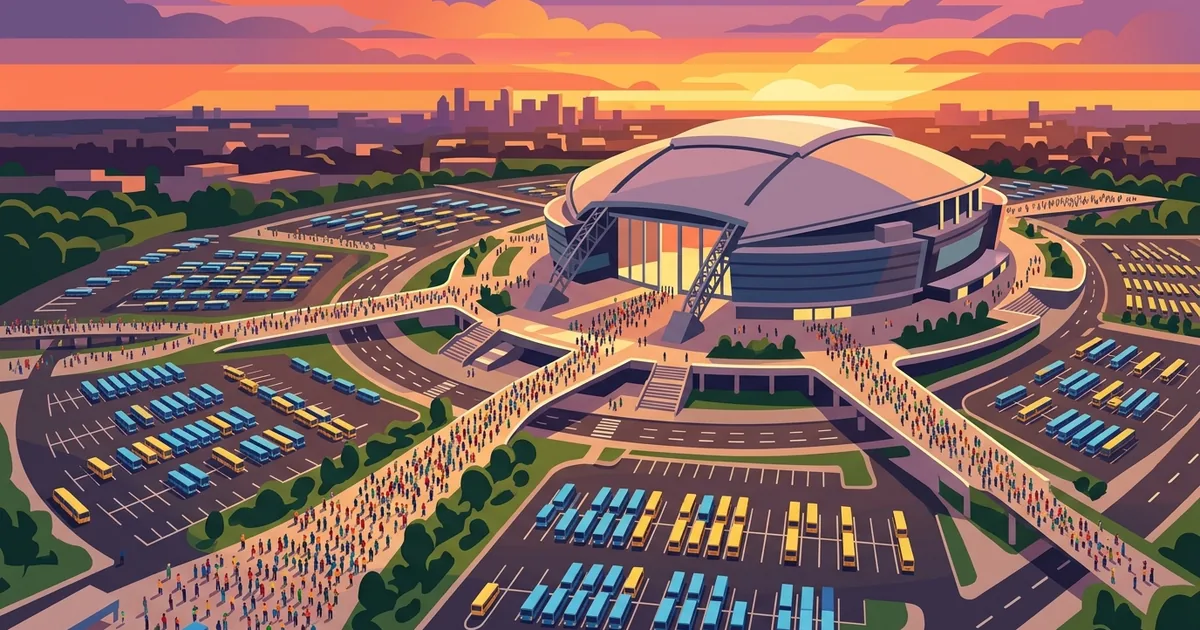
AT&T Stadium’s nine matches span the full tournament: five in the group stage, two in the Round of 32, one in the Round of 16, and the semi-final on July 14. That schedule means the transit challenge plays out across five weeks. Group stage fans face a logistical puzzle that, with planning, is solvable. Knockout-stage fans, many of them travelling specifically to North Texas, face the same puzzle with higher stakes and less room for improvisation.
The practical guidance is consistent across every AT&T match: pre-book the GoPass or secure JustPark parking before arriving in Texas. Arrive two to two-and-a-half hours before kickoff. Build in post-match time on the return. The five-hour round-trip figure from Dallas Observer reporting reflects the outer edge of the experience, not the median for a fan who plans ahead.
What should not be assumed is that the DFW Metroplex’s scale translates automatically into the transit access a major urban venue normally implies. AT&T Stadium sits in a city that chose, three times over, not to build that infrastructure. The workaround is real and functional. So is the gap it covers.
AT&T Stadium: Your Options at a Glance
- Train + free shuttle: TRE from Victory Station (Dallas) or Central Station (Fort Worth) to CentrePort, then free charter bus to stadium. $9 regional one-day GoPass. Allow 90 minutes inbound; build in extra time on the return.
- Drive and park: Mandatory advance purchase via JustPark. Group stage from $75; semi-final from $200 official pricing. No on-site sales on match days.
- Rideshare: Drop-off at Arlington Esports lot on Ballpark Way. 10-minute walk to stadium gates. Budget for three to five times base surge pricing post-match.
- Uber Shuttle: $45 flat rate inbound. Return falls to standard surge pricing.
For a venue hosting a World Cup semi-final, the one thing you cannot solve on arrival is the transit gap you did not plan around.
Sources: Dallas Observer (June 14 and 15 match coverage); KERA News (June 9, 2026); NBC 5 Dallas; Fort Worth Report; Dallas/FWC26 official transport pages; CBS News World Cup mass transit coverage.
