
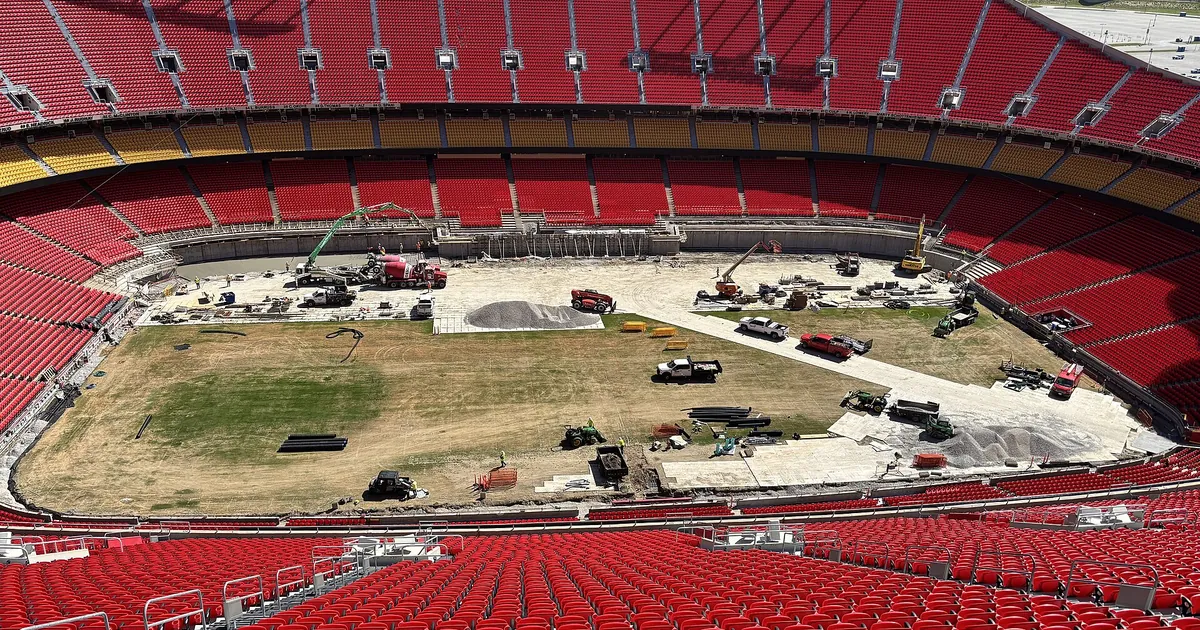
Arrowhead Stadium ahead of World Cup 2026. Photo: PCN02WPS / Wikimedia Commons, CC BY-SA 4.0. Photo: PCN02WPS / Wikimedia Commons, CC BY-SA 4.0
7 min read · 1,401 words
If you are flying into Kansas City for a World Cup 2026 group game, the single question that will decide whether your day is joyful or miserable is deceptively boring: how do you actually get to Arrowhead Stadium for the World Cup 2026? There is no train. There is barely any parking. And the bus network you will rely on did not exist a year ago and will be largely gone a month after the final whistle. Kansas City, the smallest of the 16 host cities, built a brand-new temporary transit system from scratch just to move you the seven miles from downtown to the stadium gates. This is how it works, what it costs, and where it quietly falls apart.
Why Kansas City had to build a transit system from scratch
FIFA requires host cities to provide public transport to fans, but it does not pay for it. For most host cities that is an inconvenience. For Kansas City it was a genuine engineering problem. The metro expects roughly 650,000 visitors across its six matches, more people than the city’s own estimated population of about 520,000, according to NPR and KCUR’s reporting. And the Kansas City Area Transportation Authority (KCATA) is running the fewest bus routes in its history after years of budget shortfalls, with many suburbs having cut transit service entirely.
The geography is unforgiving. GEHA Field at Arrowhead, rebranded “Kansas City Stadium” for the tournament, hosting four group games, a Round of 32 tie and a quarter-final, sits about seven miles southeast of downtown in a low-density sprawl with no rail link. “The stadium is like 7 miles from downtown, and that’s 7 Kansas City miles, not 7 New York miles,” city councilmember Eric Bunch, who sits on the KCATA board, told NPR. On the existing network, that trip is brutal: about 15 minutes on the streetcar, then a 25-minute bus that runs only once every 45 minutes, then a 15-minute walk across Arrowhead’s vast parking lots. Over an hour, door to gate, on a good day.
So the city built ConnectKC26: roughly 225 charter buses serving 15 locations that have no direct service today, running only from June 11 to July 13.
How to actually get to Arrowhead: the options, ranked
Forget driving unless you have booked a space in advance. Arrowhead normally offers around 20,000 parking spots, but under FIFA’s stadium footprint only roughly 3,000 to 4,000 will be available on match days. That leaves three realistic routes in:
- ConnectKC26 Stadium Direct (the one you want). A dedicated match-day charter that runs the seven miles in about 20 minutes without traffic. On June 5, organisers added a new spur from The Plaza to Arrowhead and back specifically to absorb the crowds, per FOX4 Kansas City. Stadium Direct boards at four park-and-ride lots and walk-up stops, and runs from three hours before kickoff until two hours after the final whistle. You need both a ConnectKC26 pass and a valid match ticket to ride.
- Regular RideKC buses. The KCATA’s everyday route 47 reaches Arrowhead seven days a week and will cost about $4 to the stadium during the tournament. It is cheaper, but slower and far less frequent, fine if you are flexible, risky if kickoff is fixed.
- Rideshare or taxi. Possible, but surge pricing and the closed-road traffic plan around the venue make this the gamble option. The city is closing 27th Street at the downtown bus mall to keep charters moving, private cars get no such priority.
The Stadium Direct park-and-rides announced earlier in the planning cycle included the FIFA Fan Festival site at the National WWI Memorial (2 Memorial Dr), Highway 40 & Stadium Dr, Independence Center, Oak Park Mall in Overland Park, and a North Kansas City lot. Pick the one nearest where you are sleeping, not the one nearest the stadium.
What it costs, and how Kansas City compares
Here is the rare piece of good news for fans: Kansas City is one of the cheaper host cities to reach the stadium. ConnectKC26’s Stadium Direct costs $15 round trip. The separate Region Direct service, which links 15 metro hubs to the free downtown Fan Festival, runs $5 a day, $25 a week, or $50 for the whole tournament, and Airport Direct between KCI and downtown is free with a pass, per KCUR.
Set that against the East Coast. New York and New Jersey fans face up to $100 for the rail run to MetLife, and Boston supporters are looking at $80 trains or $95 buses to Gillette. We covered the New Jersey backlash in our look at the $98 NJ Transit train that is selling almost no seats. By that standard, KC’s $15 is a bargain, though still pricier than Dallas or Philadelphia. One catch worth flagging: after six years of free rides, the KCATA resumed charging regular fares on June 1, so even the cheap option is no longer free.
The transit mirage: a system built to disappear
This is the part the national previews miss, and it matters more than any fare table. The ConnectKC26 network is not an upgrade to Kansas City’s transit, it is a stage set. It exists for 33 days and then it is struck. KCUR reports that once the tournament ends, the city will actually lose about a quarter of its daily bus routes, the very service residents depend on year-round. The 225 World Cup buses do not become 225 permanent buses; they go back to wherever they were chartered from.
That tells you something practical as a visitor, and something uncomfortable about the model. Practically: do not assume the slick match-day experience reflects how KC normally moves. If you arrive a few days early or stay late, the tourist-grade frequency will not be there for your non-match trips, plan those around the regular, thinner network. Structurally: FIFA’s unfunded transport mandate pushes cities into exactly this pattern, a burst of premium service for visitors, paid for partly out of a $15 million civic pledge, layered on top of a system being cut for locals. The Kansas City Bus Riders Union has been blunt about it, arguing in its “Not a Game to Us” zine that “long-term investments in our city’s transit should not be sacrificed to accommodate any single event.” KC2026 chief executive Pam Kramer frames the same system as a possible glimpse of “what a truly regional transit system could look like.” Both can be true. For one summer, Kansas City is showing residents the transit network they were told the region could never afford, and then taking it away.
For a fan, the takeaway is simple: lean on ConnectKC26 hard on match day, but treat the rest of your KC trip like the mid-sized, car-shaped city it actually is.
Frequently asked questions
Is there a train to Arrowhead for the World Cup? No. There is no rail link to the stadium. The streetcar serves downtown only; reaching Arrowhead means a bus, a charter, or a car.
How long does it take to get from downtown to Arrowhead? About 20 minutes on a ConnectKC26 Stadium Direct charter without traffic, versus over an hour on the regular network and roughly 15 minutes by car if you have one of the scarce parking spots.
How much is the Stadium Direct bus? $15 round trip per rider per match. You also need a valid match ticket to board.
When do the World Cup matches in Kansas City take place? The six matches fall on June 16, 20, 25 and 27, and July 3 and 11, 2026, with Stadium Direct running on each of those days from three hours before kickoff to two hours after.
Can I drive and park at the stadium? Only with a pre-booked space. Of Arrowhead’s usual ~20,000 spots, only an estimated 3,000–4,000 will be open on match days, so driving without a reservation is a bad bet.
Will this transit be there if I visit outside match days? Partly. The match-day Stadium Direct only runs on the six game days; Region Direct and Airport Direct cover other days, but the broader frequency is temporary and ends July 13.
Bottom line
Kansas City has done more than almost any host city to solve the get-to-the-stadium problem, and for $15 it has done it cheaply. Just go in clear-eyed: buy your ConnectKC26 pass early, pair it with your match ticket, pick a park-and-ride near your bed rather than the stadium, and do not expect the same service for the rest of your stay. For the wider picture on which host cities actually move fans well, see our best host city for fans breakdown and the full World Cup 2026 fan guide plus our look at last-mile access at MetLife.
