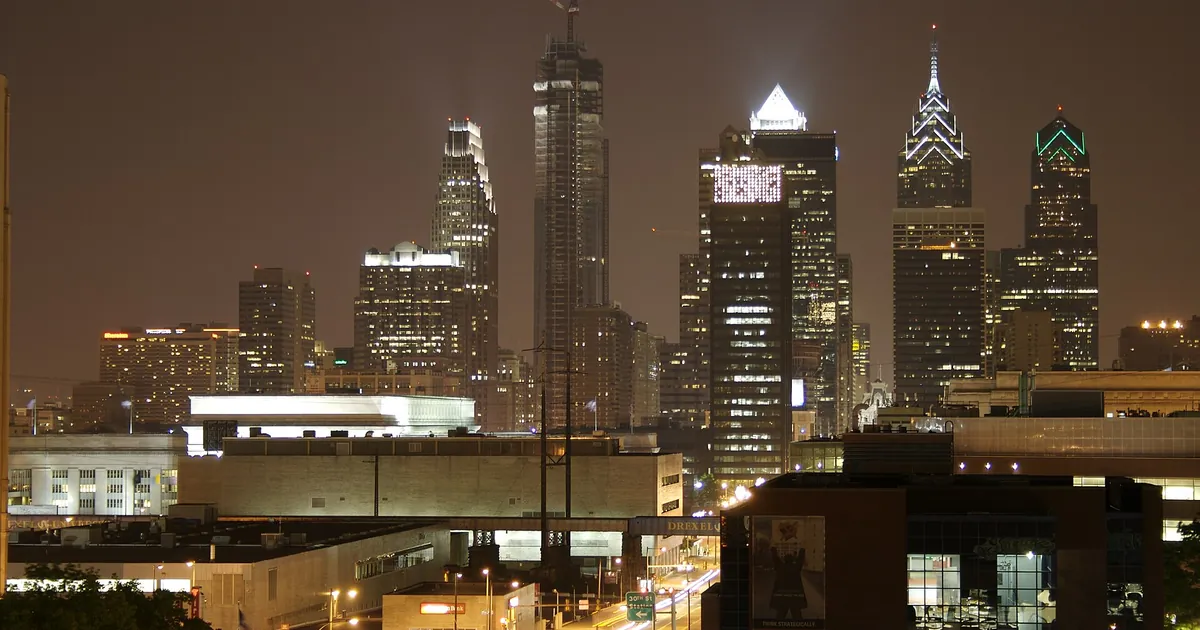
Philadelphia at night. Photo: Thesab / Wikimedia Commons, CC BY-SA 4.0
5 min read · 924 words
Philadelphia spent months building a way to cash in on the World Cup’s late-night crowds, and then quietly throttled it. The pitch was simple: let bars serve until 4 a.m. instead of the usual 2 a.m. for the duration of the tournament, capturing the spending of fans who, in a normal Philadelphia June, would be turned out onto the street at last call. The Philadelphia bars 4 a.m. World Cup 2026 programme is real, it is legal, and as the first matches kicked off this week almost nobody could actually use it.
How the Philadelphia bars 4 a.m. World Cup 2026 permit was supposed to work
The legal groundwork was laid in March, when, as Spotlight PA and the Inquirer reported, Governor Josh Shapiro signed a bill authorising the Pennsylvania Liquor Control Board to grant two-hour extensions to licensed venues for the World Cup window of June 11 through July 20. Philadelphia turned that authority into a product it calls the “Philadelphia 250 permit,” a nod to the city’s parallel role in the United States’ 250th-anniversary year.
The path to the permit is not a single form. Per the Inquirer’s reporting on the rollout, a bar has to pay $250 to the City of Philadelphia’s Department of Commerce complete the city’s “Liberty Bell Safe Certification” programme, and only then apply for the $500 permit from the PLCB with applications due 30 days before the extension period began. Three steps, two agencies, two fees, and a training course, all to move last call back by 120 minutes.
The bottleneck: 17 approvals out of a city full of bars
The result is the number that tells the story. According to the Pennsylvania Liquor Control Board’s own count, reported by CBS Philadelphia, as of Wednesday, June 10, the eve of the tournament, the board had approved just 17 of 65 Philadelphia 250 applications, with 42 still under review and six cancelled. The Inquirer, tracking the same backlog as approvals trickled out, put the running total at around 19 by later that week. The figures move in the same direction and tell the same story: in a city with thousands of licensed establishments, fewer than two dozen venues were cleared to serve a single legal drink after 2 a.m. when the World Cup arrived.
That is not a story about demand. The industry wanted this. “We think it’s a much better plan to have all these folks being served professionally than just let loose on the city at 2 a.m.,” Ben Fileccia of the Pennsylvania Restaurant and Lodging Association told CBS Philadelphia. Bar owners agreed. “It’s gonna be good for the city. It’s good for the business,” said Agapios Bouikidis of 1518 Bar and Grill. The appetite was there. The pipeline was not.
Original analysis: a revenue mechanism that throttles its own revenue
Strip away the civic branding and the Philadelphia 250 permit is a tax on a windfall, a way for two government bodies to monetise the few weeks when international visitors will pay to drink late. There is nothing wrong with that in principle. The problem is the design. By stacking a $250 city fee, a certification course, and a separate $500 state permit behind a 30-day deadline, the city built a funnel narrow enough to strangle the very windfall it was trying to capture.
Consider the incentives from a bar owner’s side. The permit costs $750 in fees before staffing two extra hours, the approval is not guaranteed, and the paperwork had to clear two agencies a month in advance, long before anyone knew how the local late-night trade would actually shake out. For a marginal venue, that is an easy thing to skip. So the supply of legal 4 a.m. bars collapses to a handful, the late-night crowd concentrates on those few addresses or spills back onto the 2 a.m. street the policy was meant to relieve, and the city collects fees on 17 permits instead of hundreds.
The deeper pattern is one host cities keep repeating with the World Cup: treating a one-month demand spike as a permanent administrative process. A genuine surge policy would have been near-automatic, a flat fee, a same-week turnaround, a presumption of approval for any venue already holding a liquor licence in good standing. Instead Philadelphia ran its surge measure through the same slow machinery it uses for everything else, and the machinery did what it always does. The tournament did not wait for the backlog to clear.
What it means for fans this month
For visitors, the practical effect is narrow and worth knowing: do not assume the bar you are in can serve past 2 a.m. just because the World Cup is on. Only a short, approved list can, the list grew slowly as the PLCB worked through its 42 pending applications, and an unapproved venue serving after hours is breaking the law, not bending it. The official Fan Festival at Lemon Hill and the city’s daytime watch-party scene are unaffected; this is purely a last-call question.
None of this will define Philadelphia’s tournament, the matches, the Fan Fest, and the crowds will. But the 4 a.m. permit is a small, clean illustration of a habit worth watching across all 16 host cities this summer: the gap between the policy a city announces and the one its paperwork actually delivers. Philadelphia announced a 4 a.m. last call. As of opening week, it had delivered one for 17 bars.
More World Cup 2026 coverage from FootyGazette: our complete guide to the tournament FIFA’s ticketing chaos and the $355m question the Airbnb gold rush that went bust and why 94% of NJ Transit’s $98 match train sat empty.
Sources: CBS Philadelphia; The Philadelphia Inquirer; Spotlight PA.
