
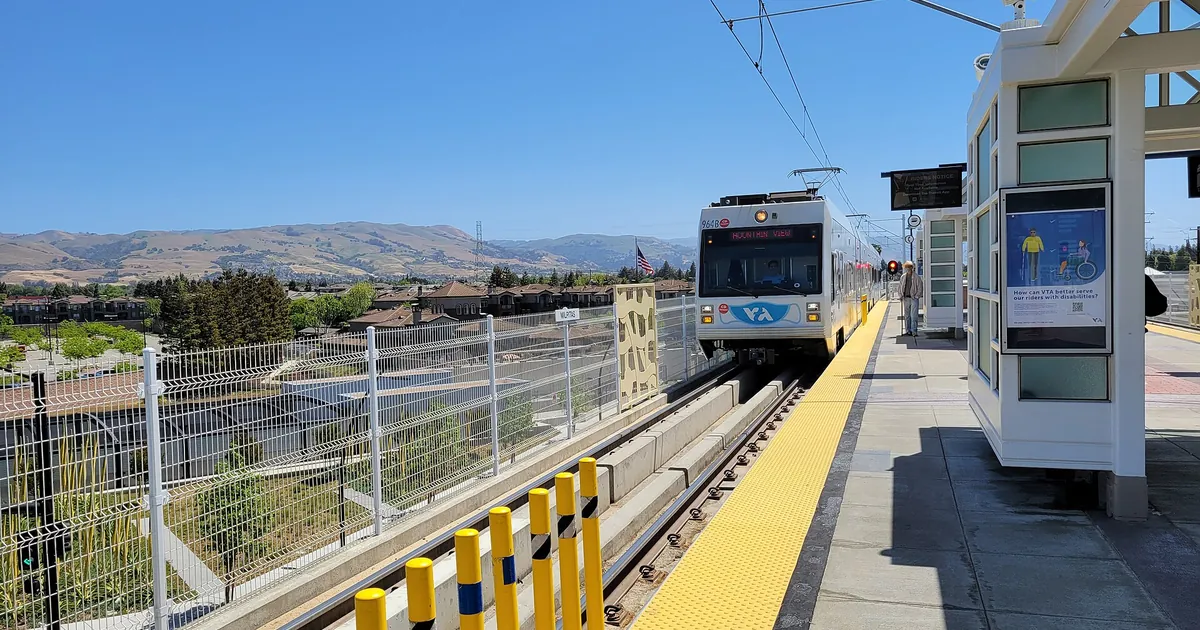
VTA light rail at Milpitas. Photo: FloofyMiddle / Wikimedia Commons, CC BY-SA 4.0
6 min read · 1,212 words
If you are trying to work out how to get to Levi’s Stadium for the World Cup 2026 start with one uncomfortable fact the official guides bury under a list of transit logos: Levi’s is the most car-dependent venue on the entire North American host map, and on match days the roads, trails and rideshare apps you would normally lean on are all being deliberately constrained at once. The Bay Area Host Committee expects 260,000 out-of-town visitors across the whole run of the region’s World Cup fixtures, while VTA says its light rail, the stadium’s only rail connection, can move at best about 15,000 people in and out per match (both figures via KQED’s transit briefing). Stack the per-match crowd against that single-line ceiling and you get the story nobody local wants to say out loud.
This is not a reason to panic. It is a reason to plan harder than you would for an NFL Sunday. Here is what is actually being closed, what is actually running, and the one option most fans will reach for that quietly does not work.
How to get to Levi’s Stadium for the World Cup 2026: the routes that hold up
Levi’s Stadium sits in Santa Clara with no heavy-rail station at its door, unlike MetLife in New Jersey, which at least hangs off the Secaucus transfer. Every reliable transit route into Levi’s therefore ends with a Valley Transportation Authority (VTA) light-rail leg. VTA is the spine; everything else is a feeder.
- VTA light rail is the workhorse. Trains will serve the stadium roughly every 10 minutes from the Mountain View Transit Center and every 20 minutes from the Milpitas Transit Center, dropping fans at the Great America and Lick Mill stations beside the venue. VTA has committed to keeping service running for up to two hours after the final whistle, the single most important detail for a late kickoff.
- Caltrain from San Francisco or the Peninsula runs to Mountain View, where you transfer to the VTA Orange Line. Caltrain spokesperson Dan Lieberman has said the agency will add “one or two scheduled additional post-game trains for each match, while also keeping an additional train on standby.” Budget about 90 minutes door to door from the city.
- BART riders take the Green or Orange Line to Milpitas, then transfer to VTA. Read the late-night timetable carefully: the last regular train out of Milpitas leaves at 11:53 p.m., after which BART runs limited-express trains every 30 minutes between roughly 12:30 and 1:40 a.m. for the 8 and 9 p.m. kickoffs, but those late trains stop at only six stations (Bay Fair, Dublin, MacArthur, El Cerrito del Norte, Pleasant Hill and Powell Street). If your home station is not on that list, the late train is not for you.
- Capitol Corridor is the sleeper option for fans coming from Sacramento, Rocklin or Auburn. Its final post-match train is timed to leave 15 minutes after the match is expected to end. The catch, per Capitol Corridor’s Rob Padgette: “we expect a lot of fans to ride, we’re going to cap the number of sales on the train.” Buy in advance or you will not get on.
If you insist on driving
You can, but the closures are staged to make it deliberately slow. Santa Clara will shut roads in two phases on match days: Phase 1 closes Tasman Drive in front of the stadium and Stars and Stripes Drive; Phase 2 adds Calle Del Sol, pushing drivers onto Lick Mill Boulevard. A local detour threads through Great America Way, Great America Parkway, Lafayette Street and Calle De Luna, while a regional detour funnels traffic onto Highways 101 and 237. Parking must be bought in advance, one pass per match ticket, no exceptions, and lots open four hours before kickoff. The pre-purchase rule alone tells you the operators are trying to throttle drive-up demand.
Cyclists and pedestrians, read this
The San Tomás Aquino Creek Trail that runs right past the stadium, the route many locals would instinctively walk or ride, is closed to both cyclists and pedestrians on match days. Bikes get rerouted onto Agnew Road, Lakeshore Drive, Gianera Street and Stars and Stripes Drive; walkers are pushed to Mission College Boulevard and Great America Parkway. If you pictured a breezy creekside stroll to the gate, picture an arterial road instead.
The last-mile trap the official guides won’t name
Here is the analysis you will not find on a host-committee landing page. Levi’s Stadium was designed in 2014 for an NFL franchise and a parking-first crowd. It was never built for a transit-dependent global tournament, and the World Cup operation is now bolting public-transit capacity onto a venue whose entire site geometry assumes you arrived by car. That is why the mitigations feel contradictory: they are simultaneously expanding rail and closing the roads, trails and rideshare lanes that the stadium normally relies on.
The clearest tell is the rideshare design. Fans using Uber or Lyft are funneled into two geofenced zones, Rideshare North at Red Lot 7 and Rideshare South at Freedom Circle. And in the most Bay Area detail of the entire plan, confirmed in KQED’s breakdown of the access rules, Waymo’s autonomous vehicles are not allowed into the rideshare lots. Think about what that means. The region that exports driverless cars to the world has built a marquee event whose access plan structurally excludes them, because the geofenced drop-off model assumes a human driver who can be told where to stop. The “just take a Waymo” instinct that works for a normal Santa Clara night will strand you at a perimeter on match day.
So the honest hierarchy is narrower than the logo-soup transit pages suggest. If you want a stress-free trip, there are really only two strong plays: VTA light rail boarded at Mountain View or Milpitas, or a pre-booked Capitol Corridor seat if you are coming from the Sacramento corridor. Driving is a managed bottleneck by design. Rideshare works only if you accept a hike from a geofence and skip the autonomous option entirely. Everything else is a feeder into that same VTA spine, which means the 15,000-per-match light-rail ceiling is the real constraint on the whole system, no matter how many transit brands appear on the map.
The practical bottom line
Treat Levi’s like an airport, not a stadium: assume the last mile is the hard part, arrive early, and lock your return leg before you leave home. Board VTA at Mountain View (via Caltrain) or Milpitas (via BART). If you are driving, buy parking now and study the two-phase closure map before kickoff, not after. And delete the assumption, common everywhere else in Santa Clara, that an autonomous rideshare will quietly handle the trip. On match day, it can’t.
For the bigger picture on which host cities make this easy and which make it hard, see our World Cup 2026 guide our breakdown of the best host city for fans and the comparable last-mile mess we mapped at Kansas City’s Arrowhead.
Sources
- KQED, “Got World Cup Tickets? What to Know About Getting to a Match in Santa Clara” (kqed.org)
- CBS San Francisco, “World Cup matches in Santa Clara to impact traffic and transit” (cbsnews.com)
- City of Santa Clara, “FIFA World Cup Match Day Road Closures and Transportation Impacts” (santaclaraca.gov)
- VTA, World Cup 2026 service page (worldcup.vta.org)
