
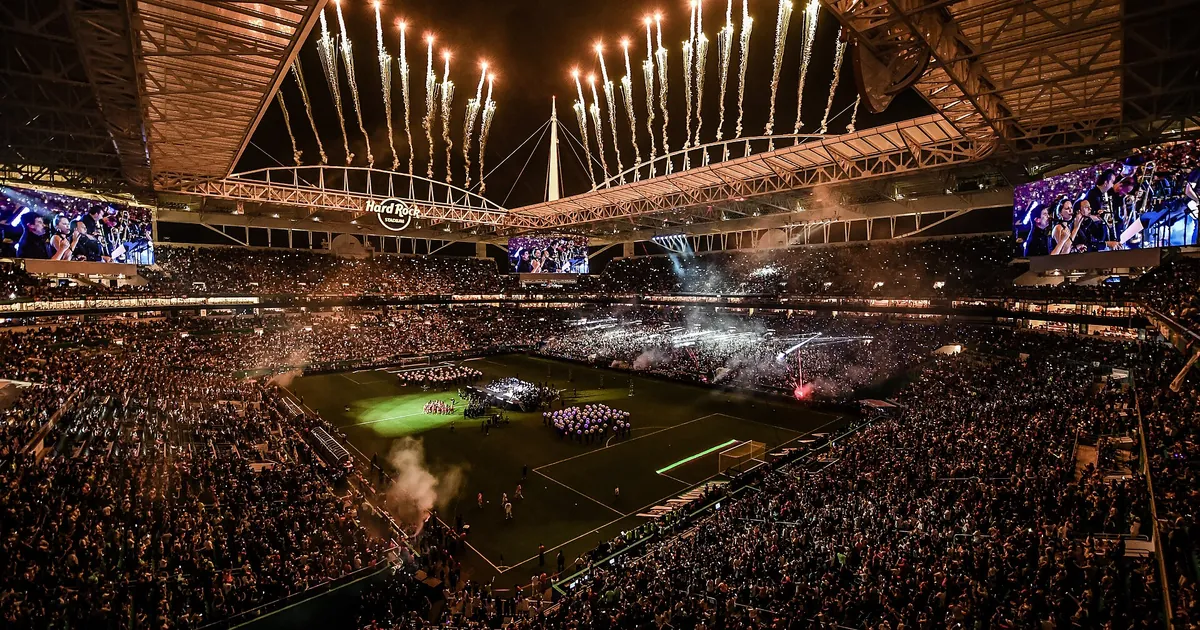
Hard Rock Stadium, Miami Gardens, configured for football. Photo: VJPannozzo / Wikimedia Commons, CC BY-SA 4.0
5 min read · 967 words
Getting to Hard Rock Stadium for the World Cup 2026 turned out to be the hardest part of the night. When Uruguay met Saudi Arabia in Miami Gardens on Monday 16 June, a six o’clock kick-off, hundreds of ticket holders were still stuck in a parking lot roughly a mile from the gates as the teams lined up. “I heard the countdown, 10, 9, 8, 7, so we missed everything beforehand,” fan Jonathan Odom told CBS Miami. Cata Balzano, who missed half the match, had blunter advice for anyone with a later fixture: leave home at least three hours early, and demand the organisers warn you first.
This is the same last-mile failure that has dogged almost every American venue this tournament, but Miami’s version has a specific, avoidable cause. It is worth walking through, because the fix is not “more buses.” It is honesty about a rule FIFA and the venue never properly explained.
How to get to Hard Rock Stadium for the World Cup 2026
Start with what the official plan actually is, because the gap between the plan and what fans expected is the whole story. There is no general parking on matchday for ticket holders without a pre-purchased pass, and there is no walk-up. If you do not have a parking credential, your only sanctioned routes in are the free Game Day Express shuttles or a rideshare to a designated drop point. The shuttles run first-come, first-served from four hubs: the Dr. Martin Luther King Jr. Plaza Metrorail station, the Golden Glades Multimodal Terminal, the Aventura Brightline station, and the Seminole Hard Rock Hotel and Casino. Rideshare drops are limited to Seminole Hard Rock, Calder Casino, and the Golden Glades park-and-ride.
Read that back and the bottleneck is obvious. A first-come, first-served shuttle from a remote staging lot is fine for a Dolphins crowd that trickles in over three hours. It is not fine for a World Cup crowd that arrives in a tight pre-kick-off surge, all funnelled through the same handful of lots, then screened, then queued for a bus that takes one load at a time. The Miami-Dade Sheriff’s Office said there were “no operational issues at security checkpoints.” That may be literally true and still miss the point. The checkpoints were not the chokepoint. The shuttle staging was, and the screening simply stacked on top of it.
The original sin: a rule born from the 2024 Copa breach
Here is the part the national coverage has skated past. Miami’s no-walk-up, shuttle-only model is not generic caution. It is a direct response to a specific disaster on this exact site. At the 2024 Copa América final, ticketless fans forced their way into Hard Rock, climbed through ductwork, and caused real damage before Argentina and Colombia could play. The lasting image of Miami as a soccer host is a perimeter that failed.
So in 2026 the venue did the intuitive thing: it pushed the perimeter out by a mile. No casual approach on foot, no parking you can drift into, everyone processed through controlled lots and delivered by bus. On a security whiteboard it is coherent. The breach happened because anonymous crowds reached the building, so you stop anonymous crowds from reaching the building. The problem is that the cure imports the disease. By forcing every fan through a few remote nodes, the plan converts a security risk into a throughput risk, and a throughput risk at a fixed kick-off time is just a different way to lose the crowd. In 2024 they lost control of who got in. In 2026 they lost control of when.
This is the through-line connecting Miami to the rest of the tournament. Empty seats on the broadcast and fans stranded outside the gates keep getting filed as separate embarrassments. They are the same phenomenon. The 48-team World Cup is being staged in stadiums built for a leisurely, car-borne American matchday, then retrofitted with crowd-control reflexes learned from previous failures, and the retrofit keeps producing the failure it was meant to prevent. Miami is the cleanest example yet because you can name the trauma that wrote the rulebook.
What to actually do if you are going
Practical, then, for the matches still to come at Hard Rock. Treat the published “arrive early” guidance as a floor, not a cushion: Balzano’s three hours is the realistic number for a shuttle-dependent fan, not the hour you would budget for an NFL game. If you can, take rideshare to the Seminole Hard Rock drop rather than gambling on a first-come shuttle from Golden Glades, because the drop points are closer and do not depend on a bus turning up. If you are committed to the free shuttle, the Brightline-to-Aventura option is the most controlled chain on paper, since it removes a parking step. And bank on the heat: a 6 p.m. South Florida kick-off in June means you may be standing in a sun-baked queue for an hour, which our heat survival guide covers in detail.
The broader lesson is the one Miami keeps teaching and FIFA keeps ignoring. The venues that are coping are the ones that already had rail to the door and a real pedestrian approach, like the Seattle car-free zone. The venues struggling are the ones that solved a hard problem by moving it a mile up the road and hoping a fleet of buses would absorb it, the same calculation that produced the MetLife closed-loop plan. Hard Rock’s shuttle trap is not a one-off Miami screw-up. It is what happens when a stadium with a breach in its past meets a tournament with no patience for nuance, and the fan in row 300 pays for both with the first forty-five minutes of the game.
For the full picture of how every host city is handling the crush, our World Cup 2026 guide is tracking it match by match.
