
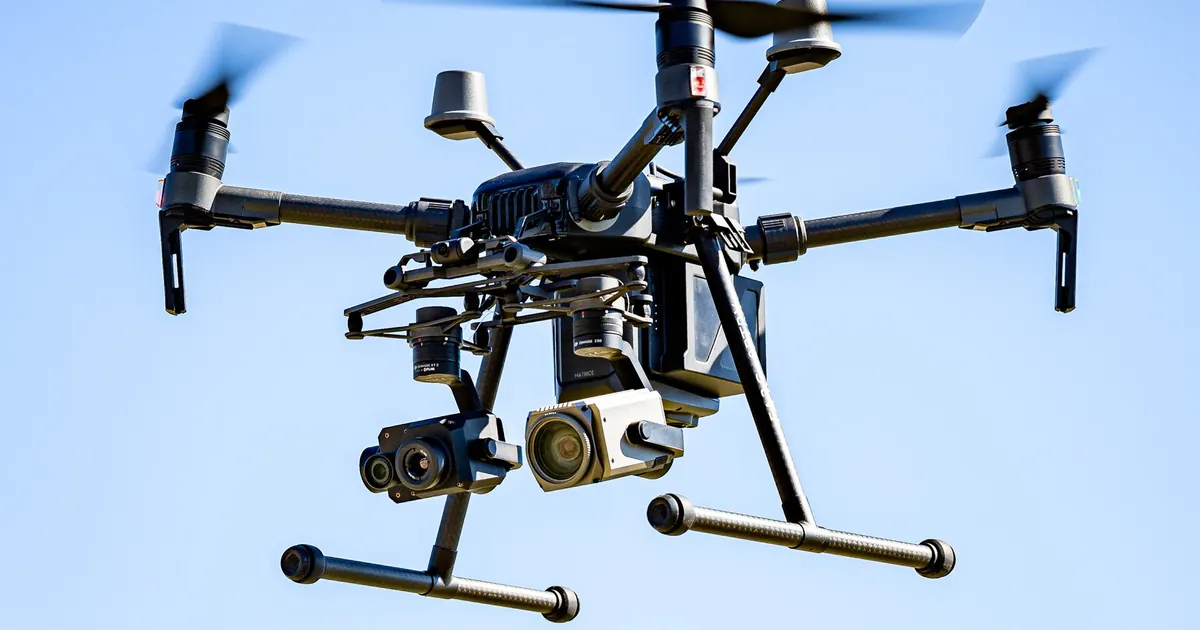
Police drone. Photo: City of Greenville, North Carolina / Wikimedia Commons, Public domain
5 min read · 978 words
Every security story of this World Cup 2026 has been about the ground. The fences pushed a mile from the turnstiles in Miami, the facial-recognition cameras fans walk into, the closed-loop bus lanes at MetLife. The World Cup 2026 drone problem is the one threat that makes all of that look like it was pointed in the wrong direction, because it comes from straight up, and no stadium operator on earth controls the sky above its own roof.
By the middle of the group stage the numbers were already startling. Federal authorities had logged roughly 145 incursions into restricted airspace around tournament venues, spread across at least eight host cities, with seizures climbing into the dozens. The FBI’s Los Angeles field office alone confiscated 28 drones near SoFi Stadium and the Coliseum in the opening days, and warned it had a “no tolerance” policy for anything flying inside the temporary no-fly zones. This is not a handful of hobbyists who didn’t read the notice. It is a steady, daily drumbeat of small aircraft drifting into the one space the World Cup’s vast security apparatus was least built to defend.
What the World Cup 2026 drone rules actually say
The legal scaffolding is clear enough on paper. The Federal Aviation Administration designates each stadium a strict no-drone zone on match days, with a temporary flight restriction banning drone operation within a three-nautical-mile radius and up to 3,000 feet above the venue. Break it and the penalties are not symbolic: fines reported as high as $100,000, federal criminal exposure, and the forfeiture of the drone itself. In Atlanta the FBI said it had already seized 13 drones near stadium sites. In North Texas, federal agents issued a public warning after repeat violations around the Dallas venue, and Texas authorities confirmed at least one operator there now faces federal charges.
So the rules exist, the penalties are heavy, and the violations keep happening anyway. That gap is the whole story. A temporary flight restriction is a line on an aviation chart. Enforcing it in real time, over a packed stadium, against a $400 quadcopter launched from a parking lot two miles away, is a different discipline entirely, and it belongs to no one FIFA employs.
The jurisdiction nobody at the stadium owns
Here is the part that separates the airspace threat from everything else FootyGazette has tracked this tournament. Ground security is layered but legible. The venue runs the perimeter, the host-city police run the streets, private contractors run the screening, and the lines of responsibility, however clumsy, are drawn. Counter-drone work fits none of that. Detecting and bringing down an aircraft is a federal competency, governed by aviation and surveillance law that a stadium’s head of security has no authority to touch. The FBI says it has deployed drone detection and mitigation technology in every host city, which is a quiet admission that the host cities could not do this themselves.
That is the asymmetry. FIFA spent years and a fortune hardening the parts of the security problem it could see and stand next to. The vertical threat was effectively outsourced to Washington, because legally it had to be. When a fan walks through a body scanner, the tournament is in charge. When a drone crosses the fence line at 400 feet, the tournament is a spectator, watching a federal team it does not direct try to solve a problem it cannot.
The people who do this for a living are not reassured by the volume. Mike Downing, who once ran the Los Angeles Police Department’s counter-terrorism bureau, called one alleged plot uncovered around the tournament “one of the most conspiratorial, dangerous plots that I have seen.” His larger worry was structural. He described a rise in what he termed “3D security problems,” where an attack is organised over social media and executed on the ground and in the air at once. “They all have to be combined,” he said, “and I would say that we don’t really think about that in terms of developing security plans.” Most plans, in other words, still defend a flat map. The threat has a third dimension now, and the planning has not caught up.
Why 145 near-misses are a policy result, not bad luck
It would be easy to file these incursions as the predictable nuisance of consumer drones meeting a big crowd. That reading is too comfortable. The cheapness and ubiquity of the hardware is precisely the point. There is no meaningful barrier to entry: anyone can put an aircraft over a stadium, and the only thing standing between a curious idiot and a genuine actor is intent, which no sensor reliably reads off a flight path. Each of those 145 incursions forced the same expensive federal response, whether it was a teenager filming the Fan Festival or something worse. The system is being made to spend its most specialised resource on a flood of low-cost provocations, and a flood is exactly how you find the gap.
That is the uncomfortable logic the rest of this tournament will be played under. The host-city security model that produced the surveillance fans walk into was designed to watch people on the ground, and it does that with unsettling thoroughness. It was never designed to own the sky, and it cannot be retrofitted to in four weeks. FIFA’s instinct, visible in everything from its handling of VAR transparency to its crowd rules, is to project total control of the spectacle. The drone numbers are the cleanest evidence yet that the control stops at the roofline.
None of the 145 has caused a disaster, and the federal effort may well hold for another month. But “held so far” is the language of a near-miss, not a solved problem. For the full picture of how every host city is policing this World Cup on the ground and in the air, our World Cup 2026 guide is tracking it match by match.
