
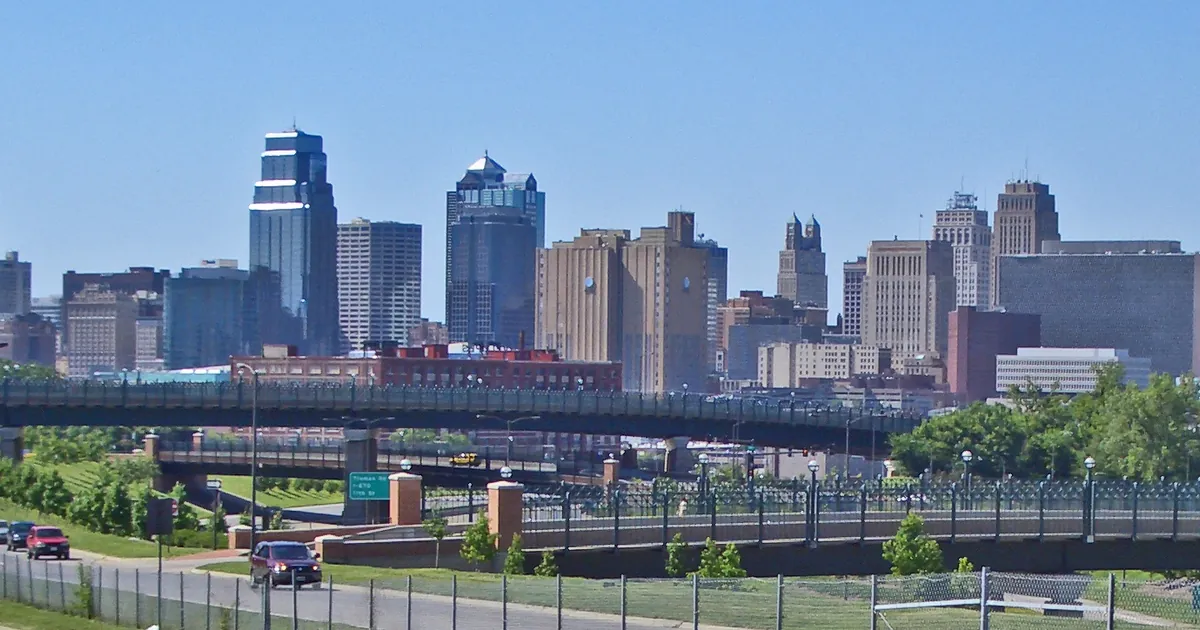
Kansas City skyline. Photo: User:Charvex / Wikimedia Commons, Public domain
5 min read · 913 words
Alejandro Berbari had done everything right. He had his ticket to Argentina against Algeria, he had his wife and two friends beside him, and rather than risk the traffic he booked an Uber to carry them the last stretch to Arrowhead. Then, on Interstate 70 near the Prospect Avenue exit, a car came up fast in the next lane. “A car drove by super fast and we heard boom, boom,” Berbari told reporters. “I look over our driver and see he has two holes in his legs.” This is the Kansas City World Cup nobody printed on the welcome banners: a fan kneeling on the floor of a moving car, pressing his hands into a stranger’s gunshot wounds while an emergency operator talked him through it.
Their driver survived. Berbari kept the pressure on for the ten minutes it took first responders to reach them, and the man was taken to hospital with wounds to his legs. The four fans were not so much rescued as relayed onward: a police officer, finding them stranded and shaken on the shoulder, drove them the rest of the way himself so they would not miss kick-off. They arrived in time to watch Lionel Messi score a hat-trick in a 3-0 win. It is a detail that should feel triumphant and instead feels like a fever, the celebration and the violence pressed flat against each other in the same hour.
The Kansas City World Cup the planning never accounted for
The shooting was not aimed at them. It was part of a roughly 30-minute spree across the city that left five people shot, one of them fatally, and triggered a manhunt for a 22-year-old suspect, Oscar Sanchez-Munoz, with the FBI posting a $25,000 reward. Investigators believe the same person was behind a separate deadly shooting and crash elsewhere in the city the same evening. The fans in that Uber were not targets. They were simply on a public highway at the wrong minute, which is the entire and terrible point.
FootyGazette has spent this tournament writing about the last mile to the stadium as a logistics failure. Shuttles that can’t clear a pre-kickoff surge in Miami, a closed-loop bus plan at MetLife, an Uber network that only patches the gap in a handful of cities. We have treated the approach to the ground as a throughput problem, something you fix with more buses and earlier arrival times. Kansas City is the reminder that the approach is also where a fan is most exposed, and that no host-city transport plan in this World Cup ever pretended to own the safety of a public road.
The fortress and the road to it
Think about where the security actually sits. By the time Berbari’s group would have reached Arrowhead, they would have walked into one of the most heavily policed perimeters in American sport: federal agents, screening, surveillance, the counter-drone teams the FBI deployed in every host city, the full apparatus FIFA and the host committees spent years assembling. None of it reaches I-70. The tournament has built a fortress and left the drawbridge a normal Kansas City street, with normal Kansas City risks, on an evening when those risks happened to be lethal.
That is not a criticism anyone could have fully engineered away. You cannot wrap a metropolitan freeway in a security cordon for a month, and it would be dishonest to pretend a better transit plan would have stopped a random gunman. But it does puncture the language the World Cup uses about itself. The host cities have sold safety as a venue you enter, a controlled space you pass into. For the fan in the back of a rideshare, safety is the twenty minutes of ordinary road before any of that begins, and the tournament’s plans go quiet exactly there.
A host city already unsure what it was promised
Kansas City came into this World Cup ambivalent. The same week, local reporting found businesses on Southwest Boulevard wondering where the promised crowds were, with one owner asking flatly where everybody had gone, even as the city’s economists braced for the now-familiar substitution effect that flattens these windfalls. The romance was real too. Algeria’s squad, KCUR reported, had made lifelong friends in the city, and Messi had turned Arrowhead into a place of pilgrimage. KC wanted the tournament to mean something, and it does. The shooting doesn’t erase that. It just sits beside it, refusing to resolve into either the postcard or the warning.
What stays with me is the officer driving four strangers to a football match because the system that delivered them that far had run out at the shoulder of a highway. There is something decent in it and something damning. The decency is obvious. The damning part is that the most reliable piece of fan-safety infrastructure on offer that night was the improvisation of one cop who happened to be there, not anything in a host-city playbook.
Berbari and his friends saw Messi’s hat-trick. They will tell that story for the rest of their lives, and the telling will always begin on I-70, not in the stands. That is the version of the Kansas City World Cup that actually happened to them, and it is worth holding onto when FIFA next describes the safest tournament ever staged. For how every host city is handling the journey to the gates, our Hard Rock access breakdown and the rest of our coverage track it match by match.
