
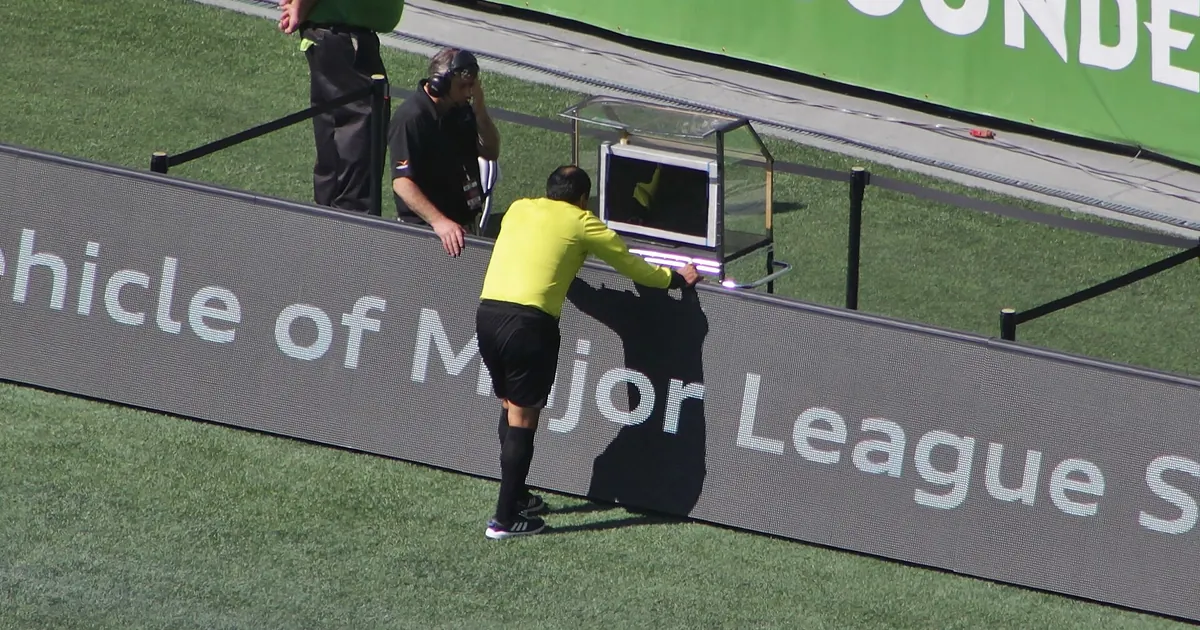
A referee consults the pitchside VAR monitor. Photo: SounderBruce / Wikimedia Commons, CC BY-SA 4.0
5 min read · 979 words
The first real World Cup 2026 VAR controversy did not arrive with a wrong call. It arrived with a blank screen. When Switzerland won a 14th-minute penalty against Qatar in the Bay Area, the one thing FIFA had promised would never happen again, happened: the offside check that cleared the move was never shown. No 3D animation. No lines on the broadcast. Just a goal, a conversion by Breel Embolo, and a stadium full of people asked to take the decision on trust.
FIFA’s explanation, posted more than four hours later, was that “a brief technical outage prevented the onside animation graphic from being generated.” The governing body insisted “the workflow of the VAR was not affected” and that its internal lines “did not show the attacking player to be in an offside position.” The match finished 1-1 after Qatar equalised in the 94th minute, so the result survived. The credibility of the system did not.
Why this World Cup 2026 VAR controversy is different
Plenty of tournaments have produced worse refereeing errors. What makes this one land harder is the gap between the promise and the moment. FIFA built the entire officiating pitch for this World Cup around openness. Semi-automated offside now sends an instant audio alert to the on-field team when a player is clearly off by more than ten centimetres, fed by sixteen optical cameras per stadium and a sensor inside the match ball generating north of 150 million data points a game. Referees have a microphone to explain final review decisions to the crowd, a feature trialled at last year’s Club World Cup. Body cameras give a first-person feed. FIFA’s own innovation desk has sold all of this as sharpening the spectator’s understanding of the game.
So when the evidence vanished on the first genuinely tight call, the silence was deafening in a way it would not have been in 2018. ITV’s Gary Neville reached for the word “dictatorship” and demanded FIFA “prove to us it’s offside.” Ian Wright called it “scandalous” and said the body “do what they want.” Strip away the studio heat and they are making a narrow, fair point: the entire value of transparency technology is that fans do not have to take the official’s word for it. The instant the proof becomes optional, you are back to taking the official’s word for it.
The part nobody is saying out loud
Here is the uncomfortable structural truth, and it is the reason this will keep happening. FIFA owns the camera. It owns the data. It owns the timeline on which the evidence is released. Every transparency feature at this World Cup is something FIFA shows you, not something you can demand. That is a fundamentally different thing from accountability, even though the two are constantly marketed as the same.
Goal-line technology, by contrast, is binary and automatic: the watch buzzes, the goal stands, there is nothing to withhold and nothing to spin. Semi-automated offside is sold as the same class of objective machine call, but it is not. The decision may be automated; the disclosure of it is editorial. Somebody chooses whether the animation renders, when it renders, and whether the version the public sees matches the version the booth used. When that somebody is also the organisation whose tournament, sponsors and broadcast product depend on the spectacle running smoothly, “the graphic didn’t generate” is not a neutral technical note. It is a decision with an interested party behind it.
Notice what FIFA did release: two-dimensional still lines, hours after the fact, showing both players onside. Notice what it did not release: the 3D animation it had promised would be the standard, public-facing proof. A still image with lines drawn on it is exactly the kind of evidence that existed in 2018, the evidence the new system was supposed to replace because nobody trusted it. Falling back to it, late, is an admission that the upgrade is conditional.
What it means for the fan in the seat
For supporters who have already navigated this tournament’s thicket of new rules, the practical lesson is bleak. The promise was that the person paying for a ticket would, for the first time, see the same evidence as the video booth in close to real time. The reality, on the evidence of this match, is that you see it when the system cooperates and when FIFA decides you should. A “brief technical outage” is plausible. It is also unfalsifiable, because the only body that can confirm or deny it is the body that benefits from you believing it.
None of this means the penalty was wrong. The likeliest explanation is dull: the rendering pipeline glitched, the call was correct, and the lines released later are accurate. But a transparency system that only works when nothing is at stake is not a transparency system. It is a feature that performs trust on quiet nights and disappears on loud ones. FIFA spent years telling fans they would never again have to simply believe the men in the room. On the first night it counted, that is exactly what it asked them to do.
The fix is not complicated, which is why the failure stings. Publish the 3D render automatically, every time, the moment the booth uses it, with no human gate between the decision and the disclosure. Until that happens, the most advanced officiating package in the sport’s history will keep colliding with the oldest problem in it. This is not really a story about one penalty in the Bay Area. It is the difference between a body showing you evidence and a body being answerable for it, and at this World Cup that difference is still entirely FIFA’s to control. Expect to revisit it before the officiating storylines of this tournament are done.
For everything else on the road to the final, our World Cup 2026 guide tracks it as it lands.
