
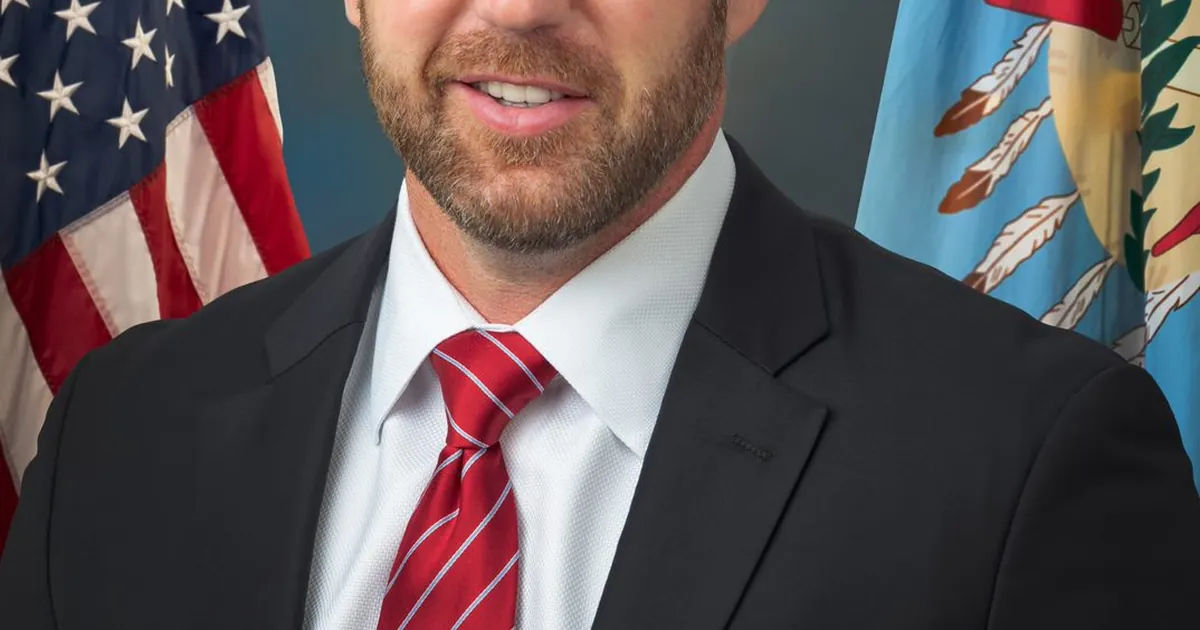
DHS Secretary Markwayne Mullin. Photo: United States Senate / Wikimedia Commons, Public domain
5 min read · 1,071 words
The DHS Secretary’s ‘Happy Dance’ Reveals FIFA’s Biggest Problem
Markwayne Mullin didn’t mince words. Standing at a World Cup security briefing in Washington on Monday, the U.S. Homeland Security Secretary told reporters he was “so glad they’re gone” after Iran drew their way out of Group G. “There wasn’t a single team,” he said, “that we dealt with more than them.” Then he added: “I might’ve sung a song or two or maybe even danced a happy dance.”
That quote landed in diplomatic circles with predictable discomfort. It shouldn’t surprise anyone who watched how Iran’s participation in World Cup 2026 actually unfolded.
This is the story of a tournament within a tournament, one where the host nation and a competing nation were, for practical purposes, adversaries. Now that Iran’s gone, the man who ran U.S. World Cup security is celebrating it publicly, at an official government briefing, on the record. That’s the tell.
Iran’s World Cup 2026: What Actually Happened
Start with February 28, 2026. The United States and Israel conducted military strikes on Iran. Four months later, Iran’s national football team arrived to play a World Cup on American soil — or tried to.
Their training base was moved from Tucson, Arizona to Tijuana, Mexico. Their ticket allocation was revoked days before the tournament began. Players and staff were permitted entry into the United States only 24 hours before each match, with mandatory departure immediately after the final whistle. When restrictions were slightly eased on June 23, DHS allowed the team in two days before their match against Egypt instead of one. That was framed as accommodation. It was the bare minimum needed to let a national team prepare for a competitive fixture.
In mid-June, Mullin told Fox News that Iran had “tried to get somebody in yesterday” with direct ties to the Islamic Revolutionary Guard Corps. The Iranian Football Federation called the claim “an outright and undeniable lie.” Whether true or not, the accusation illustrated how the U.S. security apparatus was processing Iran’s presence: not as a football delegation, but as a potential infiltration vector.
Iran drew all three group games and finished as the ninth-best third-place team. Only the top eight third-place sides advanced. Their elimination didn’t come through a match they played, but through arithmetic — a 3-3 draw between Algeria and Austria in a separate group locked them out of the round of 32.
And then Mullin danced.
Why the ‘Happy Dance’ Is the Real Story
This isn’t a diplomatic gaffe. Gaffes are accidental. Mullin spoke at a scheduled security briefing, before reporters, on a topic he’d been managing for six weeks. He knew exactly what he was saying.
What the statement confirms is straightforward: the U.S. government didn’t just manage Iran’s participation as a logistical security concern. It had a stake in the outcome. A cabinet official responsible for a football tournament’s security operations celebrated a specific team’s elimination at an official government press event. That’s without precedent.
FIFA’s founding statutes carry a political neutrality mandate — the principle that football must remain free from political interference. Host agreements carry similar language. But those statutes bind football federations and national associations, not sovereign governments. When the host nation conducted military strikes on a participating country four months before kickoff, the phrase “political neutrality” was already doing a lot of work.
We covered this structural gap when Iran filed its formal complaint with FIFA last month. The political neutrality pledge has always contained a sovereign carve-out: it governs what football bodies do, not what host governments do at border crossings and visa offices. The Iranian federation knew it. FIFA knew it. The U.S. government knew it and acted accordingly throughout the group stage.
What Monday’s briefing added was explicit, on-record confirmation that U.S. officials viewed Iran’s tournament exit as a national security outcome, not a sporting result. “So glad they’re gone” is not security-professional language about risk mitigation. It is a political statement about a football result, made by the Secretary of Homeland Security.
FIFA cannot sanction Mullin. FIFA cannot discipline the DHS. FIFA cannot even bring action against the U.S. Soccer Federation for the access conditions applied to the Iranian delegation, because those conditions were set by the executive branch of the host government, operating entirely outside FIFA’s jurisdiction. The statutes simply don’t reach there.
So what, precisely, is FIFA’s political neutrality pledge worth in practice?
The Precedent and What Comes Next
The candid answer: not much, when the host nation holds an active military confrontation with a participating team.
This isn’t FIFA’s first collision with host-nation politics. Argentina 1978 was hosted by a military junta, and that tournament generated serious questions about political interference that were never fully resolved. The 2018 tournament in Russia attracted boycott campaigns that went nowhere. FIFA has consistently chosen tournament continuity over political confrontation with host governments.
But 2026 has a feature those earlier editions lacked. A host nation conducted military strikes on a participant nation four months before the tournament, then managed that nation’s presence on a game-by-game basis throughout the group stage, then publicly celebrated their exit at a government briefing. The arc is now complete. The DHS Secretary danced at its conclusion.
The forward lens matters here. FIFA has awarded the 2030 World Cup to a consortium including Morocco and Algeria, two countries with a closed border and deep political tensions. The 2034 tournament goes to Saudi Arabia, with significant regional frictions involving several nations that could qualify. If the standard set in 2026 holds — that a host government can be in active military conflict with a participant, impose extraordinary entry restrictions throughout the group stage, and then celebrate their exit at an official briefing — the question heading into those tournaments isn’t whether FIFA can enforce political neutrality. It’s whether FIFA intends to try.
Mullin’s happy dance was a small moment. A few seconds of candour from a cabinet official who’d spent six weeks managing an unprecedented situation. But small moments have a way of confirming structural truths. The one confirmed here is that the World Cup can happen inside an active conflict between host and guest, and when the guest is eliminated, the official response is a celebration.
FIFA has public explanations for its 48-team bracket, its hydration break policies, its empty-seat attendance figures. For this, it has nothing.
See also: When a visa isn’t an admission — the CBP gap the travel guidance doesn’t cover | Inside the security and surveillance regime across host cities
