
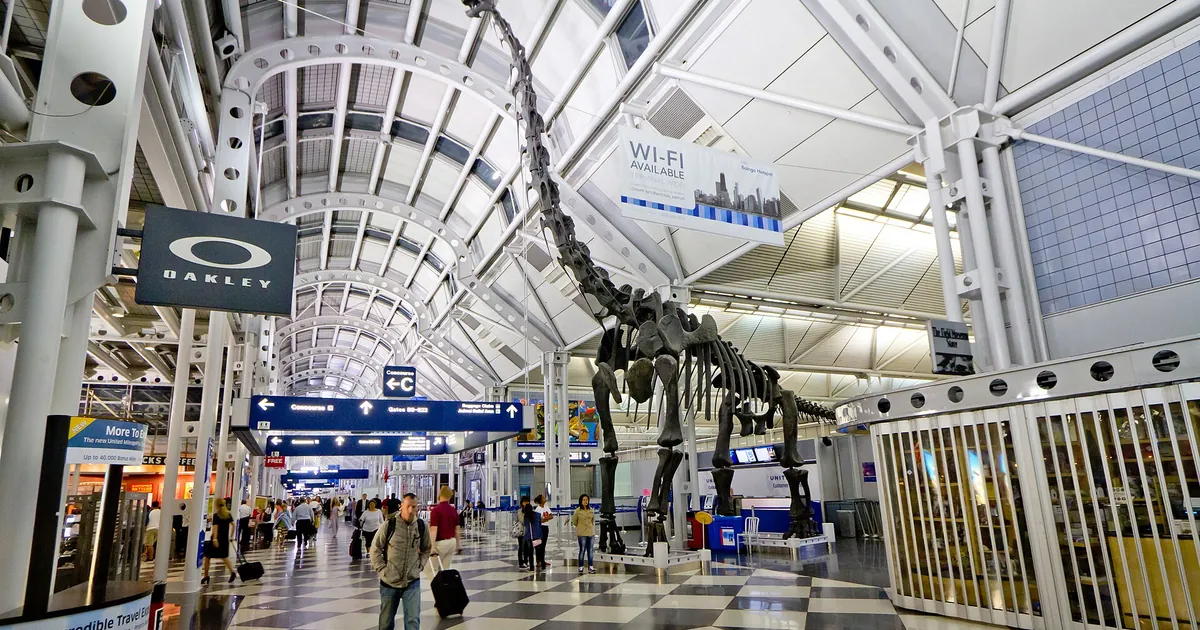
Chicago O'Hare International Airport. Photo: https://www.flickr.com/photos/15216811@N06/ / Wikimedia Commons, CC BY 2.0
6 min read · 1,317 words
Five days before the 2026 World Cup kicks off, the most-vetted travellers heading into the United States are not the fans. They are the players, and World Cup 2026 player entry was supposed to be the one part of this tournament already solved. Every squad has been name-checked on a FIFA list, cross-referenced against a federation, and waved through under a travel-ban carve-out written specifically for them. And on Saturday morning, one of them spent nearly seven hours in a back room at Chicago’s O’Hare airport anyway.
Iraq striker Aymen Hussein, 30, was held and questioned for close to seven hours after the squad landed early Saturday, with his phone inspected before he was finally admitted, according to an Iraqi sporting official quoted on the Reuters wire and corroborated by regional outlets reporting the seven-hour hold. The same wire copy reported that the team’s photographer, Talal Salah, was held for more than ten hours, underwent the same device checks, and was ultimately denied entry to the United States. The Iraqi Football Association, Hussein, U.S. Immigration and Customs Enforcement and the Department of Homeland Security all declined to comment or did not respond.
This is Iraq’s first World Cup in 40 years. They open in Group I against France, Senegal and Norway. And here is the detail that should bother anyone holding a ticket: Iraq is not on the United States’ travel-ban list at all.
World Cup 2026 player entry: the exemption that does not cover the border
The legal architecture here is worth getting exactly right, because the headlines have blurred it. The U.S. travel-ban proclamations that sweep up several World Cup nations contain a specific exemption for “athletes, coaches, support staff, and their immediate family members” participating in the tournament, per the American Immigration Council. Among qualified teams, the bans bite hardest on Haiti and Iran (full restrictions) and Côte d’Ivoire and Senegal (partial). The carve-out is what lets those squads play at all.
Iraq needed none of it. No ban applied to Hussein. He arrived as an accredited, exempt participant with a fixture against France on the calendar. He was held for seven hours regardless. His photographer, arguably “support staff,” arguably “media,” and that ambiguity is the whole story, was turned around.
So the exemption did its job and the traveller still got stopped. That is not a contradiction. It is the design. An exemption from a travel ban, and even an issued visa, is permission to board a plane. It is not an entitlement to walk out of the airport. Admission is decided at the port of entry by Customs and Border Protection, which retains broad discretion to send any arriving non-citizen into secondary inspection, search their devices, and, in the photographer’s case, refuse entry outright. No World Cup list overrides that counter.
Why this is not the Iran story in a different shirt
The visa coverage of the last month has, understandably, fixated on the banned nations. Iran’s players received their U.S. visas after applying through the embassy in Türkiye, and we covered what that approval did and did not unlock in our piece on Iran’s World Cup visas being granted. Within days, Iran said the U.S. had denied visas to key officials with Secretary of State Marco Rubio drawing the line at anyone with ties to the Islamic Revolutionary Guard Corps.
That framing, banned country, contested visa, geopolitical screening, let the public file the friction under “Iran problem.” Saturday breaks the filing system. Iraq is a qualified, non-banned, FIFA-listed participant, and the friction landed anyway, at the border, after the visa was already in the passport. The variable that produced a seven-hour hold and a denied photographer was not the ban list. It was port-of-entry discretion, applied to credentialed people the system had already cleared on paper.
The original problem: what survives the carve-out, and what fans should read into it
Strip the incident down and you are left with a hierarchy of guarantees, each weaker than the last.
At the top sits the player: named, exempted, often visa-in-hand weeks early. Hussein is as protected as a World Cup traveller can be, and he absorbed seven hours. One rung down sits “support staff,” where the exemption’s wording starts to fray: a federation photographer is plausibly staff, plausibly media, and the proclamation explicitly does not shield journalists or media. Salah fell through that seam and was refused. The carve-out is not a wall; it is a list, and lists have edges.
Now drop to where the fans actually stand, which is below the bottom rung. The participant exemption covers athletes, coaches, support staff and immediate family, and, per the American Immigration Council, explicitly excludes fans, journalists, corporate sponsors and extended family. Ordinary ticket-holders get none of the protection Hussein had. What they were offered instead was logistics: the FIFA Priority Appointment Scheduling System (FIFA PASS), which moved ticket-holders to the front of the visa-interview queue and, for citizens of five qualified nations facing the new bond regime, Algeria, Cabo Verde, Côte d’Ivoire, Senegal and Tunisia, waived a refundable bond of up to $15,000 for those who enrolled by April 15. Useful. Also beside the point on Saturday. FIFA PASS is a faster appointment, not a faster border. As the program’s own terms concede, holding a 2026 ticket “does not guarantee visa issuance or admission to the United States,” and PASS does not override a travel ban.
That is the line every fan flying in should underline. The single guarantee FIFA could not sell, because it was never FIFA’s to sell, is the one that decides whether you make kickoff: admission at the desk. If a non-banned nation’s starting striker can lose seven hours to it and his colleague can lose his tournament to it, the realistic planning assumption for a fan from a flagged country is not “I have a visa, I’m fine.” It is “build in a day, carry your documents, and expect the device search.” None of that is in the brochure. It is, increasingly, in the arrivals hall.
The accountability gap
There is a governance question sitting underneath the human one, and it will outlast this week. FIFA staged a bidding contest, took the United States’ assurances that participants and visitors could enter, and built a 48-team, three-country tournament on top of them. Those assurances covered the part of the journey the host government chose to make legible, the visa, the exemption, the named list. They did not, and arguably could not, bind the part that actually gates entry: the discretionary call at the border. When that call goes against an accredited member of a competing nation, there is no published appeal, no FIFA remedy, and, as Saturday showed, no immediate answer from the agencies involved.
A tournament can absorb one striker losing an afternoon. What it cannot easily absorb is the precedent: that the most-cleared travellers in the building are not actually cleared until a border officer says so, and that the gap between “exempted” and “admitted” is wide enough to swallow a man’s entire World Cup. For the fans now packing bags for June, many crossing the same three sovereign borders we mapped in our look at the single-entry re-entry trap that gap is the whole risk, and almost nobody is pricing it. For a fuller picture of how the entry, travel and ticketing pieces fit together, our complete guide to World Cup 2026 remains the place to start; for the side of Iraq’s story that isn’t about a back room at O’Hare, there is the 40-year wait that got them here.
Hussein, at least, made it through. He will line up against France with the rest of a squad that waited four decades for the chance. His photographer will not be there to shoot it. Somewhere in the difference between those two outcomes is the only World Cup guarantee that ever mattered, and the one nobody got to sign.
