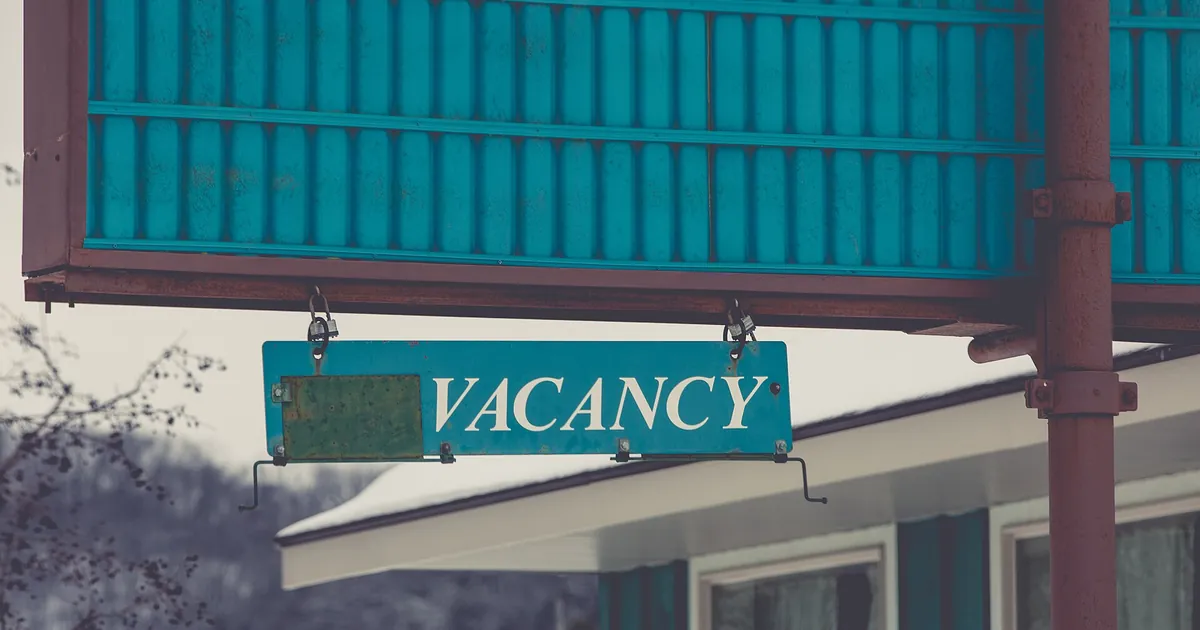
A vacancy sign — host-city rooms are easier to find than the pre-tournament hype suggested. Photo: Tony Webster from Minneapolis, Minnesota, United States / Wikimedia Commons, CC BY-SA 2.0
6 min read · 1,307 words
World Cup 2026: The Airbnb Gold Rush That Went Bust
For two years, the pitch to anyone with a spare room in a host city was simple: list it, name a silly price, and let the World Cup do the rest. By the first week of June 2026, World Cup 2026 Airbnb demand has turned out to be the great anticlimax of the build-up. Across the eleven American host cities, the booking data is not telling the story of a sold-out continent. It is telling the story of a windfall that, for thousands of first-time hosts and a fair number of hotels, simply has not arrived.
This is not a vibe. It is a number. According to a survey by the American Hotel and Lodging Association dated 7 May 2026 and reported by Fortune hotel bookings are running softer than expected in all eleven U.S. host cities. The spread between the cities is the interesting part, and it is the part the national previews keep skipping.
What the World Cup 2026 Airbnb demand data actually shows
Take the AHLA’s share of hotels in each market that expect to miss their occupancy targets for the tournament:
- Miami, 45%. The best-performing host city in the country, and still nearly half its hotels are bracing for a shortfall.
- Philadelphia, 75%.
- San Francisco, 75%.
- Kansas City, 85–90%. The worst in the field. Fortune notes the projected occupancy is, astonishingly, lower than a normal summer in KC with no mega-event in town at all.
When the strongest market in the country is at 45% and the weakest is pushing 90%, the problem is not local. It is structural. And the short-term rental side, where amateurs rather than revenue managers set the prices, is where the damage is rawest.
Kansas City is the cautionary tale. Local NPR station KCUR found first-time hosts who blocked out their calendars, dreamed of a payday, and then watched the inbox stay empty. One host, less than two weeks before kickoff, reported not getting “a single bite,” and called the whole thing “kind of a bust.” This was not a thin market: KCUR reports KC saw the largest jump in Airbnb listings of any host city, up 43% since June 2025, with 13.6% of the new listings available only for the World Cup. More supply, chasing demand that under-delivered.
The hotels are recovering faster than the spare-bedroom crowd. KCTV5 reported that for Kansas City’s first match, Argentina against Algeria on 16 June, the hotel booking rate had crept to 59%, up from 56% a week earlier. Climbing, yes. But 59% a fortnight out, for the biggest event the city will host this decade, is not the hockey-stick anyone sold to the new hosts.
The projection that became a lobbying tool
Here is the original sin, and it is a money story, which is why it interests me more than the hard-luck anecdotes. The shortfall everyone planned for was a shortage. It is now looking like a glut.
Look north to Vancouver. A Deloitte report commissioned in the Airbnb camp projected the city would be short roughly 70,000 room-nights during the tournament’s busiest stretch, and warned that hotel prices could spike by as much as 200%. Airbnb took that projection to the British Columbia government and asked for a temporary exemption from the province’s short-term rental rules, the licensing regime that, post-housing-crisis, deliberately makes casual hosting expensive and difficult.
Premier David Eby said no. “Regardless of whether it’s the World Cup, or a huge convention of dentists, or whatever it is coming to Vancouver,” he said, “what we can’t do is displace people who work and deliver services in Vancouver to support those activities. That housing is needed.”
That refusal is now ageing extremely well. The 70,000-night shortage was the entire premise for loosening the rules, and the demand that was supposed to cause it has not materialised at anything like the projected scale. A regulation written to protect housing has, almost by accident, protected hosts from over-committing to a boom that isn’t booming. The shortage forecast did not describe the market. It described what Airbnb wanted the market to look like when it walked into the premier’s office.
This is the pattern worth naming, because it will repeat at every mega-event from here to the 2028 Olympics. A consultancy models peak-day scarcity. That model becomes a press release. The press release becomes both a lobbying instrument and a price signal that tells thousands of amateurs to chase the peak, by late spring, Goal.com found Kansas City topping every host city for short-term rental prices at an average of $539.95 a night. Everyone prices for the peak. The peak is one or two match-days per city, not a five-week sell-out, and a 48-team tournament spread across three countries dilutes even that. The scarcity was always going to be narrow and brief. The supply response was broad and permanent. Gluts are made this way.
What it means if you are still going
For the host with an empty calendar, the lesson is the one veteran property managers were giving all along: a property manager quoted by KCUR warned clients off the “hype cycle,” noting that comparable one-offs, the NFL Draft, a Taylor Swift run, typically deliver only a 10–15% revenue bump, not a life-changing one. Price for that, not for the fantasy.
For the fan, the read is genuinely good news, and it is the inverse of everything you were told to fear. Soft demand means leverage. Rates that were set in hope are being cut in panic. The closer you book to a non-marquee match, anything that isn’t a USA, Mexico, or Argentina fixture, the better the deal is likely to get, because a host staring at a blank June would rather take 40% of their dream price than 100% of nothing. The blanket warnings to “book now or pay triple” were written off the 200% surge forecast. That forecast is not what is happening.
None of this means the World Cup will be empty or that the host cities will not have a party. It means the accommodation economics were sold on a scarcity that the actual booking data has quietly refused to deliver, the same disconnect between projection and turnstile we saw when New Jersey’s $98 matchday train sold under 6% of its seats and the same demand-elasticity that FIFA’s own dynamic ticket pricing has been testing all spring. The hype was priced in. The people were not. For more on getting the tournament right, start with our complete World Cup 2026 guide.
FAQ
Is World Cup 2026 Airbnb demand really down?
Bookings are running below host expectations in all eleven U.S. host cities, per an American Hotel and Lodging Association survey reported by Fortune. The share of hotels expecting to miss occupancy targets ranges from 45% in Miami to 85–90% in Kansas City.
Will hotel and Airbnb prices drop before the tournament?
In the soft markets, they already are. Hosts who set aspirational rates are increasingly cutting them as kickoff nears, especially for non-marquee matches. Booking later, closer to a less-hyped fixture, is where the discounts are appearing.
Why did everyone predict a shortage?
Pre-tournament forecasts, including a Deloitte report used by Airbnb to lobby British Columbia for looser short-term rental rules, modelled a Vancouver shortfall of about 70,000 room-nights and 200% price surges. Those projections drove the “book now” panic. Actual demand has so far undershot them badly.
Sources
- Fortune “Miami is the World Cup’s best-performing host city, and 45% of its hotels are still projecting a miss” (5 June 2026): fortune.com
- KCUR (NPR Kansas City), “Airbnb hosts in Kansas City hoped for a World Cup windfall. For some, it’s ‘a bust’ instead” (3 June 2026): kcur.org
- KCTV5, “KC’s first World Cup match is two weeks out. Are Airbnb’s filling up?” (3 June 2026): kctv5.com
- Global News, “Airbnb wants exemption during FIFA World Cup in Vancouver, but Eby says ‘no'”: globalnews.ca
- Goal.com, “High costs in the heartland: Kansas City tops 2026 World Cup Airbnb prices at $539.95 per night”: goal.com
