
9 min read · 1,781 words
There is a particular kind of political theatre that football has always been good at producing, even when it would rather not. World Cup 2026, sprawling across the United States, Canada and Mexico in a format that still feels experimental, is generating that theatre at volume, and we haven’t yet kicked a ball in anger. Gianni Infantino is at the centre of most of it, as he tends to be.
The Infantino–Trump Dynamic: Management or Capitulation?
Miguel Delaney’s investigation for The Independent is the most forensic account yet of how the FIFA president has conducted himself around Donald Trump in the lead-up to this tournament. The language from those inside the process is instructive: sources describe Infantino’s posture variously as “fawning and adoration” and, more charitably, as careful “management” of an unpredictable head of state who happens to control the host nation. Both readings can be true simultaneously, which is rather the problem.
The central tension is whether the strategy has produced anything of substance. The Independent’s reporting suggests a growing sense among FIFA insiders that the ass-kissing, their phrase, not mine, has yielded precious little in terms of concrete guarantees around visa access, tournament logistics or the kind of political non-interference that a genuinely global event requires. You can read that as a diplomatic failure or as the unavoidable cost of doing business with this particular administration. Either way, it sits uncomfortably alongside FIFA’s stated ambitions for a tournament that is supposed to celebrate football’s universality.
Infantino is not the first FIFA president to blur the line between sport and geopolitics, and he will not be the last. But the scale of the 2026 tournament, 48 teams, 16 venues, three nations, makes the stakes of any political miscalculation considerably higher than at a conventional 32-team edition. There are more moving parts to go wrong, more governments to keep onside, more diaspora communities whose ability to travel and attend depends on decisions made in Washington rather than Zürich.
The Pageantry Offensive
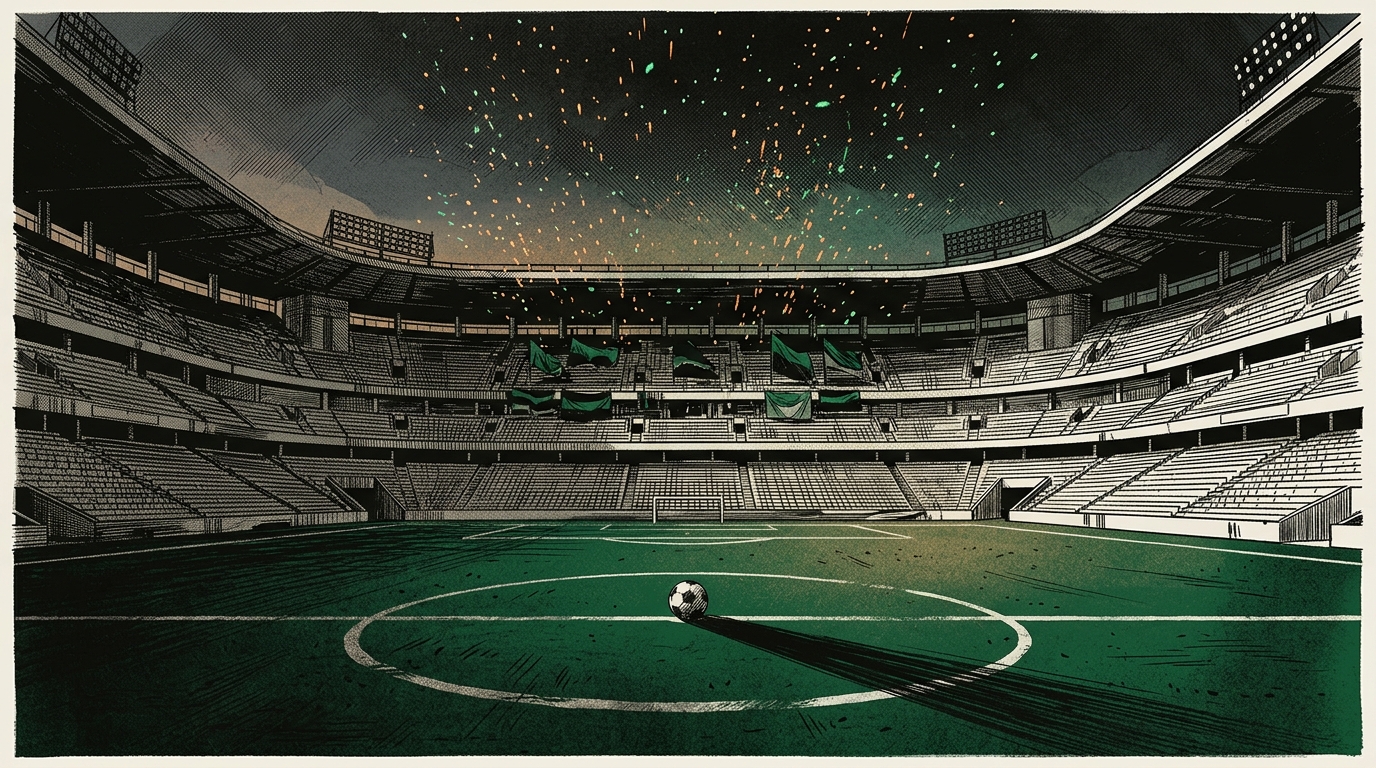
Perhaps aware that the optics around tournament governance are not ideal, FIFA has invested heavily in spectacle. BBC Sport reported this week on the organisation’s newly unveiled pre-match ceremony concept, huge flags, pyrotechnics, bespoke World Cup anthems, which FIFA is billing as a “unique, immersive experience.” The phrase is doing a lot of work there. What it describes is, in practice, a longer, louder version of the kind of opening-ceremony theatre that major tournaments have been deploying for decades.
That is not necessarily a criticism. The atmosphere inside a stadium before a significant match is one of football’s genuine pleasures, and if FIFA can manufacture something approaching it artificially for the group stage in Kansas City or Seattle, so much the better. The sceptical reading is that the ceremonial investment is partly compensatory, a way of ensuring that the tournament feels historic regardless of what is happening in the corridors of power. Bread and circuses, updated for the streaming age.
What the pyrotechnic ambitions do not address, of course, is the question of who can actually get into the stadium. Which brings us back to Infantino, and to the communities for whom World Cup 2026 carries a weight that goes well beyond football.
The Diaspora Dimension
One of the genuinely moving stories emerging from the build-up involves Bosnia and Herzegovina, a nation that has never previously qualified for a World Cup under its current name and whose diaspora in the United States is substantial, concentrated and deeply invested. The Independent has reported on the Bosnian community in St Louis, one of the largest outside the Balkans, and the prospect of a home-away-from-home atmosphere when Bosnia play their group matches in the American Midwest.
The numbers are striking. St Louis’s Bosnian population is estimated at around 70,000, many of them refugees or descendants of refugees from the 1990s conflict. For this community, a World Cup on their adopted doorstep is not merely a sporting occasion; it is something closer to a statement of arrival, of permanence, of belonging. The Independent’s piece captures that emotional register without over-sentimentalising it, which is the correct editorial call.
It also, implicitly, illustrates the stakes of the visa and immigration questions that Infantino’s Trump diplomacy has so far failed to resolve definitively. Bosnian fans travelling from Europe, or Moroccan fans, or Iranian fans, or any number of communities whose relationship with the current US administration is complicated, their ability to attend depends on political decisions that FIFA cannot control but has arguably been too deferential in challenging. The pageantry is lovely. The access question is more important.
England in Group L: Familiar Names, Familiar Anxieties
Amid the macro-politics, the football itself continues to take shape. England’s group, L, since you ask, has been comprehensively dissected by The Independent and the headline finding is that Thomas Tuchel inherits a squad carrying sky-high expectations and the particular psychological weight of sixty years without a World Cup. Croatia, Panama and Ghana complete the group, and the piece correctly identifies Croatia as the most tactically interesting opponent rather than the most dangerous on paper.
Luka Modrić will be 40 by the time the tournament begins. Whether he plays a significant role or functions primarily as a symbolic presence is one of the minor subplots worth watching. Croatia’s 4-3-3 under Zlatko Dalić has always been more about positional discipline and transition than the romantic midfield carousel the Modrić mythology implies, and England, under a Tuchel system that will presumably retain some variant of the high-press, positional structure he deployed at Chelsea and Bayern, should have the physical and tactical tools to manage them.
Ghana and Panama represent different problems. Ghana’s squad is in a transitional phase, with the post-Ayew generation still establishing itself, but African sides have consistently outperformed their pre-tournament xG projections at recent World Cups, and England have a habit of making group-stage football more complicated than it needs to be. Panama are compact, organised and entirely comfortable playing on the counter. England’s expected goals across their group-stage matches will be high; their actual goals may be more modest. That is a pattern Tuchel will be aware of.
For a broader look at how England’s campaign fits into the wider tournament picture, our World Cup 2026 guide has the full group-by-group breakdown, and the 48-team format explainer remains essential reading for anyone still adjusting to the new knockout structure.
Scotland’s Parallel Story
BBC Sport is meanwhile soliciting fan footage and stories for a programme documenting Scotland’s World Cup campaign from the supporters’ perspective. It is a sensible editorial idea, Scotland’s qualification, after decades of near-misses and heartbreak, is a story with genuine emotional texture, and the fan-led framing acknowledges that the most interesting World Cup narratives often unfold in the stands and the streets rather than on the pitch.
Scotland’s tactical situation under Steve Clarke is worth a separate analysis, but the short version is that they will be competitive without being fancied, which is historically their most comfortable register. The supporters, travelling in numbers to North America, will provide the colour regardless of results. That is not a small thing.
What Comes Next
The convergence of these stories, Infantino’s political navigation, the diaspora communities for whom access is existential, the ceremonial ambitions, the group-stage football, produces a tournament that is already more complicated than a simple celebration of the game. That has always been true of World Cups, particularly those hosted in politically charged environments. Mexico 1986, USA 1994, Russia 2018: the football eventually overwhelms the context, or at least runs alongside it in parallel.
Whether Infantino’s management of Trump produces the access guarantees and operational stability that the tournament requires will become clearer in the coming weeks. The Independent’s reporting suggests the relationship has been more transactional than transformative, which is perhaps the most honest assessment of what was ever achievable. FIFA needed the United States; the United States wanted the tournament. Everything else is negotiation.
The pyrotechnics will go off on schedule. The anthems will play. Whether everyone who wants to be in the stadium can get there is a different question, and a more important one. You can follow all the build-up across our World Cup coverage hub and for the tactical previews as squads are confirmed, the Premier League season preview has context on the English contingent heading to North America. If you want to know how to watch matches from outside a traditional broadcast market, our watching guide has the relevant options.
The tournament starts in June. The politics, unfortunately, started considerably earlier.
FAQ
Why has Infantino been so close to Trump ahead of World Cup 2026?
The relationship is primarily strategic. The United States is the dominant host nation across the 48-team tournament, controlling the majority of venues and much of the logistical infrastructure. Infantino’s approach, characterised by sources as “management” of an unpredictable political figure, reflects FIFA’s dependence on US government cooperation for everything from visa processing to security arrangements. Whether the strategy has produced meaningful concessions remains, according to The Independent’s reporting, an open question.
Which groups are England and Scotland in at World Cup 2026?
England are in Group L alongside Croatia, Ghana and Panama. Thomas Tuchel’s side are among the tournament favourites but face a Croatia side with significant tournament experience and a Ghana team that has historically overperformed at World Cups. Scotland’s group allocation and full fixture schedule can be found in our World Cup 2026 guide.
How does the 48-team World Cup format work?
The 2026 tournament features 48 nations divided into 12 groups of four, with the top two from each group plus the eight best third-placed sides advancing to a 32-team knockout round. It is a significant structural change from the previous 32-team format and has implications for squad management, fixture scheduling and the relative importance of group-stage results. Our 48-team format explainer covers the detail.
Will Bosnian fans be able to attend World Cup 2026 matches in the United States?
The large Bosnian-American community in St Louis and elsewhere in the Midwest means many fans will not need to travel internationally at all. For those coming from Europe, the visa situation depends on bilateral arrangements and the broader political climate around US immigration policy, one of the unresolved issues that FIFA’s relationship with the Trump administration has so far not definitively addressed.
What are FIFA’s plans for the pre-match ceremonies at World Cup 2026?
FIFA has announced a new ceremonial format for all 104 matches, incorporating large-scale flag displays, pyrotechnics and specially commissioned anthems. The organisation describes it as a “unique, immersive experience,” though the concept builds on pre-match theatrical traditions that have been part of major tournaments for some time. Whether it enhances the atmosphere or simply extends the pre-match wait depends largely on your tolerance for organised spectacle.
