
9 min read · 1,830 words
There is a particular kind of cognitive dissonance that settles over a city preparing to host the world’s biggest sporting event while simultaneously tearing itself apart at the seams. Mexico City, la Ciudad de México the sprawling, magnificent, maddening megalopolis, is living that contradiction in real time. The World Cup has arrived for an unprecedented third time, and the capital is not quite sure whether to celebrate, protest, or simply shrug and get on with the traffic.
Having covered tournaments from Montevideo to Madrid, I have rarely encountered a host city so ambivalent about its own moment in the global spotlight. That ambivalence, I would argue, is not apathy, it is something far more politically and culturally loaded than Anglo football coverage tends to acknowledge.
The Streets Tell a Different Story to the Billboards
Walk through Coyoacán or Condesa this week and you will find the visual language of the tournament plastered everywhere. Hugo Sánchez, the great former Real Madrid striker, arguably the finest Mexican footballer in history, stares down from advertisement hoardings with the imperious confidence of a man who knows his cultural currency has never depreciated. Raúl Jiménez occupies a few billboards; Toluca’s Alexis Vega a couple more. FIFA’s signage competes aggressively with the city’s visual noise at the airport, reportedly obscuring the arrivals lane for international passport holders, a metaphor that writes itself, even if immigration procedures are, as the Guardian notes rather more straightforward than the symbolism implies.
Frida Kahlo murals in Coyoacán have acquired newly painted football elements nearby, though by all accounts the great artist’s stern expression in those originals suggests something less than wholehearted endorsement. Flags hang from café ceilings in certain barrios. But the anecdotal evidence gathered by reporters on the ground this week points to something more muted than the commercial apparatus suggests: waiters and taxi drivers express genuine surprise at encountering someone actually attending a World Cup match, which tells you the anticipated influx of international visitors has not yet materialised in the way organisers hoped.
Meanwhile, a teachers’ strike has compounded the city’s legendary traffic paralysis. The streets are choked, though whether that constitutes World Cup fever or simply a Tuesday in CDMX is, as the Guardian drily observes, genuinely difficult to determine.
Protest as Political Theatre on a Global Stage
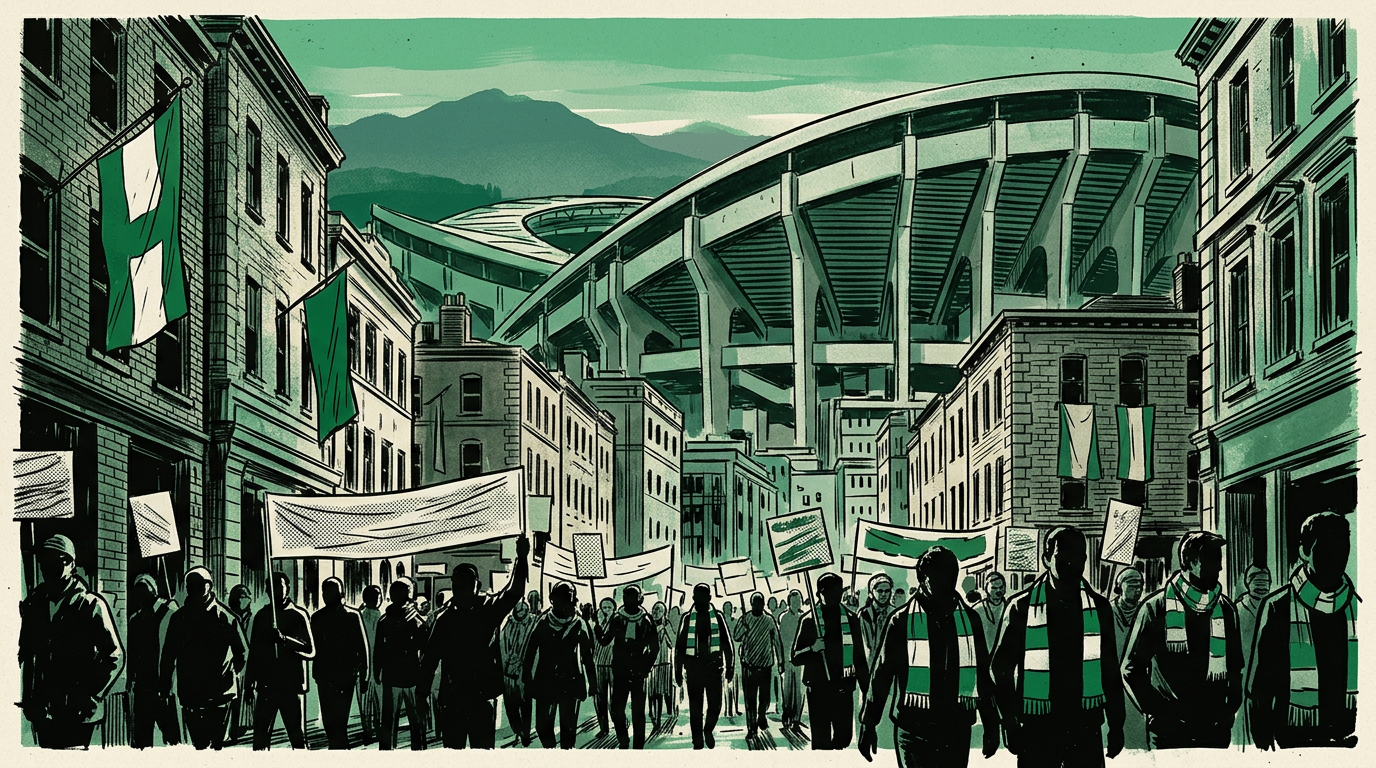
The more significant story, and the one that deserves more than a sidebar in the mainstream coverage, is the deliberate use of the World Cup platform by protest movements. BBC Sport reports that protesters are actively seeking to leverage the unprecedented visibility of Mexico City hosting a third World Cup to amplify their causes to an international audience.
This is not a new phenomenon, major sporting events have long served as pressure points for civil society, but the specific context of Mexico in 2026 gives it particular urgency. The country is navigating a complex political moment: a new administration, ongoing security crises in several states, persistent impunity around femicide cases, and the ever-present tension between institutional football’s commercial spectacle and the lived realities of ordinary Mexicans who will bear the costs of hosting without necessarily sharing the benefits.
The teachers’ strike is itself illustrative. Education workers taking to the streets during the opening days of a World Cup is not accidental timing, it is a calculated choice to ensure their grievances reach audiences that would otherwise never encounter them. From my experience covering Spanish football and its intersections with Catalan and Basque political movements, I can say with some confidence that sport’s ability to create these moments of amplified visibility is one of the few genuine leverage points available to civil society groups operating outside mainstream media channels.
Women selling knock-off Mexico shirts amid the traffic jams, as the Guardian’s correspondent observes, represent a different kind of protest: the informal economy’s quiet insistence on existing alongside, and often despite, FIFA’s ferociously protected commercial exclusivity zones.
Trump’s Shadow and the Co-Host Complication
Perhaps the most culturally resonant tension in Mexico City this week is the one that exists between the football and the politics of the co-hosting arrangement itself. The 2026 World Cup is shared between the United States, Canada, and Mexico, and the uncomfortable reality, as multiple reporters on the ground have noted, is that many Mexicans feel like a sideshow to what is, in effect, Donald Trump’s main event.
That feeling is not irrational. The United States is hosting the majority of matches, including the final. The political backdrop of US-Mexico relations, immigration enforcement, tariff disputes, the rhetorical hostility that has characterised the relationship in recent years, makes the enforced partnership of co-hosting something that requires a particular kind of collective cognitive effort to compartmentalise. Mexican fans are being asked to celebrate a tournament whose primary beneficiary, in terms of global narrative and commercial return, is a country whose government has spent years treating Mexico as an adversary.
Gianni Infantino’s pre-tournament press conference did little to ease tensions. The Independent reports that the FIFA president, speaking four years after his infamous ‘I feel gay’ press conference mired Qatar 2022’s opening days, was this time occupied with playing down a controversial saga involving a Somali referee. The word ‘shambolic’ appears in their headline, and it is not unearned. FIFA’s capacity for self-inflicted reputational damage in the days before a tournament kicks off remains, apparently, undiminished.
El Tri and the Weight of Expectation (or Lack of It)
What of the football itself? Mexico’s national team, El Tri carries into this tournament the peculiar burden of a side that has historically underperformed relative to the passion invested in it by its supporters. The famous quinto partido curse, the inability to progress beyond the Round of 16, has become so deeply embedded in Mexican football culture that it has almost transcended sport to become a kind of national mythology.
Anecdotally, few Mexicans seem to expect much from their side this time around, according to reporters working the city this week. That is a striking admission for a host nation. Home advantage at a World Cup is a statistically significant factor, host nations have historically outperformed their pre-tournament rankings, but the psychological weight of expectation, combined with the political noise surrounding the tournament, may complicate that advantage in ways that are difficult to quantify.
Raúl Jiménez, at 35, is the elder statesman of a squad that blends experience with younger talent still finding its level on the international stage. The question is whether the combination of home crowd support and genuine quality can finally break that Round of 16 ceiling, or whether the circus surrounding the tournament will prove too distracting for a squad that needs focus above all else.
For context on how the expanded 48-team format reshapes the path to the knockout rounds, our guide to the World Cup 2026 48-team format is worth reading before the group stage gets underway.
What Comes Next: Football, Finally
The Guardian’s correspondent, surveying the chaos of the build-up, poses the question that many in Mexico City are quietly asking themselves: is it time to simply forget the sullied preamble and enjoy the tournament? It is a reasonable impulse, and one I have some sympathy with. The football, when it finally takes centre stage, has a remarkable capacity to cut through noise that would otherwise feel insurmountable.
But the protesters in the streets of Mexico City would argue, not without justification, that ‘just enjoy the football’ is precisely the response that major sporting events are designed to elicit, and that the moment the cameras are on, the moment the global audience is paying attention, is precisely when the noise should be loudest rather than quietest.
Both things can be true simultaneously. The football can be magnificent. The protests can be legitimate. The co-hosting arrangement can be politically uncomfortable. Infantino can be shambolic. Hugo Sánchez can sell you something from a billboard. And Mexico City can be, as it always is, gloriously, exhaustingly, irreducibly itself, a city that refuses to be merely a backdrop to anyone else’s story, even when the world’s biggest sporting event has decided that is precisely what it should be.
For everything you need ahead of the tournament, our comprehensive World Cup 2026 guide covers the full picture, from group stage draw to final venue, and our summer 2026 storylines feature tracks the broader narratives shaping this remarkable, complicated, necessary tournament.
If you want to follow every match of the tournament, details on how to watch are available on our watch page.
FAQ
Why is Mexico City hosting the World Cup for a third time?
Mexico City’s Estadio Azteca previously hosted the 1970 and 1986 World Cup finals, making it the only stadium to have staged two finals. The 2026 co-hosting arrangement between the United States, Canada, and Mexico gave the Azteca a historic third tournament, though significant renovation work was required to bring the stadium up to current FIFA standards.
What are protesters in Mexico City demonstrating about during the World Cup?
Multiple causes are being amplified under the World Cup spotlight, including a teachers’ strike over pay and working conditions, feminist movements highlighting femicide and gender violence, and broader civil society groups using the global platform to reach international audiences that would not otherwise encounter their campaigns. As BBC Sport reports the unprecedented visibility of a third World Cup in the city makes it a uniquely powerful moment for protest movements.
How has the political relationship between the US and Mexico affected the co-hosted tournament?
Many Mexicans reportedly feel their country is playing a secondary role in a tournament whose dominant narrative is shaped by the United States. Years of political tension over immigration and trade policy have made the enforced partnership of co-hosting culturally complex, with anecdotal reports suggesting Mexican fans feel somewhat sidelined from what should be their own moment of football celebration.
What is Mexico’s realistic expectation at World Cup 2026?
Despite home advantage, historically one of the most significant factors in World Cup performance, the mood on the ground in Mexico City is reportedly cautious rather than euphoric. The so-called quinto partido curse, Mexico’s inability to advance beyond the Round of 16 in seven consecutive World Cups, weighs heavily on public expectation, and few locals appear to be predicting a deep run for El Tri.
What happened at Gianni Infantino’s pre-tournament press conference?
FIFA’s president held his first pre-World Cup press conference since the Qatar 2022 event that became notorious for his ‘I feel gay’ remarks. This time, as The Independent reports Infantino was largely occupied with downplaying a controversy surrounding a Somali referee, with the overall impression described as shambolic, continuing a pattern of FIFA struggling to keep the pre-tournament narrative focused on football rather than institutional controversy.
Where can I find a full guide to the World Cup 2026 format and fixtures?
FootyGazette’s World Cup 2026 guide covers the full tournament structure, while our dedicated explainer on the 48-team format breaks down how the expanded group stage and new knockout bracket work for the first time in World Cup history.
