10 min read · 2,176 words
The story so far. The 2026 World Cup expands from 32 teams to 48, organised into 12 groups of four. The top two from each group plus the eight best third-placed sides advance to a new Round of 32 knockout stage. The expansion was approved by FIFA in January 2017 and runs across the USA, Canada and Mexico. This piece explains the full mechanics: group structure, advancement maths, the criticism, and how it actually plays out across 104 matches.
In January 2017, six months into his FIFA presidency, Gianni Infantino put a proposal to the FIFA Council. Expand the World Cup from 32 teams to 48 starting in 2026. The Council voted unanimously in favour. The decision was the largest structural change to the tournament since 1998, when it expanded from 24 to 32.
Nine years later the format goes live. Few fans understand the actual mechanics. The 48 teams do not simply produce twelve groups that flow into a familiar knockout. There is a new round in the bracket, the Round of 32, and a new qualifying mechanism that lifts eight third-placed teams into the knockout stage. This piece walks through every piece of how the tournament actually works.
Why FIFA expanded
Infantino’s pitch in 2017 rested on three arguments. The first was financial. More teams means more federations engaged, more sponsor markets activated, more broadcast deals signed in territories that previously had no qualified national team to follow. FIFA’s internal projections estimated the 48-team tournament would generate $11 billion in revenue compared to $7 billion in 2018.
The second was political. Expansion meant more votes for Infantino at FIFA Congress. The smaller federations, particularly in Africa, Asia, and CONCACAF, benefit most from a tournament that qualifies more teams from their continents.
The third was developmental. Infantino argued, with some merit, that more qualification spots create incentive for federations to invest in youth football, coaching infrastructure, and grassroots participation. A country that can realistically dream of qualifying is a country whose government and sponsors are more willing to fund academies, hire foreign coaches, and build pitches. Whether that investment actually materialises is a separate question, and the evidence from past expansions is mixed. But the logic is not empty.
The critique was articulated most clearly by Arsène Wenger before he joined FIFA’s own staff, by Jürgen Klopp loudly throughout his Liverpool tenure, and by managers across Europe quietly throughout. Three points: tournament length, player burden, and dilution of competitive quality. All three are real, and we’ll return to each below.
The format nobody remembers: 16 groups of three
Here’s the part most fans have forgotten. When the Council approved 48 teams in 2017, the format it signed off on was not 12 groups of four. It was 16 groups of three. Each team would play two group matches, the top two from each three-team group would advance, and the tournament would run to 80 matches total.
That version had a fatal flaw, and people spotted it immediately. With only three teams in a group, you cannot play the final round of group matches simultaneously. One team always sits out the last fixture. So the two teams playing the decisive match would walk onto the pitch knowing the exact result that suits both of them. A draw, in some scenarios, eliminates a third party who is already done playing and can only watch.
Football has seen that movie before. The infamous 1982 match between West Germany and Austria in Gijón, where a 1-0 German win sent both through at Algeria’s expense, is the reason simultaneous final group games exist at all. A three-team group reintroduces that risk by design. FIFA floated ideas to patch it, including mandatory penalty shootouts to eliminate draws, but that only moved the problem rather than solving it. Teams could conceivably lose a shootout on purpose to engineer a favourable opponent.
So FIFA kept working. In 2023 it scrapped the three-team groups and confirmed 12 groups of four. The change pushed the match count up from 80 to 104 and guaranteed every team a minimum of three games rather than two. It also restored simultaneous final fixtures within each group, which is the structural defence against collusion. The format you’ll watch in 2026 is the second answer to a question FIFA got wrong the first time.
The new 48-team World Cup structure
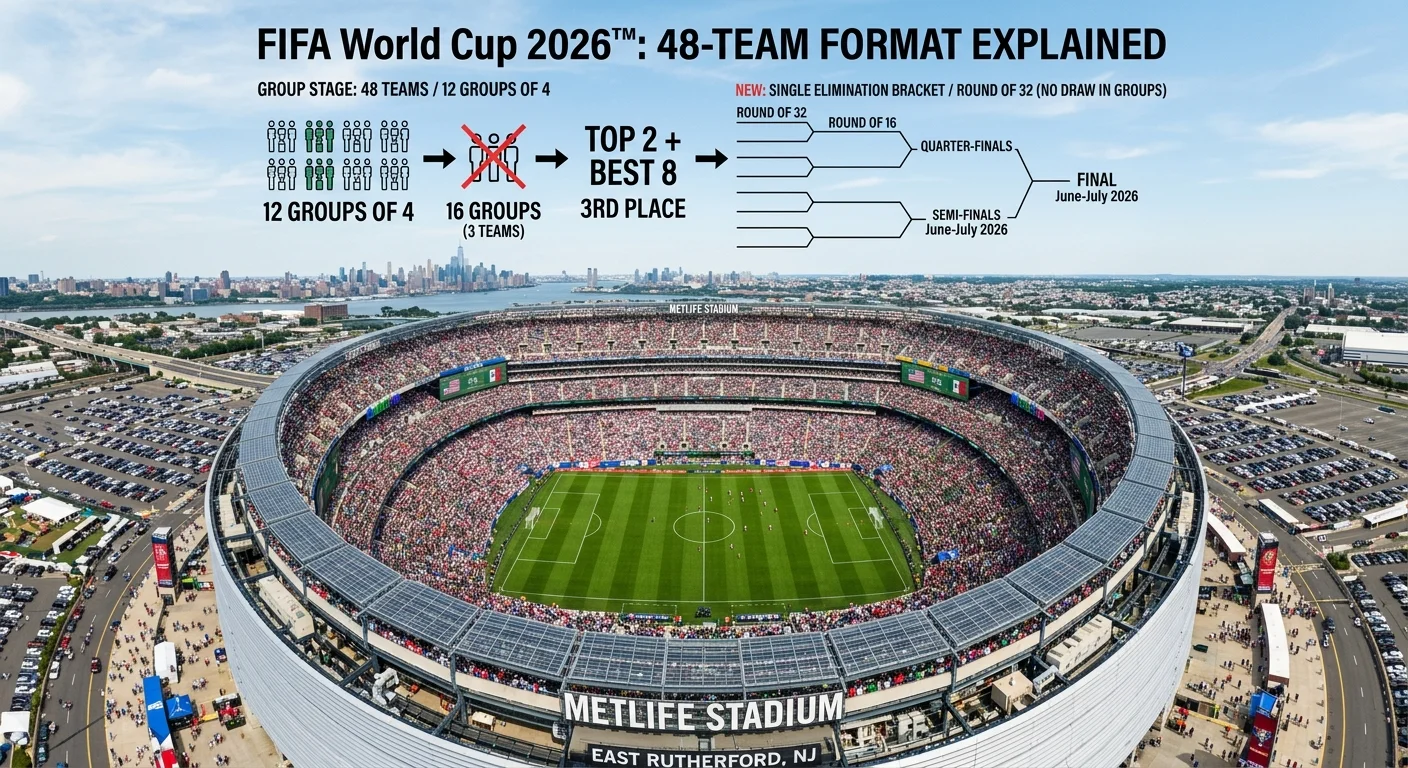
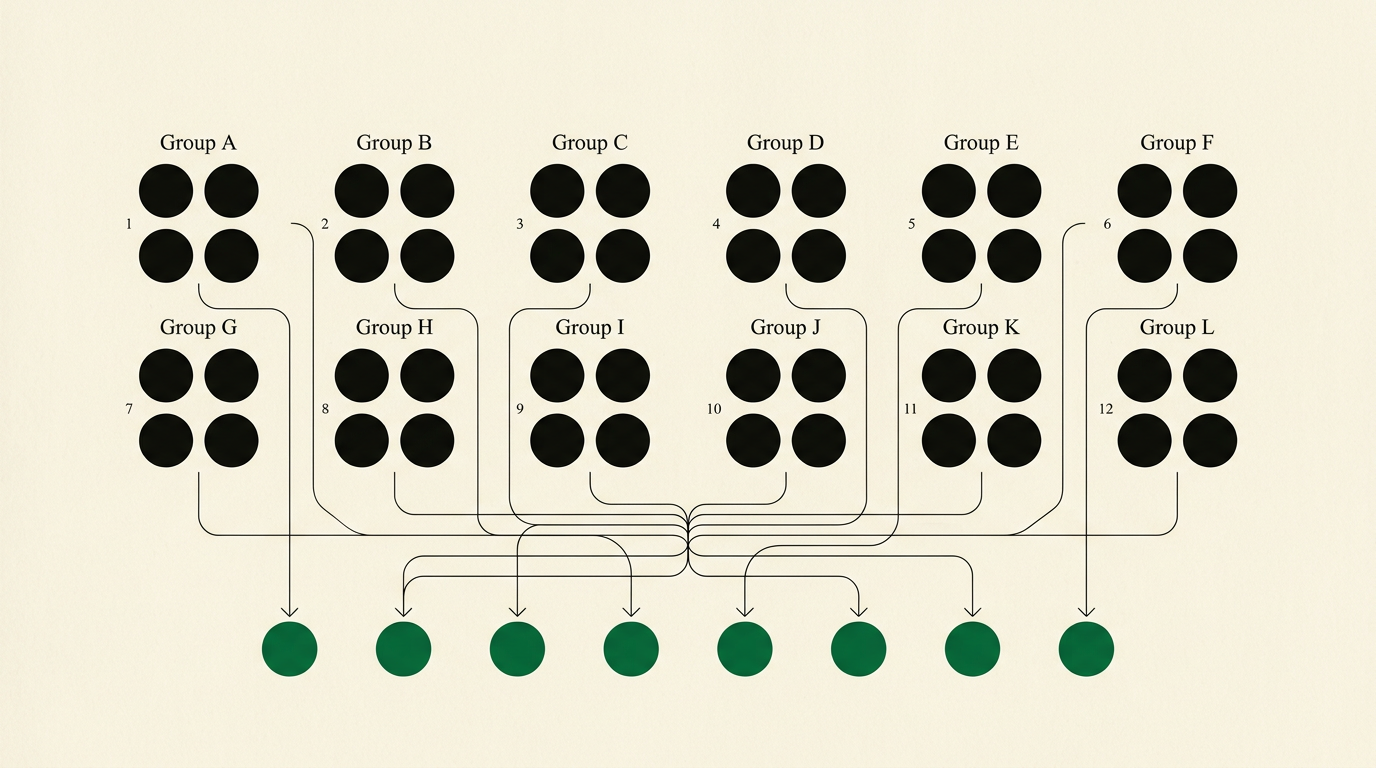
Forty-eight teams are drawn into twelve groups of four. Each team plays the other three in its group once. That produces three group-stage matches per team and six group-stage matches per group. Twelve groups times six matches equals 72 group-stage fixtures, played between 11 June and 27 June.
The top two teams in each group advance automatically. Twelve groups times two equals 24 qualified teams. The remaining eight knockout places go to the best third-placed teams across all twelve groups, ranked by points, then goal difference, then goals scored, then disciplinary record.
That mechanism, the eight third-placed qualifiers, is borrowed from UEFA Euro tournaments since 2016, where 24 teams in six groups used the same method. The Euro precedent gives FIFA a tested model, though scaling it from six groups to twelve is new territory.
The advancement maths, worked through
It’s worth slowing down on how a third-placed team actually qualifies, because this is the bit that confuses people. Each of the 12 groups produces a third-placed finisher. That’s 12 teams. Eight of them go through. Four go home. The cut is made on a single league table that ranks all 12 third-placed teams against each other.
Points come first. A team that finishes third with four or five points is in good shape; a team that finishes third with one or two points is almost certainly out. In practice, the survival line tends to land around three to four points, which usually means a win and a draw, or a single win plus a heavy goal difference. Lose all three and you’re gone regardless. Pick up four points and third place will very likely be enough.
The practical effect is that a defeat in your opening match no longer ends your tournament. Under the 32-team format, an early loss often left a team needing to win its remaining two games just to scrape into the last 16. Now a single win across three matches can carry a side into the knockouts through the back door. That changes how managers approach the opening fixture, and it keeps more groups mathematically alive going into the final round.
The flip side is seeding in the Round of 32. The eight third-placed qualifiers are slotted into the bracket against group winners. A team that limps through on four points is likely to meet a group winner who collected seven or nine. So the reward for sneaking through is a hard draw, which is arguably how it should be.
Round of 32, then traditional knockout
Thirty-two teams enter the knockout stage. The Round of 32 is new to World Cup football, though familiar to anyone who has watched the Europa League. Sixteen matches across six days, 28 June to 3 July.
From the Round of 32, the bracket runs as football fans recognise it. Round of 16, quarter-finals, semi-finals, third-place play-off, and final. Total knockout matches: 32. Total tournament matches: 72 group plus 32 knockout equals 104. Compare to 64 matches at every World Cup from 1998 to 2022.
One quiet consequence of the extra round is the path to the trophy. A team now needs to win four knockout ties rather than three to lift the cup, on top of its group campaign. More on what that does to player workload below.
What changes for fans
The volume of football is the headline. One hundred and four matches across thirty-nine days averages 2.7 matches per day, with as many as six on busy group-stage days. For anyone planning to watch a meaningful chunk of it, the group stage alone is close to a full-time commitment.
Group-stage drama is the second change. Finishing third in your group now has meaning. A team that loses its opening match still has clear qualification routes, which keeps neutral interest alive in groups that, under the old format, would have been settled early.
Upset opportunities are the third. The eight third-placed paths into the knockout stage will, mathematically, include sides that finished with four or five points. Their Round of 32 opponents will be group winners with seven or nine. That gap is where giant-killing happens.
Travel is the fourth, for fans following a team across the tournament. The three-nation format means fixtures could be in Toronto, then Mexico City, then Atlanta within a fortnight. The host region spans roughly four time zones and several thousand miles, and the venues stretch from Vancouver in the north-west to Mexico City in the south. Fans should budget for flights, not road trips, between many fixtures.
What changes for players
Eight matches to reach the final, up from seven. A team that finishes third in its group and qualifies through the best-thirds path will play eight knockout-eligible fixtures. A team that wins its group will play seven.
Squad sizes are expanding. FIFA permitted 26-player squads in 2022 as a Covid-era adjustment that became permanent. For 2026, the technical committee has confirmed squads will rise to 26 players minimum, giving managers more bodies to rotate across a longer schedule.
Recovery windows tighten. The 2022 tournament gave knockout teams 3-4 days between matches in most rounds. The 2026 schedule maintains that gap in later rounds but compresses the early knockout stages. Layer in the heat and travel across the host nations, and the physical demand on a deep-running squad is meaningfully higher than anything the 32-team format produced.
The criticisms
Jürgen Klopp called the expanded calendar “a joke” on multiple occasions. Pep Guardiola has been more measured but consistent: players are not machines, and the international calendar is approaching its physical limit. Carlo Ancelotti, Mikel Arteta, and Xabi Alonso have all said variations of the same thing in 2025-26.
The dilution argument has force in theory. Forty-eight teams means qualification spots go to nations that would not have made the 32-team tournament, and some early group matches will be lopsided. A handful of mismatches in the opening week is a fair price to expect.
The defence is twofold. First, the third-placed-team qualification mechanism means weaker sides still have to perform across three group matches to advance. Second, the global growth argument is empirical: federations like Morocco in 2022 demonstrated that “smaller” footballing nations can produce tournament-defining runs when given the platform.
The format is more interesting than its critics allow, but the calendar question is real and it isn’t going away. Club competitions keep growing, the expanded Club World Cup has eaten into what used to be rest, and the players carrying the elite game are being asked to do more every year. The 2026 World Cup is one more brick on that load.
How it compares to other tournaments
UEFA Euro: 24 teams, 51 matches, 31 days. Copa America: 16 teams, 32 matches, 26 days. Africa Cup of Nations: 24 teams, 52 matches, 28 days. Asian Cup: 24 teams, 51 matches, 28 days.
The 2026 World Cup at 48 teams, 104 matches, and 39 days is now both the largest and longest international football tournament. By a substantial margin in both dimensions. The next biggest single-confederation event, the Africa Cup of Nations, plays barely half as many matches.
For more on tactical formats and tournament-design parallels, see our Champions League 2026/27 format explainer. If you want the wider lay of the land, our World Cup 2026 guide covers hosts, venues and storylines, and our country-by-country viewing guide sorts out where to actually watch it.
FAQ
How many teams qualified from each continent?
UEFA (Europe): 16 places. CAF (Africa): 9 places plus 1 inter-confederation play-off. AFC (Asia): 8 places plus 1 play-off. CONMEBOL (South America): 6 places plus 1 play-off. CONCACAF: 3 automatic plus 3 host nations plus 2 play-offs. OFC (Oceania): 1 place plus 1 play-off.
What happens if two third-placed teams have identical records?
The ranking criteria, in order, are: points, goal difference, goals scored, disciplinary points (yellow and red cards converted to a numerical score), and finally a drawing of lots conducted by FIFA. The same tie-break ladder applies within each group when teams finish level on points.
Why did FIFA drop the 16-groups-of-three plan?
Three-team groups can’t stage their final fixtures simultaneously, which opens the door to collusion in the last round, when two teams might both benefit from a particular result against an opponent who has already finished playing. The 12-groups-of-four format restores simultaneous final games and guarantees every team three matches instead of two.
How long is the tournament?
Thirty-nine days from opening match on 11 June to final on 19 July. The 2022 World Cup ran 29 days. The 1998 tournament, the previous longest, ran 33 days.
Will it be like this in 2030?
Yes. FIFA has confirmed the 48-team format for the 2030 World Cup, hosted across Morocco, Spain, Portugal, with celebratory opening matches in Uruguay, Argentina, and Paraguay marking the centenary.
Has the format actually been tested?
Not at this exact configuration. The eight third-placed-team mechanism was tested at UEFA Euro 2016, 2020, and 2024 with 24 teams across 6 groups. Scaling to 48 teams in 12 groups is new, and 2026 will be the first real-world stress test of how the maths plays out at this size.
Reference: for how the major leagues and UEFA competitions are structured this season, see our football league & competition format reference.