
9 min read · 1,851 words
There is a particular kind of football joy that has nothing to do with trophies, rankings, or tactical sophistication. It is the joy of arrival, of simply being there, of a nation planting its flag at the world’s biggest tournament after years, sometimes decades, of absence. In the opening days of the 2026 World Cup, two such arrivals have captured something the tournament’s slicker, more permanent residents rarely manage: genuine, unmediated emotion.
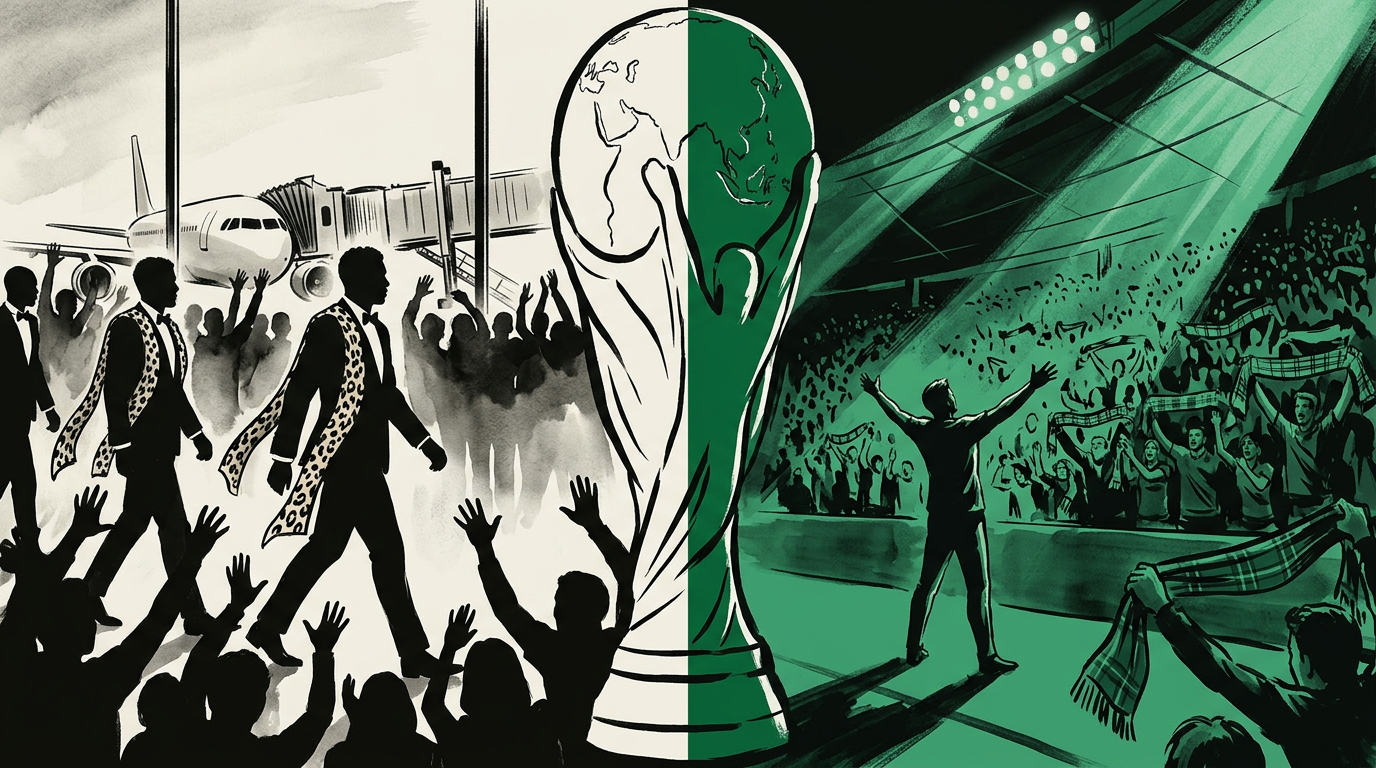
The Democratic Republic of the Congo walked into George Bush Intercontinental Airport in Houston on Thursday dressed in tuxedo suits and leopard-print sashes, channelling the La Sape vogue movement that swept Kinshasa in the 1970s. Across the Atlantic, John McGinn scuffed a shot into the net in Boston and Scotland ended a 36-year wait for a World Cup victory. Different continents, different histories, different obstacles, but the same overwhelming sense that the fact of being here matters more than almost anything that will follow.
La Sape, Leopard Print and 52 Years of Waiting
The DRC’s entrance at Houston airport was, as the Guardian reported a genuinely wholesome moment in a climate where little can be taken for granted. The La Sape movement, La Société des Ambianceurs et des Personnes Élégantes, is not mere fashion; it is a political and cultural statement rooted in Congolese identity, a form of dignified self-expression that emerged partly as resistance to colonial and post-colonial hardship. For the DRC squad to arrive at a World Cup dressed in its aesthetic was a declaration: we are here, we know who we are, and we intend to be seen.
That cultural weight is important context for an Anglo-American football media that tends to process African teams primarily through the lens of potential upsets or raw athleticism. The DRC are not here as a curiosity. They last appeared at this tournament in 1974, when they competed as Zaire, a name imposed by Mobutu Sese Seko’s regime, and were famously humiliated 9-0 by Yugoslavia in a match that has since been recontextualised as something far more complicated than a simple footballing defeat. That squad operated under extraordinary political pressure; players reportedly feared punishment for poor results. Fifty-two years later, the return carries the weight of all that history.
The journey to Houston was not straightforward. The Guardian notes that an Ebola outbreak in the DRC led US authorities to impose a 21-day isolation period on the squad, forcing them to form a bubble in Belgium. They managed one friendly against Denmark and were compelled to cancel a planned match against Chile in Cádiz. The logistical and psychological burden of that quarantine, preparing for the most important tournament of these players’ careers while separated from home and restricted in movement, is something the fixture list will not record. It should be acknowledged.
Scotland’s 36-Year Itch, Scratched in Boston
Meanwhile, in Boston, Scotland were writing their own chapter of long-deferred history. John McGinn’s goal, his own description of it as “scuffed” is both accurate and endearing, was enough to beat Haiti 1-0 and deliver Scotland their first World Cup victory since 1990. BBC Sport reported McGinn as “beaming with pride”, a phrase that sounds like a cliché until you understand that Scotland have attended five World Cups since that 1990 win and failed to progress beyond the group stage at any of them.
McGinn, speaking after the match, said he hoped kids around Scotland were watching and feeling proud to represent the shirt. The Independent quoted him expressing particular delight at seeing young Scotland fans engaged with the tournament, a generational handover that matters enormously for a national football culture that has spent much of the past three decades oscillating between hope and heartbreak. Scotland’s last World Cup appearance before this one was 1998; an entire generation of supporters has grown up without seeing their team at the tournament.
The 1-0 victory over Haiti was not, by most accounts, a performance of great beauty. But beauty was not the point. The Independent noted that the win represents a giant step towards the knockout stages, in the expanded 48-team format, three of the four teams in each group advance, which transforms Scotland’s mathematical position from precarious to genuinely promising after just one match.
The 48-Team Format as Equaliser, and Its Complications
It is worth pausing on that structural point, because it connects the DRC and Scotland stories in ways that are not immediately obvious. The expanded 48-team format was sold partly as an act of footballing democratisation, more nations at the table, more stories told, more of the world represented. The DRC’s return after 52 years and Scotland’s return after 28 are, in different ways, products of that expansion. Whether either side would have qualified under the previous 32-team structure is a question worth asking, though not one that diminishes the achievement.
What the format undeniably does is extend the window of possibility. Scotland, with three points from one game, are already in a strong position to reach the round of 16. The DRC face a brutally tough group, the Guardian’s framing is precise on this, but the expanded format means that even a single victory or a sequence of draws could be enough to progress. For nations returning after long absences, that margin for error is psychologically significant. It allows the tournament to be experienced rather than merely survived.
There is a counter-argument, of course. Critics of the 48-team format contend that it dilutes quality, that group stages become processional, that the genuine drama of elimination is deferred too long. Those are legitimate concerns. But they tend to be made by people whose nations have never spent half a century watching the World Cup from the outside. For the DRC, for Scotland, for the dozens of nations attending their first or returning after long absences, the format is not a dilution, it is an invitation.
What These Returns Actually Mean
The risk with narratives of this kind is sentimentality, the reduction of complex national stories to feel-good vignettes that the tournament machine can process and move on from. The DRC’s La Sape entrance was beautiful, but it should not obscure the fact that the country remains in the grip of one of the world’s most devastating ongoing humanitarian crises, with conflict in the east displacing millions. Football does not solve that. It does not even address it directly. What it can do, what it did, briefly, at George Bush airport on Thursday, is provide a moment of collective pride that travels back home.
Scotland’s situation is different in scale but not entirely in kind. The national football culture carries genuine psychological weight; the pattern of near-misses, early exits, and qualification failures has shaped how a generation of Scots relate to sport and, by extension, to national identity. McGinn’s goal in Boston was a small but real rupture in that pattern. The Independent’s framing, that Scotland can now “dream of a mythical extra game”, captures something true about what knockout football means to a nation that has not experienced it at a World Cup in living memory for most of its current supporters.
From a Spanish perspective, it is tempting to draw comparisons with moments in La Roja’s own history, the years before 2008 when Spain were perennial underachievers at major tournaments despite obvious talent, the weight of expectation that curdled into anxiety. But those comparisons have limits. Spain always knew they belonged at the top table; the question was when they would sit at it. For the DRC, the question for 52 years was whether they would be allowed through the door at all. That is a different kind of waiting.
Looking Ahead: Group Stage Realities
The DRC face a group that will test them severely. The Guardian is careful not to name the opposition in the sections available, but the framing, “brutally tough”, suggests they are not in a bracket designed to ease their return. Their preparation, compromised by the isolation period and the cancelled Chile friendly, leaves questions about match sharpness that a single game against Denmark will not fully have answered. What they have, potentially, is the psychological momentum of an arrival that captured attention and the tactical unpredictability of a side that has not been extensively scouted in competitive conditions.
Scotland’s path is clearer. Three points from the Haiti game, combined with the expanded format’s generosity, means Steve Clarke’s side control their own destiny to a significant degree. The challenge now is managing the shift in psychological register, from the relief of ending a long wait to the pressure of protecting and building on what has been achieved. That transition is where many returning nations have historically struggled. The adrenaline of the first win can dissipate quickly when the next opponent is better organised and better prepared.
For both nations, the World Cup 2026 represents something beyond football results. It is a renegotiation of national self-image, a chance to write new stories over old ones. The DRC doing so in leopard-print sashes, with 52 years of history on their shoulders, is the kind of image that stays with you. Scotland doing so through a scuffed McGinn goal and a stadium full of tartan-clad supporters who had waited their entire adult lives for this moment, that stays with you too.
The tournament has barely started. Both nations have everything still to play for.
FAQ
When did DR Congo last play at a World Cup?
The DRC last appeared at the World Cup in 1974, when they competed under the name Zaire. That makes their 2026 appearance a return after 52 years, the longest gap of any nation at this tournament.
Why were DR Congo in isolation before the World Cup?
US authorities imposed a 21-day isolation period on the DRC squad due to an Ebola outbreak in their homeland. The players and staff formed a bubble in Belgium, where they played one friendly against Denmark before travelling to Houston.
When did Scotland last win a World Cup match?
Scotland’s previous World Cup victory came in 1990, making John McGinn’s goal against Haiti their first winning strike at the tournament in 36 years. Scotland had attended five subsequent World Cups, in 1992, 1994, 1996, 1998, before this 2026 appearance, failing to win a match at any of them.
How does the 48-team World Cup format help smaller nations?
Under the expanded 48-team format three of the four teams in each group advance to the round of 16, compared to two of four previously. This significantly improves the odds for nations returning after long absences, giving them a greater margin for error in the group stage.
What is La Sape and why did the DRC squad wear it?
La Sape, La Société des Ambianceurs et des Personnes Élégantes, is a cultural movement rooted in Kinshasa that uses elaborate, elegant dress as a form of self-expression and identity. It emerged in the 1970s and carries political resonance as a statement of dignity. The DRC squad’s tuxedo suits and leopard-print sashes at Houston airport were a deliberate cultural declaration.
Where can I watch DR Congo and Scotland’s remaining World Cup matches?
For information on how to follow the World Cup coverage, visit our watching guide for details on available broadcast options.
