
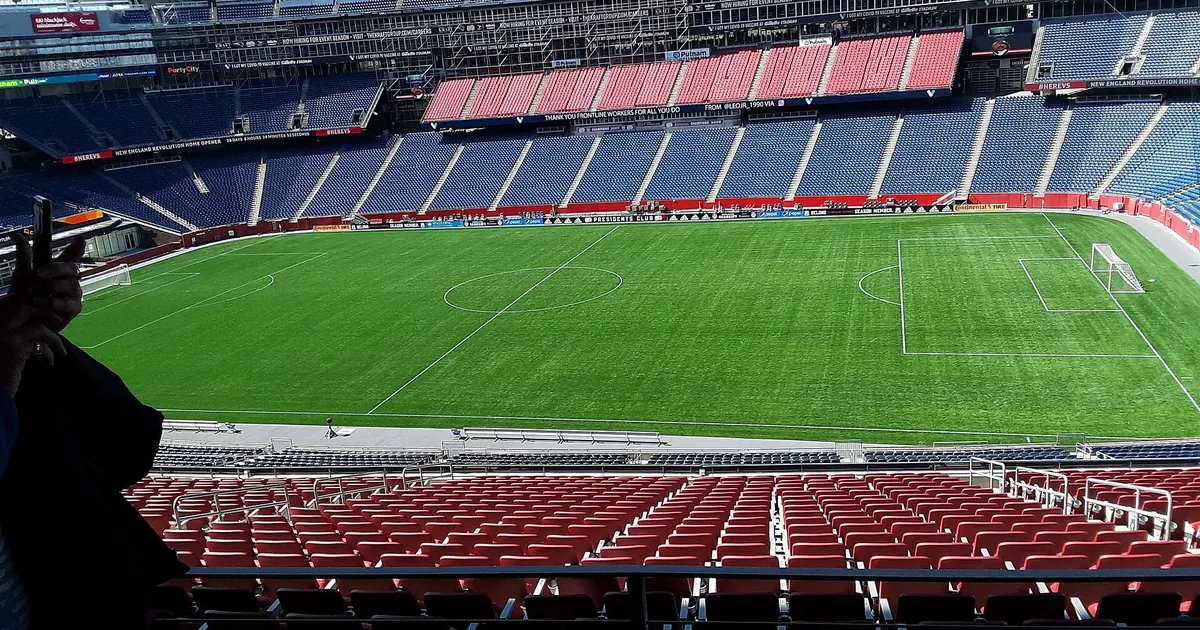
Gillette Stadium, Foxborough, Massachusetts. Photo: Abzeronow / Wikimedia Commons, CC BY-SA 4.0
5 min read · 937 words
World Cup 2026 quarterfinal ticket prices didn’t drift down this week. They fell off a cliff. The average get-in price across the four remaining quarterfinals dropped 31.5% in a single day and 50.4% over three days, according to SeatPick data reported by Forbes on July 7. The cheapest ticket for the Los Angeles-area quarterfinal between Spain and Belgium went from $2,950 to around $1,200, a drop of nearly 60%, per TickPick data cited in the same report. Available secondary-market inventory across all four matches jumped from 28,285 tickets to 49,415.
The trigger was Monday’s Round of 16 results. The United States lost 4-1 to Belgium in Seattle. Spain beat Portugal 1-0, ending Cristiano Ronaldo’s tournament. Both results eliminated the fan bases that had been driving speculative demand for the LA-area quarterfinal, and the sellers holding those tickets started dumping them the moment their teams went out. Thursday’s France-Morocco quarterfinal at Boston Stadium, the last World Cup match the venue will host, is now the cheapest of the four remaining games at $989 a ticket, according to TickPick, despite carrying a global superstar in Kylian Mbappé and a Moroccan side that just became the first African team in tournament history to reach back-to-back World Cup quarterfinals.
A Fan-to-Fan Crash, Not a FIFA Discount
It’s worth being precise about what’s actually collapsing here, because it isn’t FIFA’s own primary market. FIFA sold every one of these tickets months ago, in most cases before either finalist in a given quarterfinal was known. The people now eating the loss are the fans, often speculators, who bought or held tickets betting their own national team would still be alive this week. When USMNT and Portugal fans got eliminated on Monday, they didn’t just lose a match. Many of them were suddenly holding a ticket to a game between two other countries that they had no reason to attend, and the resale market did what resale markets do: it repriced fast and brutally.
That’s a genuinely different mechanism from what drove the tournament’s earlier pricing controversies. FootyGazette has previously reported on how FIFA’s own dynamic-pricing model left group-stage sections visibly empty even as FIFA claimed near-capacity attendance, and on how the host nation’s own opener sat unsold in primary channels for weeks. Those were stories about FIFA managing its own unsold inventory. This week’s collapse is different: it’s tens of thousands of individual fans losing money to each other on a secondary market, after the fact, because they bet on results that didn’t go their way.
The One Thing That Doesn’t Move Either Way
FIFA’s resale marketplace charges a 15% fee to the seller and another 15% to the buyer on every transaction, a combined cut of roughly 30% confirmed in Boston Globe reporting on the Foxborough quarterfinal market last week. That fee doesn’t care which direction the price is moving. When a scalper sells a hot ticket for triple face value, FIFA takes 30% of the inflated number. When a USMNT fan dumps a Spain-Belgium ticket for the roughly $1,750 less it’s now worth (the gap between that match’s $2,950 pre-elimination price and its post-elimination $1,200 floor) just to recoup something, FIFA takes 30% of whatever that sale actually clears.
No incumbent covering this week’s price crash has connected it back to the fee structure FIFA built into its own marketplace. The two stories have mostly run separately: reporters covering the collapse have focused on which teams got eliminated and by how much prices fell, while reporters who wrote about the 30% fee back in late June and early July did so in the context of scalping premiums, not post-elimination fire sales. Put them together and the asymmetry is stark. FIFA designed a pricing system volatile enough to produce both a scalper’s markup and a devastated fan’s markdown inside the same three-week knockout stage, and its own platform is structured to collect a percentage cut at every point on that curve, rising or falling. The volatility is the fans’ problem. The fee income isn’t.
Why Foxborough Is the Outlier Worth Watching
Thursday’s game complicates any easy read on how this collapse works. Unlike the LA-area match, Foxborough’s quarterfinal wasn’t emptied of a “home” fan base this week. Neither France nor Morocco is a North American team, and neither lost anything on Monday. Their $989 get-in price, the cheapest of the four remaining matches, sits below a Los Angeles quarterfinal that just cratered nearly 60% and far below the $9,346 get-in price Forbes reported for the July 19 final at MetLife Stadium. That’s true even though Morocco’s run and Mbappé’s presence would, on paper, be the kind of demand driver that keeps a market firm.
The honest answer is that nobody covering the collapse has fully explained the Foxborough number, and FootyGazette isn’t going to invent an explanation the data doesn’t support. It could be a weekday afternoon kickoff suppressing walk-up demand, the logistics of trans-Atlantic travel on four days’ notice, or simply a smaller North American fan base for either finalist relative to the eliminated USMNT and Portugal contingents that had been propping up the LA market. What the number does confirm is that the quarterfinal ticket market isn’t behaving like one market right now. It’s behaving like four separate ones, each driven by whichever fan base got its heart broken, or didn’t, on a single Monday.
For fans still weighing a purchase, the practical read is simple: this week’s “prices are crashing” headlines are describing panic-sold inventory from eliminated countries, not a tournament-wide discount, and FIFA’s marketplace is collecting its usual cut regardless of which fan base is doing the panicking. For the fuller record of how FIFA’s ticketing model has behaved across the tournament, see FootyGazette’s dynamic-pricing coverage and the World Cup 2026 guide.
