
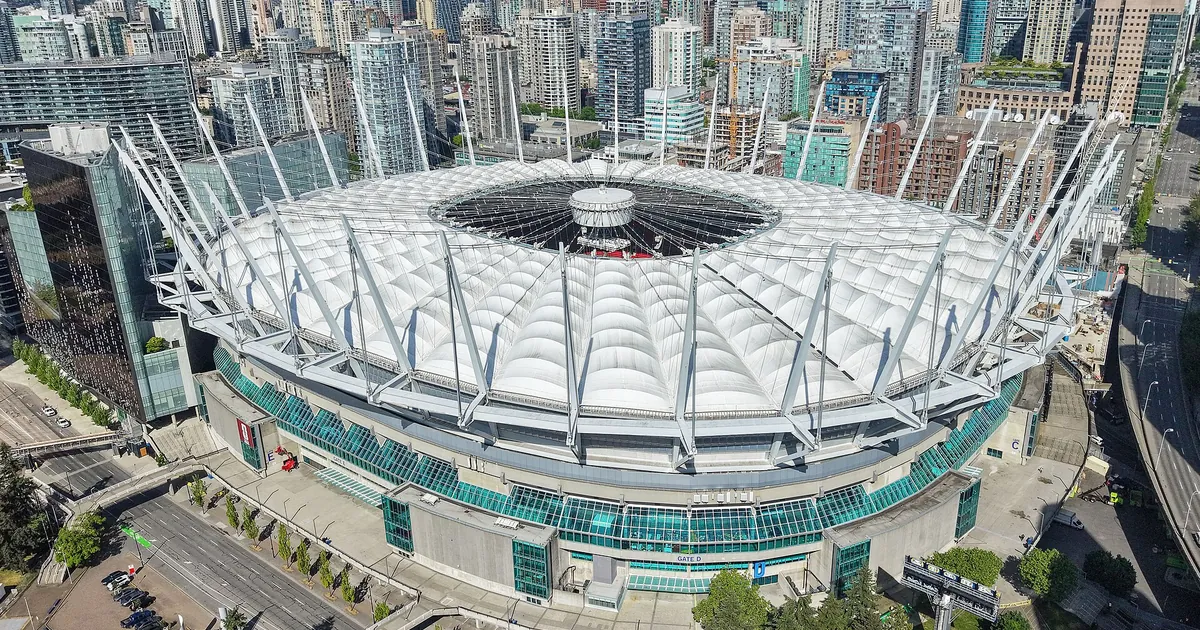
BC Place Stadium, Vancouver. Photo: Quintin Soloviev / Wikimedia Commons, CC BY 4.0
5 min read · 1,019 words
Vancouver’s mayor gave the city’s World Cup an A+. A new Research Co. poll found residents rate the tournament’s economic payoff higher than they ever rated the 2010 Winter Olympics. The province is circulating sales figures showing restaurants and bars up as much as 40 percent on match days. By the numbers that get quoted in press releases, Vancouver’s World Cup is a clean win.
Six blocks from BC Place, the numbers look different. Hotels built for budget travelers are running at half their usual summer occupancy. A working artist on Granville Island, a few hundred meters from an official fan zone, describes the slowest weeks of her year. And in Oppenheimer Park, people who’d been sleeping in tents on the morning of a Switzerland-Algeria match said city crews swept the site faster than they’d ever seen it done, days after officials insisted the World Cup had nothing to do with their timing.
None of this makes the tournament a failure. It makes the “A+” a grade for one Vancouver, not all of them.
The Sentiment Number
Research Co.’s Mario Canseco surveyed 604 Metro Vancouver adults from June 30 to July 2, a live sample taken mid-tournament rather than a retrospective. The headline comparison is to February 2010, when Vancouver last hosted a mega-event: back then, 45 percent of residents called the Olympics “an inconvenience to their day-to-day lives.” This time, only 30 percent say the same about the World Cup. In 2010, 84 percent of residents believed politicians were the main beneficiaries of the Games. That number has fallen 26 points, to 58 percent. Sixty percent of respondents said they watched Canada’s matches at home; another 22 percent watched at a bar or pub.
Those are real, favorable numbers, and they track with what officials have been saying since the tournament passed its halfway point. But a household survey about inconvenience and perceived beneficiaries measures something specific: whether the event feels disruptive and who gets credit for it. It doesn’t measure whether a hostel two blocks from a fan zone is filling its beds, or whether the people already living outside before kickoff are having a better July than usual.
The Receipts
CBC’s reporting on the ground found a genuinely split picture. The province’s “up to 40 percent” restaurant and bar figure is accurate for parts of downtown on match days. It just isn’t universal. Hilary Morris, who runs Beaver Pond Creative on Granville Island, a short walk from a designated fan zone, told CBC the past few weeks have been “unbelievably quiet” during what’s normally one of her busiest stretches of the year. Rhian Charette, general manager of Hostelling International Canada’s downtown and Jericho Beach locations, said her hostels are usually running at 90 to 92 percent occupancy in early July. This year, she’s struggling to reach half that. Bek Shamsiev, general manager of the AZUR Legacy Collection Hotel, put his property 20 to 25 percent behind a normal June at the luxury end of the market.
Three different price points, three different neighborhoods, one pattern: proximity to a match or a fan zone isn’t the same as capturing World Cup spending, and in at least these cases it correlated with losing regular customers who assumed the area would be too crowded or too expensive to bother with.
The Enforcement Cost
The starkest gap is the one Reuters documented at Oppenheimer Park, a few minutes’ walk from BC Place. On the morning of the Switzerland-Algeria last-32 match, people sleeping in tents and on benches said city staff cleared the site earlier and faster than usual sweeps. Confiscated belongings were a recurring complaint; residents said items left on sidewalks during street cleanups are typically thrown out rather than stored.
The joint response to Reuters from the FIFA World Cup 2026 Vancouver Host Committee and the City of Vancouver was that overnight sheltering is permitted under existing bylaws, but tents and belongings must come down during the day so parks stay accessible, and that “this work is routine and is not influenced by FIFA World Cup 2026 matches at BC Place Vancouver.” That may be the technically accurate policy. It’s a harder sell to the people who watched the timing change on a match morning.
Why the Grades Diverge
This is where the three storylines actually connect, and where none of the outlets that broke them individually drew the line between all three. A phone survey about inconvenience captures the experience of people who watch the World Cup on television, walk past a fan zone, or read that their politicians handled it well. It cannot capture what happens to a hostel’s booking calendar or a park sweep schedule, because most respondents never touch either. The B.C. government’s economic messaging is built from aggregate, city-wide sales data, which by construction averages away a Granville Island storefront that’s down against a sports bar three blocks over that’s up 40 percent. And enforcement decisions that happen at 6 a.m., before most residents are awake, don’t show up in anyone’s satisfaction poll at all.
Vancouver’s World Cup didn’t produce one economy. It produced at least three: a spectacle economy that shows up in TV ratings and survey sentiment, a hospitality economy that split unevenly by neighborhood and price point, and an enforcement economy borne entirely by people who were never going to be surveyed about it. The mayor’s grade describes the first one. It says nothing about the other two, and the tournament’s other host cities, several of which have run into the same mismatch between civic messaging and neighborhood-level reality, would do well to ask which of their own numbers are actually citywide before they hand out the next report card.
Sources: CBC News, “Province says World Cup is boosting B.C. economy, but some businesses report softer demand,” July 6, 2026; Reuters via The Star, “In World Cup shadows, Vancouver’s vulnerable communities fear sweeps and raids,” July 7, 2026; Business in Vancouver, “Mario Canseco: Metro Vancouverites see bigger payoff in FIFA World Cup than 2010 Olympics, poll finds,” July 7, 2026; CTV News Vancouver, “When it comes to the World Cup, mayor gives Vancouver an ‘A+,'” July 7, 2026. See also FootyGazette’s BC Place transport coverage and Houston-Kansas City transit legacy piece, part of our World Cup 2026 guide.
