
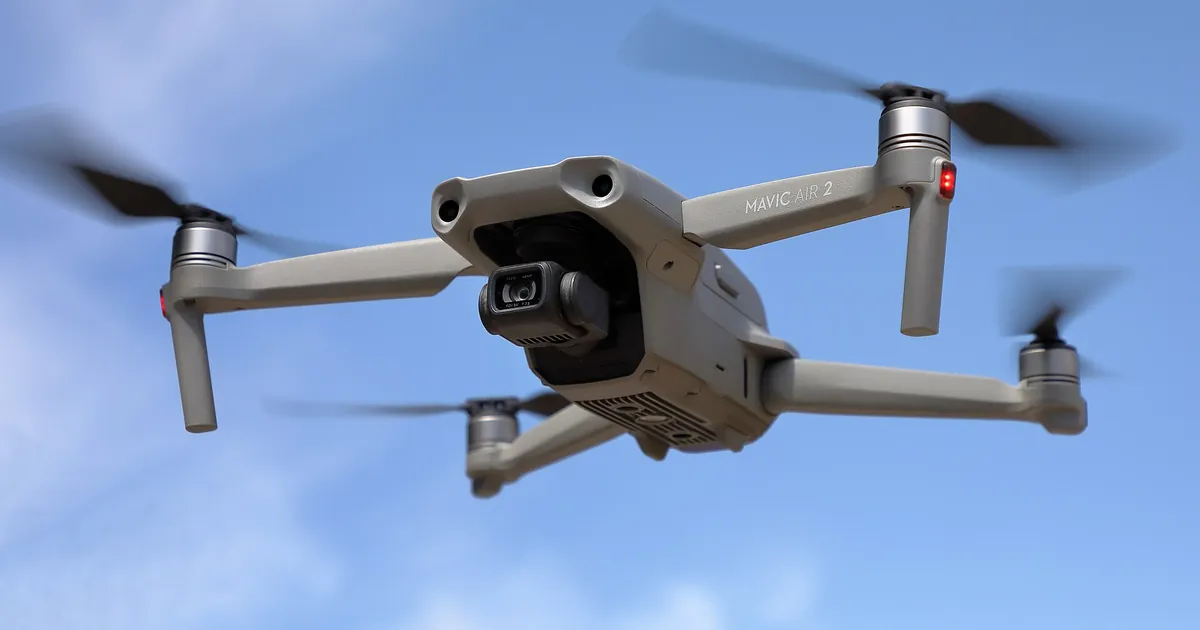
DJI Mavic Air 2. Photo: C.Stadler/Bwag / Wikimedia Commons, CC BY-SA 4.0
5 min read · 1,019 words
World Cup 2026 drone seizures have topped 600 since the tournament opened on June 11, a number that has doubled in less than two weeks and now spans all 11 U.S. host cities. Miami leads with 99 seizures, Atlanta has 77, Dallas has 63, and even Kansas City, a market with no marquee airspace controversy of its own, has logged 32. Most of those stops end the same way: a citation, a confiscated aircraft, and no further news coverage.
A handful do end differently. FootyGazette pulled the Justice Department’s own press releases on three of the cases that have gone to federal charges, and the pattern in what DOJ chose to publicize is not about drones at all.
The Doubling Curve
FootyGazette first covered the counter-drone effort on June 19, when the FBI had logged 145 incursions across eight cities and the story was about jurisdiction: no single stadium operator can police the sky above it, so the entire vertical threat sits with a federal apparatus of limited size. Three weeks later, cheap consumer hardware has done exactly what that piece predicted. The count has more than quadrupled, three more host cities have joined the tally, and NBC News reports the national total “doubled in less than two weeks” even as fines of up to $75,000 civil, $100,000 criminal, a year in prison, and forfeiture of the aircraft sit on the books as a deterrent. Volume like that is not a security program working. It’s a security program absorbing an endless supply of hobbyists and treating each one as a routine citation.
Same Charge, Very Different Press Release
That’s what makes the exceptions worth reading closely. On June 15, the U.S. Attorney’s Office for the Northern District of Georgia announced charges against Lorenzo Rojas-Martinez, a 37-year-old Mexican national, for flying a drone over Centennial Olympic Park during Atlanta’s Fan Festival. The headline on the release is “Illegal Alien Felon Arrested for Flying Drone in World Cup Restricted Airspace after Prior Deportations.” The body leads with his immigration history and a prior cocaine distribution conviction before it gets to the airspace violation itself, and it names the case as part of Operation Take Back America, a DOJ initiative explicitly built around immigration enforcement and cartel disruption, not aviation safety. The investigation was run jointly by the FBI and ICE.
The same week in Dallas, federal prosecutors charged Luis Mauricio Flores Ordonez, a 33-year-old Honduran national, over an unregistered DJI Mini 3 Pro flown near AT&T Stadium during a match. He didn’t even pilot it himself, according to the complaint; he was charged with owning the unregistered aircraft that someone else flew. He’s been in federal custody since his June 14 arrest and is detained pending trial. Even NBC News’s own aggregate story on the 600-seizure milestone, an article that is otherwise about nationwide numbers, introduces him this way: “a Honduran national was charged by federal authorities for piloting an unregistered drone around Dallas Stadium.” Nationality comes first in that sentence. The charge comes second.
For a domestic counterexample, look at Houston. On June 11, opening day of the tournament, 26-year-old Texas resident John Alexander Meza allegedly flew a DJI Mavic 3 in restricted airspace while trying to capture video of a nearby church. He faces the same charge as Rojas-Martinez and Flores Ordonez: operating a drone inside a temporary flight restriction. There’s no DOJ press release built around his citizenship, no reference to a named federal initiative, and coverage stayed local and brief. Same statute, same tournament, same three-hour no-fly window on either side of kickoff. The only variable that changed the size of the headline was who was flying the drone.
Compare all three with Kansas City, where the U.S. Attorney’s public comment on that market’s 32 seizures reads like a standard safety bulletin: “If you see a drone breaking the rules, report it. If you are flying an illegal drone, think twice because violators will be held accountable by the Department of Justice.” No nationality, no immigration status, no reference to a federal task force with a name. The underlying offense, flying a consumer drone inside a temporary flight restriction, is identical in all three cases. Only two of them became immigration stories.
Where the Other 597 Go
Here’s the honest limitation in this piece: nobody has published a case-by-case accounting of all 600-plus stops, so it’s not possible to prove DOJ is running a formal policy of surfacing immigration cases and burying the rest. What’s verifiable is narrower and still telling. NBC News reported plainly that “most of the drones law enforcement detects have resulted in ticketed citations and seizures,” meaning the overwhelming majority never reach a courtroom or a press release at all. Against that backdrop, a Justice Department that chooses to write, publish, and promote exactly two immigration-framed prosecutions out of a mostly invisible enforcement pool isn’t just describing outcomes. It’s picking which three-percent of a routine security program gets a name, a face, and a headline.
A Pattern Bigger Than Drones
This isn’t the first time World Cup 2026’s federal security build-out has doubled as an immigration-enforcement channel. FootyGazette has previously reported on the FIFA accreditation regime that required stadium workers to disclose immigration status, on a FinCEN financial-surveillance program tied to an immigration executive order, and on travel restrictions that swept up players and officials from banned countries. Counter-drone enforcement fits the same shape: a genuinely necessary security tool, built for a genuinely large event, that keeps finding its highest-profile public use in immigration cases rather than the aviation-safety rationale that justified building it.
None of that makes Rojas-Martinez’s or Flores Ordonez’s conduct legal, and a temporary flight restriction is a temporary flight restriction regardless of who breaks it. But 600 seizures is a lot of raw material for two immigration-framed press releases and one generic safety quote from Kansas City. The World Cup didn’t create that instinct in federal law enforcement. It just gave it 11 stadiums and three more weeks to work with.
For the full picture of how the tournament’s security apparatus is built, see FootyGazette’s host-city surveillance and perimeter guide and the World Cup 2026 fan guide for everything else worth knowing before the final on July 19.
