
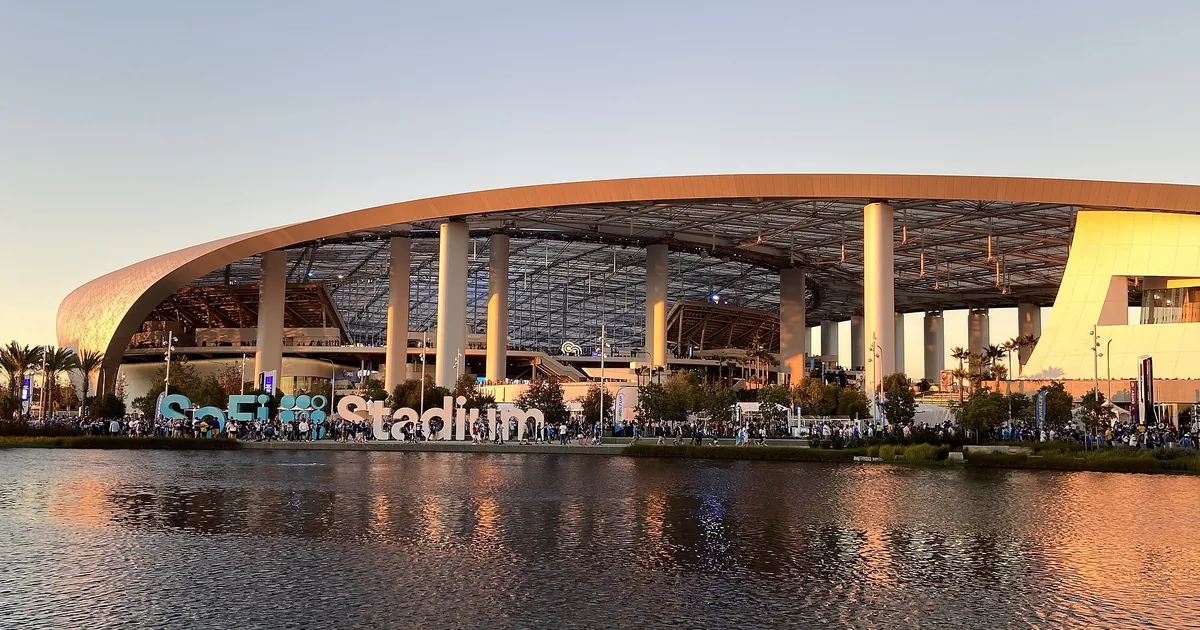
SoFi Stadium, a World Cup 2026 host venue.. Photo: Troutfarm27 / Wikimedia Commons, CC BY-SA 4.0
6 min read · 1,214 words
Four days into the World Cup 2026, the verdict on the tournament’s economic impact is already being written, and it is not the one host cities spent years selling to their taxpayers. The pitch was simple: more teams, more matches, more visitors, more money. The reality, according to the sports economists who study these events for a living, is that for most American host cities the World Cup will be, in the words of one, “roughly a wash.”
That is a remarkable thing to be able to say before the group stage is even over. Normally the autopsy on a mega-event waits until the closing ceremony. This time the warning signs arrived early enough that the diagnosis is essentially complete, and it cuts against the breathless nine-figure projections that justified the public spend in the first place.
The “a wash” verdict, before the group stage ends
Host cities across North America have laid out hundreds of millions of dollars on security, fan zones and venue retrofits, and “experts say they are unlikely to recoup those investments,” The Washington Times reported on the eve of kickoff. Each US jurisdiction spent an estimated $50 million to $100 million to meet FIFA’s security and venue requirements. The early studies that sold those bills to city councils, more than $600 million of “economic impact” for places like Seattle and Kansas City, were, economists say, optimistic to the point of fantasy.
“Those numbers are wildly unlikely,” Victor Matheson, a sports economist at the College of the Holy Cross, told the paper. “That presumes that every single person who walks through the stadium gate is contributing $1,000 to the economy that would not have otherwise done that.” His bottom line: “For most cities, it’s going to be roughly a wash. It’s certainly not going to be an economic enhancer.” Richard Sheehan of Notre Dame put it more bluntly still: across prior tournaments, “the local hosts have not made money. And in many cases, they’ve spent billions and billions of dollars.”
The demand data backs the skepticism. A May survey by the American Hotel and Lodging Association found more than 75% of hoteliers across the 11 US host cities reporting bookings below their initial forecasts, with fewer than a quarter seeing any meaningful lift over a normal summer. CNBC’s reporting drawing on RateGain and Sojern travel data, shows just how lopsided the picture is: Houston (+11.6%) and Dallas (+9.5%) are pacing well ahead of last June, while Seattle (−21%), Mexico City (−21%) and Guadalajara (−24%) are running sharply behind. “Demand is real and positive, but it’s not evenly distributed across host cities,” Sojern’s Jay Wardle told CNBC.
Why a sold-out stadium can still be an economic wash
Here is the part the host-committee press releases never mention, and it is the heart of why the World Cup 2026 economic impact lands so far short of the brochure. A full stadium is not the same as new money. Three separate leakages drain the windfall before a single city accountant ever sees it.
First, FIFA keeps the prize. Matheson projects FIFA’s total tournament revenue at more than $10 billion; Sheehan estimates the governing body will pocket roughly $7 billion from ticket sales alone under this year’s dynamic-pricing regime. Almost none of it stays local. “FIFA is very stingy about sharing any of their revenues,” he noted, adding that the governing body has also been “very restrictive about the ways that local host committees can get sponsors.” Broadcast rights and sponsorship deals flow the same way, past the cities entirely. That dynamic is the same one we traced when Toronto resorted to reselling its own ticket allocation to corporates just to claw back a sliver of its outlay.
Second, the buyers are locals. The nine-figure projections assumed planeloads of free-spending foreigners. Visit KC, for instance, modelled 650,000 unique visitors flying in and filling $300-a-night hotel rooms. Instead, a “huge number of tickets sold are going to locals,” Matheson said, and locals do not book hotels, and the meals they buy near the stadium are dollars that “would have benefited the local economy even without the World Cup.” Hard Rock’s Jim Allen confirmed the pattern from the demand side, telling CNBC that more than half of tickets for the Miami-area matches were bought by locals. Money moving from one local pocket to another local till is not economic impact; it is a rounding error wearing a scarf.
Third, and this is the leakage almost nobody prices in, the tournament displaces the tourists a city already had. June and July are peak season in Los Angeles, Houston, Kansas City and New York anyway. New York reported merely average summer demand to the AHLA; Los Angeles and Kansas City hoteliers reported fewer bookings than a typical summer. When World Cup crowds, road closures and inflated room rates push out the conventions, trade shows and ordinary holidaymakers who would have come regardless, the net new spending shrinks toward zero. “You have the World Cup displacing a bunch of regular tourists,” Matheson warned. The substitution effect is the quiet assassin of every mega-event business case, and it is doing its work in real time.
The honest caveat
None of this means the tournament is an across-the-board bust, and it would be dishonest to claim otherwise. The flight-booking data shows genuine, outsized demand in Houston, Dallas and Miami, cities with deep Latin American ties and the soccer culture to match. Hotel executives stress that 35% of bookings for events like this land in the final week, so the late-rounds picture could brighten if the right national teams advance, “when your country’s team starts winning, that’s when travel budgets go out the window,” as the Marcus Samuelsson Group’s Derek Evans put it. FIFA president Gianni Infantino, predictably, urged everyone to “make the analysis after the end of the World Cup,” citing record ticket requests.
But ticket requests are not sales, and a strong second week does not retroactively justify a $600 million projection that assumed a foreign-visitor surge that visa friction and high prices helped strangle. The cities most likely to bank a real return are the ones that needed the World Cup least as an advertisement, and the “legacy” argument, that hosting puts a city on the global map, only works for places not already on it. As Matheson dryly observed, the Olympics “aren’t going to put Paris or London on the map. Because if Paris and London aren’t already on your map, then you need a new map.”
What it means for the people who actually live there
For the resident, the takeaway is sharper than any GDP figure. The bill, the $50–$100 million in security and venue spending, is socialised onto the city’s books, while the revenue that would justify it is either pocketed by FIFA, recycled among locals who would have spent it anyway, or cannibalised from the summer tourism the city already counted on. That is the same supply-trap logic we found in the collapse of the host-city lodging boom and the same gap between FIFA’s haul and the fan’s experience that left the US opener short of a sell-out. The football, for a few weeks, will be glorious. The economics, for most host cities, will be a wash, and the people paying for it are the ones who were promised a windfall.
For the full picture of the tournament, see our World Cup 2026 guide.
