
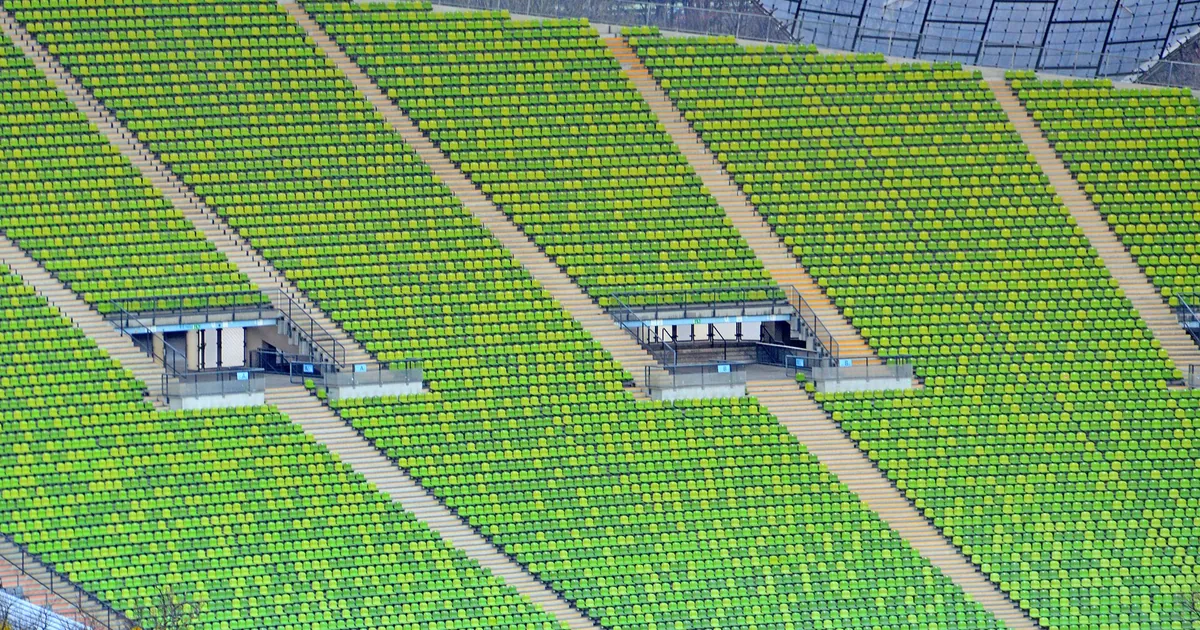
Empty stadium seats (illustrative). Photo: Spielvogel / Wikimedia Commons, CC BY-SA 4.0
6 min read · 1,172 words
For months the story was that you couldn’t get a ticket. Now the cameras have arrived, the matches are being played, and the most striking thing on the broadcast isn’t the football, it’s the red plastic. Empty seats at the World Cup 2026 are showing up across the opening round, and FIFA’s response has quietly told us everything about what its “record-breaking” sales figures actually mean.
This is the development that changes the ticketing story we have been tracking since the spring: the manufactured-scarcity narrative has collided with what fans can see on television, and FIFA has responded not by cutting prices, but by redefining what a full stadium is.
What changed: empty seats at the World Cup 2026, on camera
The visible gaps started on day one. At Estadio Akron in Guadalajara, patches of empty seats dotted the stands as South Korea beat Czechia 2-1, even as the official crowd was logged near capacity, a contrast flagged in NBC News reporting on the opening day. Then came Canada’s home debut. According to Sports Illustrated Canada’s 1-1 draw with Bosnia & Herzegovina at BMO Field drew an announced 43,002 against a 44,315 capacity, more than 1,000 seats unsold, with the cheapest remaining tickets still listed at $1,645 to $2,240 in the Category 1 and 2 tiers.
That is the tell. These are not no-shows from people who paid and stayed home. These are seats that were never sold, on a host nation’s opening night, while the lowest available price sat north of $1,600.
The backdrop, also via Sports Illustrated, is that only 29 of the 104 matches were sold out before the tournament kicked off. Football Supporters Europe has said prices in the most affected areas have run roughly five times higher than at Qatar 2022, with tickets in some sections priced between $400 and $5,000. FIFA’s dynamic pricing model has been reported to range from $60 all the way to $6,000 for a single seat.
FIFA’s answer: redefine the full house
Faced with rows of empty seats on a global broadcast, FIFA did not blink on price. It changed the subject to accounting. In a statement reported by Sports Illustrated, the governing body said its official attendance figures “reflect the number of tickets scanned and spectators present within the stadium footprint, rather than visual assessments of seating occupancy at any given moment during the match,” and attributed the visible gaps to fans standing on concourses rather than sitting in their assigned seats.
Read that again. “Within the stadium footprint” is doing an enormous amount of work. A ticket scanned at the gate counts toward the attendance figure whether the holder is in their seat, in the concourse queue for a $15 beer, or, plausibly, in the case of a comped or corporate allocation, barely in the building. FIFA president Gianni Infantino, meanwhile, has stuck to the demand line, pointing to more than six million tickets sold and describing demand as “unprecedented, not by a little bit, but by a factor of 10 or more.” That number deserves an asterisk: the “factor of 10” describes the ratio of ticket requests to available supply, not sales, and fact-checkers have noted FIFA’s previous attendance records ran closer to three million, so six million sold is roughly a doubling, not a tenfold leap.
The original read: scarcity was the product, not the problem
Here is what the incumbents covering the empty-seat photos are mostly missing. The empty seats are not a failure of FIFA’s pricing model. They are the predictable output of it.
We flagged the mechanism back on June 3: dynamic pricing is a tool for transferring risk onto the most committed buyers. By pricing each match to whatever the market will bear and refusing to discount in public, FIFA captures the maximum from the fans who buy early and pay anything, and then lets the unsold inventory sit empty rather than cut the price and admit the ceiling was set too high. A few days later, the host nation’s own opener still hadn’t sold out four days before kickoff, and as we reported then, resale “get-in” prices had slid to around $560 from roughly $720 a month earlier, a 24% drop, well below FIFA’s primary figure.
An empty premium seat is not a loss to FIFA in the way it would be to a normal promoter, because FIFA has already banked the high-priced sales and faces no obligation to fill the room. The empty seat is simply the visible residue of a strategy that optimises for revenue per ticket, not for a full stadium. That is why the organisation can look at gaps in the stands and genuinely tell you demand has “never been greater”, both things are true at once. The seats it priced for billionaires sold to billionaires; the rest stayed empty, and the average price still went up.
Which reframes the attendance statement entirely. When a body that sells scarcity starts redefining “sold out” down to “tickets scanned within the footprint,” it isn’t defending its credibility, it’s protecting the pricing model from the one thing that could force a climbdown: a televised, undeniable picture of a half-full house at $1,600 a seat. The same supply-and-demand logic showed up off the pitch too, where a predicted hotel shortage turned into a lodging glut once the inflated demand forecasts met reality.
What it means for fans still deciding
The practical takeaway is that the scarcity signal is unreliable, and increasingly so. “Only a few left” and even “sold out” are now marketing states, not physical ones, the empty seats prove it. For the matches that are visibly under-selling, the smart money waits: the resale market has reportedly opened below FIFA’s primary price as kickoff nears, as it did for the US opener, and an empty seat earns FIFA nothing in the 89th minute. Patience, not panic, is the fan’s only real leverage against a pricing engine built to punish exactly the opposite instinct.
For the full picture on tickets, transport and fan rules across the tournament, see our World Cup 2026 guide.
Frequently asked questions
Why are there empty seats at the World Cup 2026 if matches are “sold out”?
Many matches were not actually sold out, only 29 of 104 had sold out before the tournament began. High dynamic-pricing tiers left premium seats unsold, and FIFA counts attendance by tickets scanned within the stadium footprint rather than by seats physically occupied.
How does FIFA count World Cup attendance?
FIFA has said its official figures reflect tickets scanned and spectators present within the stadium footprint, not a visual assessment of how many seats are occupied at any given moment, so concourse crowds and unused premium seats can coexist with a near-capacity official number.
Will World Cup 2026 ticket prices come down?
FIFA has not cut primary prices publicly. The resale market, however, has repeatedly opened below FIFA’s primary “get-in” price as kickoff approaches for under-selling matches, which is where any real discount has appeared.
How expensive are World Cup 2026 tickets?
Reporting puts FIFA’s dynamic pricing between roughly $60 and $6,000 per seat. Football Supporters Europe says prices in the most affected sections run about five times higher than at Qatar 2022, with some seats between $400 and $5,000.
