
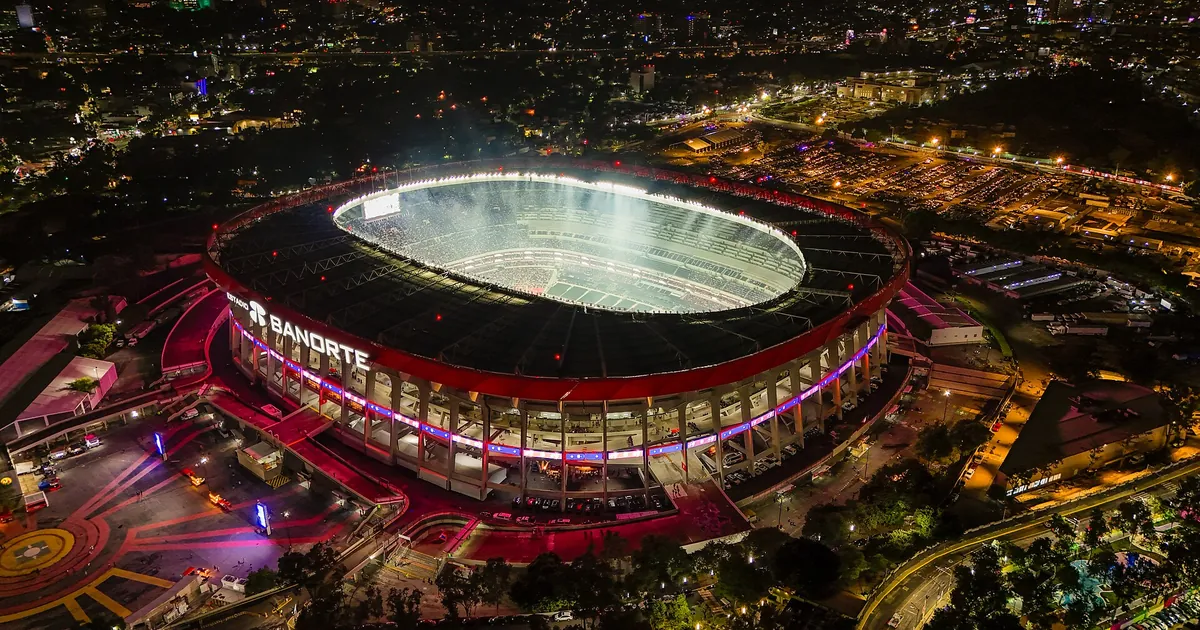
Estadio Ciudad de México (Azteca), Mexico City. Photo: ProtoplasmaKid / Wikimedia Commons, CC BY 4.0
5 min read · 1,026 words
For a month we have written the same warning about how to get to Estadio Ciudad de México for the World Cup 2026 opener as we have for every other venue: in North America, the stadium is the easy part and the last mile is where the plan breaks. Mexico City breaks the pattern. When Mexico kick off against South Africa on Thursday 11 June at the stadium the world still calls the Azteca, fans will arrive at a venue that, almost uniquely among the 16, has a passenger rail line running to its front door. The problem is the opposite of the one we documented at Arrowhead or MetLife, not abandonment, but concentration.
How to get to Estadio Ciudad de México for the World Cup 2026 opener
The spine of the journey is short and cheap. From the centre of the city you ride Metro Line 2 (the blue line, Cuatro Caminos–Tasqueña) to its southern terminus at Tasqueña. A five-peso Metro fare, roughly 25 US cents, buys the whole underground leg. At Tasqueña you transfer to the Tren Ligero, the light-rail line whose third stop, Estadio Azteca, deposits you within walking distance of the gates. Infobae’s transport guide lays out the supporting cast, Metrobús, Trolebús and feeder routes, but the Line 2-to-Tren Ligero hop is the one almost everyone will use, because it is the only rail combination that actually terminates at the stadium.
That is the headline a visiting fan should hold onto: there is a train to the door. After three explainers about American venues where the nearest rail station is measured in miles, the contrast is genuinely jarring.
The “última milla” cordon: why everyone finishes on foot
The city has wrapped the venue in what its planners call an operativo de última milla a last-mile operation built around a security cordon roughly 1.6 kilometres across. Inside that ring, vehicle access is essentially banned: only motorcycles, cars and vans belonging to residents who hold a QR code issued by the Coyoacán borough are allowed through the control filters, according to Expansión’s mobility plan for the opening. There is no meaningful matchday parking for visitors and no rideshare drop at the gate. Whether you arrive by Tren Ligero, by Park & Ride shuttle from an outer lot, or on foot, the final stretch is the same: you walk it, through a filtered perimeter, alongside everyone else.
The schedule compounds the squeeze. El Universal’s route-and-cost guide notes the opening spectacle begins around 11:00 local time with kick-off at 13:00, meaning the entire arriving crowd is funnelled into a two-hour late-morning window rather than spread across an evening.
Original analysis: the inverse failure mode
Across this tournament we have built a single recurring picture of North American stadium access: venues designed for cars and retrofitted, badly, for crowds. Kansas City’s Arrowhead sits seven miles out with no rail at all and a temporary bus network that is dismantled after 13 July. Levi’s Stadium can move barely 15,000 fans a match by light rail. MetLife runs a closed-loop regime where every sanctioned mode is gated behind a match ticket. In each case the failure is dispersal the system cannot deliver enough people to the door, so it rations or strands them.
Estadio Ciudad de México has the opposite vulnerability. Here the rail genuinely arrives, which means the risk migrates from the last mile to the choke points along the way. Two single lines, Metro Line 2 and the Tren Ligero, carry the overwhelming share of an 83,000-seat crowd, and both feed through one transfer node at Tasqueña. Concentrate a stadium’s worth of people onto two parallel rails and a single interchange and you have not solved the access problem; you have relocated it to the platform edge. Tasqueña on a normal rush hour is already one of the busiest interchanges in the network. Add a World Cup opener, a fixed 13:00 kick-off, and a 1.6-kilometre walking cordon that meters how fast people can actually clear the area, and the binding constraint becomes crush management, not coverage.
There is a second variable the American venues never face: altitude. The stadium sits around 2,240 metres above sea level. For fans flying in from sea level, a brisk uphill walk through a security perimeter in the late-morning sun, after a packed train, is a physical load most arrival guides quietly omit. It is not dangerous for the healthy, but it changes the honest advice from “leave early” to “leave early, arrive unhurried, and carry water for the queue.”
So the practical verdict inverts everything we have said about the US hosts. At Arrowhead the instruction is “have a car or a plan.” At Estadio Ciudad de México it is the reverse: do not drive, because you cannot; take the train, but take an early one, because the train is the system and the system is two lines deep. The venue that looks easiest on a transit map is the one most exposed to its own popularity.
The fan’s actual plan
- Default route: Metro Line 2 to Tasqueña, transfer to Tren Ligero, exit at Estadio Azteca. Five pesos for the Metro leg; carry coins and a charged Movilidad Integrada card.
- Timing: with an 11:00 ceremony and 13:00 kick-off, treat 09:30–10:00 as your arrival-at-Tasqueña target, not your leaving-home target. The cordon, not the turnstile, sets your pace.
- Do not plan to drive or be dropped off: inside the 1.6 km perimeter only QR-credentialed Coyoacán residents pass. Park & Ride shuttles from outer lots are the only vehicle option, and they still end on foot.
- Getting out is the hard half: the same two lines that brought 83,000 people in have to take them back. Expect staged egress and budget an hour of patience after the final whistle.
Mexico City has done the thing the United States largely could not: it built a stadium reachable by public transport and is leaning on that network instead of fighting it. That is a real advantage. It is just not the same as an easy one. For the fuller picture of how the 16 venues compare, see our World Cup 2026 guide and pack for the walk, not the parking lot.
