
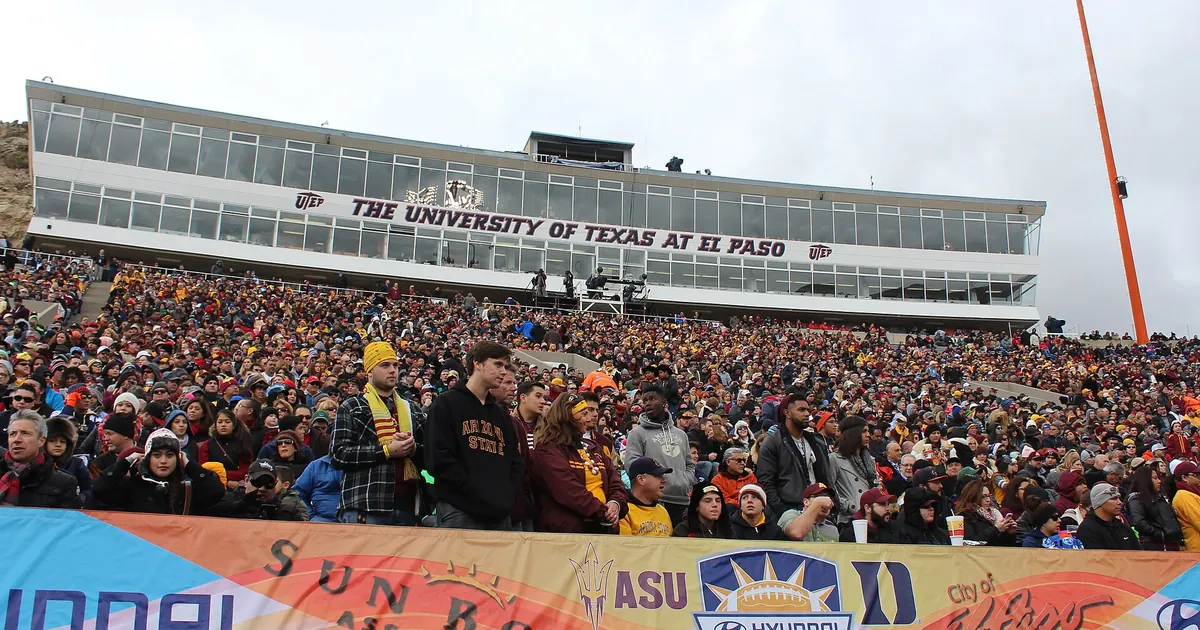
Heat and sun fill the stands at a daytime fixture. Photo: Visit El Paso / Wikimedia Commons, CC BY 2.0
5 min read · 1,043 words
The forecasts for the opening week have arrived, and they have turned World Cup 2026 heat from a background worry into the single most practical question facing anyone with a ticket. Almost every analysis published this month has framed it as a player-welfare story, whether elite athletes can survive a 5pm kickoff in Miami. That is the wrong question for the 60,000 people in the stands. Players get three-minute hydration breaks, ice towels, and a team doctor. You get a seat, a security line, and a bag policy that just took away your water bottle. This is a fan-survival guide, not a medical paper.
Start with the scale of the problem, because it is bigger than the headlines suggest. Research summarised by The Conversation found that 14 of the 16 host cities are likely to exceed the 28°C wet-bulb globe temperature (WBGT) that FIFPRO, the global players’ union, treats as the danger line. NPR’s reporting on the same modelling put roughly a quarter of the 104 matches in conditions above recommended safety limits, nearly double the heat exposure of USA 1994.
Why World Cup 2026 heat is worse for fans than for players
Here is the line that should be on every ticket confirmation. As The Conversation put it, “tens of thousands of spectators will still spend hours travelling, queueing and celebrating in dangerous outdoor heat.” Read that back. The match is 90 minutes plus stoppages. Your exposure is the whole day.
The asymmetry is stark when you lay it out. A player is on an air-conditioned coach to the stadium, in a climate-controlled dressing room until kickoff, and on the pitch for at most 90 minutes with two mandated hydration breaks. A supporter travelling to a 5pm fixture is in a security queue from mid-afternoon, on metal-and-concrete concourses with little shade, and, at open-air venues, baking in direct sun through the first half. The people most at risk are not the fittest in the building; they are the oldest, the ones who have had a beer in the fan zone, and the visitors who flew in from a Northern Hemisphere spring with no acclimatisation. The Conversation flagged exactly this group as the hidden casualty list.
FIFA’s mitigation is built around the players. Mandatory three-minute hydration breaks at the midpoint of each half are real, but they are for the 22 people on the grass, and even sports scientists quoted by TIME argued three minutes is too short to meaningfully cool an athlete, let alone help a stand full of fans who get no break at all.
The hydration trap: the bottle ban meets the afternoon sun
This is where two FIFA decisions collide, and it is the part the national outlets have missed entirely. The tournament’s stadium code of conduct restricts what you can bring through the gate, the reusable-bottle question we covered in detail in our guide to the World Cup 2026 water-bottle and bag rules. So the fan walking into a 30°C concourse is the one fan in the building forbidden from carrying their own water, and reliant on concession queues and stadium fountains during the exact windows when everyone else wants the same thing.
Now overlay the kickoff schedule. FIFA shifted some games later to protect players, but the heat-risk modelling is unambiguous about which slots remain dangerous: late-afternoon and early-evening matches in Miami and Kansas City carry a greater-than-30% chance of breaching the 28°C WBGT line in a normal summer, rising past 50% in a hot one, per the same analysis NPR and The Conversation drew on. The MetLife final, a 3pm kickoff in New Jersey, sits around a 30% risk in a typical July and 55% if the weather turns. The “evening kickoff fixes it” framing simply does not hold for the afternoon slots, and those are the tickets a lot of neutrals have bought.
FootyGazette’s fan heat-risk read by venue type
Strip out the player-welfare noise and the fan-exposure picture sorts host venues into three practical tiers. This is our read, not a FIFA classification, use it to decide how hard to plan.
- Air-conditioned roofs (lowest fan risk): Dallas and Houston have climate-controlled stadiums. The catch, your exposure is the journey and the queue, not the seat. The walk from transit and the security line are still outdoors.
- Open-air, afternoon-slot cities (highest fan risk): Miami and Kansas City in the 5–6pm window are the fixtures the modelling singles out. If you have one of these, treat it as an endurance event.
- Open-air, variable (plan for the worst): the New York/New Jersey, Atlanta and Philadelphia venues swing on the day’s weather. A 3pm MetLife knockout game is a genuine heat fixture, the modelling shows.
The fan zones deserve their own warning. Free public viewing sites are where the unticketed crowds gather, and they are almost universally outdoor, shadeless and alcohol-served, the worst possible combination for the over-50s and the dehydrated. If you are heading to one of the official sites or an overflow alternative from our piece on what to do when the fan festival sells out the heat maths applies there with no stadium medical team nearby.
What a fan can actually do
None of this means stay home. It means plan like the heat is the opponent, because for an afternoon fixture it is.
- Pre-hydrate, don’t catch up. You cannot drink your way out of a deficit mid-match, especially without your own bottle. Arrive hydrated.
- Scout the gate and water points before kickoff, not at half-time when the whole concourse has the same idea.
- Treat alcohol as a heat multiplier. The fan-zone pint that feels great at 3pm is dehydration you will pay for by the 70th minute.
- Pick your seat shade if you can. At open-air venues the sun side bakes through the first half; the difference between sides is real.
- Know your group’s weak link. Older relatives and unacclimatised visitors are the ones the research keeps flagging. Watch them, not yourself.
If you are still deciding which games to attend, factor heat into the choice the way you would factor in price or transport, our ranking of the best host cities for fans and the full World Cup 2026 guide both fold it in. FIFA built its heat plan around protecting the players. Protecting yourself is on you, and it starts before you reach the gate.
