
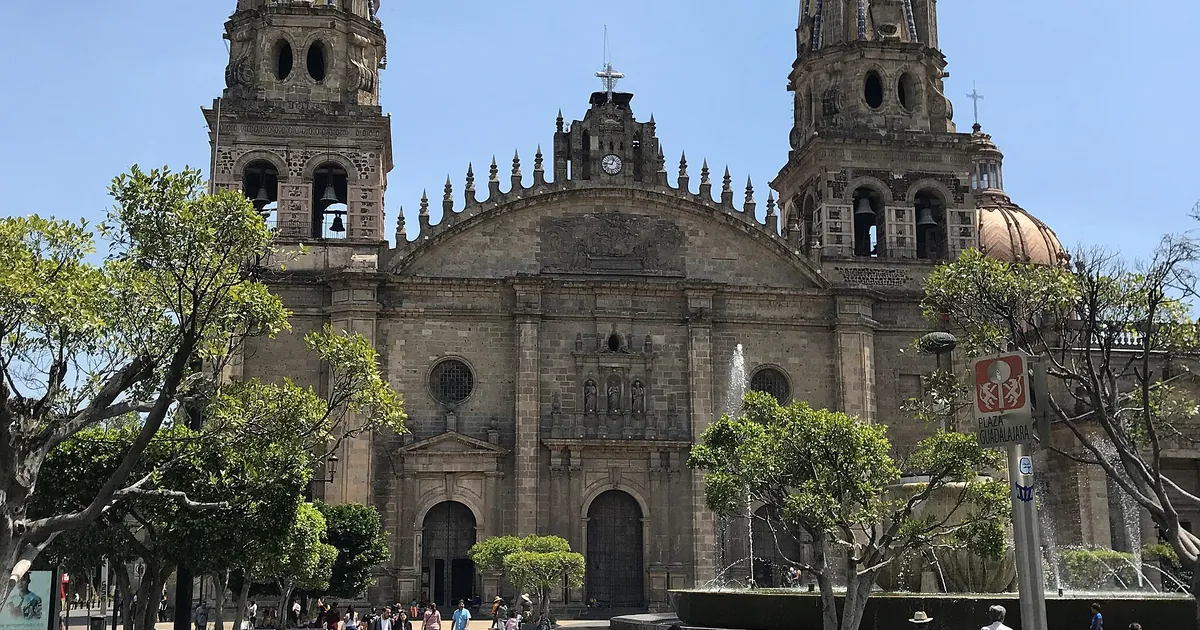
Guadalajara, Jalisco. Photo: Elserbio00 / Wikimedia Commons, CC BY-SA 4.0
5 min read · 1,053 words
Ten days before the Guadalajara World Cup 2026 opener, the city is being scrubbed clean. New paving, repainted facades, widened avenues, a remodelled Historic Center. And, activists say, something else: the quiet removal of the people who do not fit the picture FIFA’s cameras will broadcast to the world. Street musicians, windshield washers, informal vendors and people experiencing homelessness are reportedly being pushed out of the central zones tourists will see, a process local organisers have a blunt name for. They call it limpieza social. Social cleansing.
The national press covering the tournament from New York and London is busy with ticket prices, transit chaos and stadium bottle bans. Almost none of it has looked south, at what hosting actually costs the residents of a Mexican host city. This is that story.
Inside the Guadalajara World Cup 2026 cleanup
According to reporting by Agencia Presentes the metropolitan area of Guadalajara and neighbouring Zapopan has launched a wave of infrastructure and “beautification” projects timed to the tournament: highway widening, the remodelling of the Historic Center, and a broad tidying of the streets nearest the venues. Alongside the construction has come pressure on the people who live and work on those streets.
Danna González, of the city’s Critical and Dissident Bloc, told the outlet that “modernization is being spearheaded by social sanitization,” describing a “policy of deliberate exclusion, without citizen consultation.” People in precarious situations, she said, “are being harassed, intimidated, and removed” from the areas being readied for visitors. The same reporting notes Guadalajara’s public-transport fare has climbed from roughly nine to fourteen pesos, a quiet cost passed straight to the residents least able to absorb it, in the name of a month-long event most of them will never get a ticket to.
It is not only Guadalajara. In Monterrey, activist Ana Eugenia Rodríguez of Casa Trans described 34 simultaneous public-works projects “designed to beautify or whitewash the city.” In Mexico City, a geographer at UNAM’s Institute of Geography, Luis Alberto Salinas Arreortua, framed the whole exercise to the same outlet as “the logic of a completely mercantilist city”, neoliberal urban projects that displace low-income residents. Three host cities, one playbook.
The image, and what it is built to hide
There is a darker layer beneath the fresh paint. Jalisco, the state Guadalajara anchors, carries one of Mexico’s heaviest burdens of forced disappearance: by the figures cited in that reporting, roughly 16,000 officially registered missing people in Jalisco, out of more than 130,000 nationally. In an essay for Al Jazeera writers documented official talk of removing the portraits that families have hung at Guadalajara’s “roundabout of the disappeared,” a memorial the searching mothers built themselves. Maribel Cedeño, of the collective Guerreros Buscadores de Jalisco, said that for families still digging through clandestine graves, “absolutely nothing has changed.” The tournament, the essay argues, threatens to “re-disappear” the disappeared, to sand the city’s grief down to something photogenic.
This is the same instinct that moves a homeless man off a plaza and a missing woman’s photograph off a roundabout: the host city is being curated. Even residents who are staying put have raised the alarm. In February, Al Jazeera reported on Guadalajara locals worried that the spotlight would expose, not solve, the violence they live with year-round, and that the cleanup was cosmetic, not protective.
This is a pattern, not an accident
Here is the part the matchday previews leave out, and the reason this should not surprise anyone who has watched a World Cup arrive in a developing host nation before. Displacement is not a Guadalajara glitch. It is a recurring feature of the mega-event itself.
Brazil 2014 is the clearest precedent. Ahead of that tournament and the 2016 Olympics, an estimated 250,000 people across the twelve host cities faced eviction, by figures compiled by housing-rights campaigners and echoed in UN monitoring. The UN’s then-Special Rapporteur on adequate housing, Raquel Rolnik, warned as early as 2011 of “a pattern of lack of transparency, consultation, dialogue, fair negotiation, and participation of the affected communities.” Human Rights Watch later catalogued families resettled far from their jobs and services, or paid below market value for homes bulldozed for stadiums and access roads. The bill for the spectacle, again, landed on the people with the least.
What makes 2026 distinct is the marketing. This is sold as the “United” World Cup, the rich-nation tournament, 48 teams across the United States, Canada and Mexico, the most lucrative in history, with FIFA projecting record revenues. The displacement is supposed to belong to football’s past, to Brazil and Qatar, not to a 2026 host. Guadalajara is the seam where that story tears. And there is no real enforcement mechanism to stop it: Amnesty International has repeatedly warned that FIFA and host authorities must prevent the tournament from becoming a threat to the very communities that house it, a warning that carries no binding consequence when it is ignored.
What a travelling fan should actually do with this
If you are one of the diaspora fans or neutrals flying into Guadalajara, and the city is genuinely worth the trip, as we argued when we ranked the best host cities for fans the honest move is not to boycott a vendor or feel guilty about a tidy plaza. It is to see the city as it is, not only as it has been staged. Eat at the fondas and street stalls a few blocks off the show route. Tip the musicians who are still there. Read a local outlet, not just the FIFA host-city guide. The version of Guadalajara that gets cleared away for a month is the one that makes the city worth visiting in the first place.
The tournament will be spectacular; that was never in doubt. The question Guadalajara forces is who pays for the spectacle, and whether anyone watching from the stands, or from a sofa in a diaspora watch party half a continent away will ever know their names. For the full picture of how this tournament is being built, and what it is costing, see our complete World Cup 2026 guide.
Sources reviewed for this piece: Agencia Presentes (Feb 2026), Al Jazeera (Dec 2025 and Feb 2026), EL PAÍS, UN OHCHR (2011), Human Rights Watch World Report 2014, and Amnesty International. Figures on disappearances and the Brazil 2014 eviction estimate are drawn from the cited reporting and may be contested by local authorities.
