8 min read · 1,678 words
There will be 48 nations at this summer’s World Cup across the United States, Canada and Mexico. None will carry a heavier burden of context than Iran. The Guardian’s World Cup Experts’ Network frames Team Melli’s campaign as one of the most unusual and unpredictable of recent times, and that assessment is, if anything, an understatement. The ongoing conflict involving Iran, the United States and Israel transforms every fixture, every pre-match ceremony, every post-match press conference into something that transcends sport. That is the reality Iran’s players, staff and supporters must navigate across what promises to be a deeply charged few weeks in North America.
For those of us who have spent years covering the cultural and political dimensions of football in the Spanish-speaking world, the Iranian situation carries uncomfortable echoes. Argentina 1978. The 1982 boycott debates. Spain’s own fraught relationship with football as political theatre during the Franco era. Football has always been a stage on which larger dramas play out, but rarely quite so acutely as Iran in the summer of 2026.
Team Melli: The Squad and Its Strengths
Who leads the line for Iran?
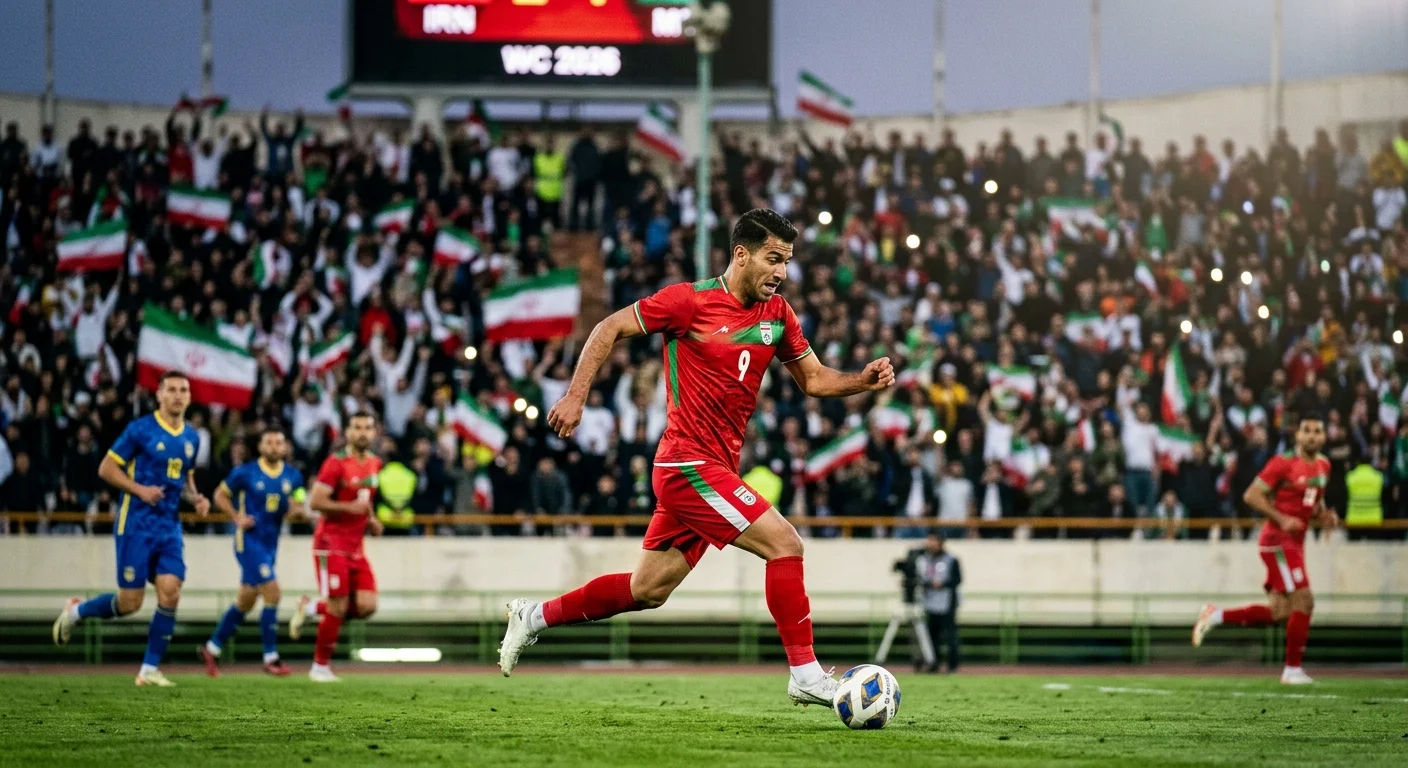
Iran’s attacking threat has long been concentrated through Sardar Azmoun, the Bayer Leverkusen forward whose movement and technical quality give Team Melli a genuine focal point at the highest level. Azmoun’s relationship with the national side has been turbulent, he has retired and returned more than once, but his presence in the squad signals that the technical staff have managed to keep their most dangerous weapon engaged. Mehdi Taremi, now at Inter Milan after his move from Porto, provides an alternative profile: a more physical, hold-up striker capable of linking play in tight spaces. Having two forwards of genuine European pedigree gives Iran a front line that most of their likely group-stage opponents will respect.
What is Iran’s tactical identity?
Under coach Amir Ghalenoei, Iran have settled into a pragmatic, defensively disciplined structure that prioritises compactness and transitions. The 4-2-3-1 has been their most consistent shape in qualifying, with the double pivot providing protection for a back four that can be vulnerable to pace in behind. Iran’s Asian qualifying record, they topped their group, demonstrated an ability to control games against lower-ranked opposition, though their performances against the continent’s stronger sides were more mixed. The question at a 48-team World Cup, where group stages can be navigated with a degree of caution, is whether that pragmatism is sufficient to reach the knockout rounds. In 2022 in Qatar, Iran reached the group stage finale before exiting; replicating that progress in 2026 would represent a reasonable baseline ambition.
Which European-based players carry the greatest weight?
Beyond Azmoun and Taremi, Iran’s squad contains a growing cohort of players operating in European leagues, reflecting the diaspora dimension of Iranian football. Several players hold dual nationality and have chosen Iran over European nations, a dynamic that adds layers of identity to an already complex story. The midfield engine room, anchored by players combining physicality with technical awareness, will need to function efficiently if Iran are to compete against the tournament’s elite sides. One stat worth noting: Iran conceded just four goals in their final six Asian qualifying matches, suggesting a defensive solidity that could prove crucial in a compressed group-stage format.
The Geopolitical Dimension: Football in a War Zone’s Shadow
It would be journalistically irresponsible to write about Iran at this World Cup without addressing the elephant in every room. The tournament is being hosted, in part, by the United States, a nation with which Iran has no formal diplomatic relations and with which tensions have escalated dramatically in the period leading up to the tournament. Should Iran and the United States meet in the group stage or beyond, the fixture would carry a weight comparable to the famous 1998 encounter in France, which Iran won 2-1 in what became one of the most politically charged matches in World Cup history.
The Guardian’s Football Daily newsletter has taken to calling this the “Geopolitics World Cup”, a wry acknowledgement that the 2026 edition is unusually saturated with political subtext. Iran are far from the only nation carrying such baggage, but they are perhaps the most extreme case. The players themselves are in an impossible position: representatives of a state whose government many of them, and much of the Iranian diaspora in North America, oppose, while simultaneously being Iranian footballers who have worked their entire careers for this moment.
In 2022, several Iranian players declined to sing the national anthem before their opening match against England, a gesture of solidarity with the Woman, Life, Freedom protests that had swept the country. The reaction at home was divided; the reaction internationally was largely sympathetic. What choices players make in 2026, in a country where many of their compatriots now live in exile, will be watched with extraordinary attention. This is not background noise. It is the story.
How Iran Compare to the Tournament’s Contenders
Placing Iran in the wider World Cup picture requires honesty. They are not favourites, nor are they expected to threaten the final stages. The expanded 48-team format does, however, meaningfully improve their chances of progressing from the group stage. Under the new structure, 32 of 48 nations advance, meaning that finishing third in a group of three, provided the record is competitive enough, can still be sufficient. For a side of Iran’s calibre, this is a significant structural advantage that did not exist in previous tournaments.
Compare their situation to the Netherlands, whose goalkeeper Bart Verbruggen told The Independent that “our defence is one of the best in the world” and that the Dutch are in North America to finally win the tournament after so many near misses. The Netherlands, like Iran, have a proud footballing identity and a history of underachievement relative to their talent; unlike Iran, they are legitimate dark-horse contenders for the trophy itself. The gap between the two nations is real, but it is not unbridgeable across a single match on a given day.
The full World Cup 2026 guide on FootyGazette covers all 48 nations’ prospects in depth, and Iran’s section makes for particularly compelling reading in the context of the broader tournament narrative.
What the Record Books Say, and What They Miss
Iran’s World Cup history is modest by the standards of the tournament’s giants. Their best finish remains the group stage, though their 2022 campaign showed genuine tactical development under Carlos Queiroz’s successor. BBC Sport’s deep-dive into World Cup record holders is a reminder of how the tournament’s statistical landscape is dominated by the same handful of nations, Brazil, Germany, Italy, Argentina, France, who have contested the majority of finals and semi-finals. Iran have never come close to that company, and realism demands acknowledging that 2026 is unlikely to change that.
But records and statistics capture only part of what makes a World Cup campaign meaningful. Iran’s presence in North America this summer, the symbolism of their players standing on American soil, representing a nation in open conflict with their hosts, watched by millions of Iranians in the diaspora who fled the Islamic Republic, is a story that no spreadsheet can contain. Football has always been about more than results, and rarely more so than now.
Forward Look: What Iran Need to Progress
What does a successful group stage look like for Iran?
Advancing from the group stage would represent a genuine achievement and would match their best recent World Cup performances. Given the 48-team format, finishing second or third in their group with four points, a win and a draw, should be sufficient in most scenarios. Their defensive solidity gives them a platform; the question is whether Azmoun and Taremi can provide the goals when they matter.
How will the political atmosphere affect the players?
This is genuinely unknowable, and anyone who claims certainty is not being honest. Some players may find the weight of expectation and political scrutiny galvanising; others may find it paralysing. The Iranian Football Federation and the coaching staff will work hard to create a bubble of normalcy, but the outside world will not cooperate. Every press conference will include questions that have nothing to do with football.
Could Iran cause an upset against a major nation?
Yes, plausibly. Iran’s 2-1 win over Wales in Qatar demonstrated their capacity to beat sides ranked significantly above them when the tactical plan is executed correctly. A compact defensive shape, quick transitions through Taremi’s link play, and Azmoun’s ability to punish a single defensive lapse make them dangerous on a given day. They are not favourites in any fixture against a top-20 nation, but they are not pushovers either.
What is the wider significance of Iran’s participation?
For the millions of Iranians in the diaspora, many of whom are now American, Canadian or Mexican citizens, this World Cup presents a uniquely complicated emotional landscape. Supporting Team Melli has always carried political freight in the Iranian community; in 2026, with matches potentially being played in cities where large Iranian diaspora populations live, that freight becomes almost unbearable. The football matters. But it is also, unmistakably, about something much larger than football.
Iran’s World Cup 2026 campaign will be analysed through tactical lenses, through squad-depth lenses, through the lens of the broadcast and viewing landscape that makes this the most widely accessible tournament in history. But the lens that will matter most, to the players, to the diaspora, to the watching world, is the human one. Team Melli are footballers. They are also, inescapably, symbols. How they carry that weight across the group stage and potentially beyond will be one of the defining narratives of a tournament already overflowing with them.
For those wanting to follow Iran’s progress alongside the full World Cup 2026 coverage on FootyGazette, including tactical breakdowns, squad analysis and match reports, our dedicated tournament hub will be updated throughout the competition. And if you are looking for viewing options, our guide to watching football online covers the available services across different territories.