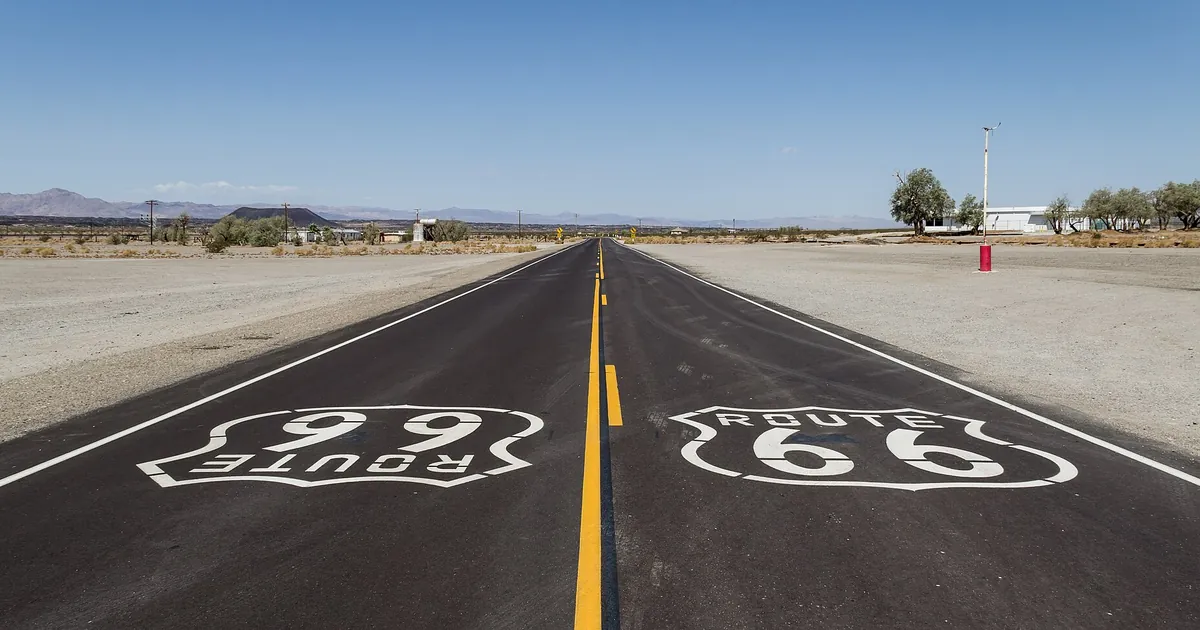
An open American highway — the scale of driving between 2026 host cities. Photo: Dietmar Rabich / Wikimedia Commons, CC BY-SA 4.0
9 min read · 1,790 words
Short answer: sometimes, and only if you respect the geography. The 2026 World Cup runs from June 11 to July 19, spreads 104 matches across 16 host cities, and stretches nearly 3,000 miles end to end across three countries. Some city pairs sit close enough for a comfortable drive. Others look close on a flat map and turn out to be a flight you cannot avoid. The trick is knowing which is which before you book anything.
If you are still mapping out the whole trip, start with our complete guide to the 2026 World Cup, then come back here to figure out how you actually move between cities.
This is not a European tournament
Plenty of fans arrive with a European mental model. At Euro 2024 you could hop a cheap train between host cities and treat day-trips as routine, because the whole thing sat inside one country. That model falls apart fast here. The United States hosts 11 cities, Mexico hosts three, and Canada hosts two, and the distances between them are continental rather than regional.
Think of it less as one tournament and more as three loosely connected tournaments happening at once. FIFA grouped the venues into rough regional clusters to keep most group-stage travel sane. The Western region links the Pacific coast cities, the Central region anchors the American heartland and Mexico’s northern hubs, and the Eastern region runs up the Atlantic seaboard. Teams play most of their group games inside one cluster, which is the only reason driving is realistic at all. Step outside a cluster and you are almost always looking at a plane.
Where the map lies to you
A flat map flattens your judgment. Miami and Vancouver both sit on the same continent, so the eye says “doable.” In reality Miami to Vancouver is 2,801 miles, the longest gap between any two host cities. Seattle to Miami is roughly 2,725 air miles and works out to about six days of continuous driving. Nobody does that for a football match, and nobody should try.
So which pairs actually drive well? A handful stand out, and they tend to share a cluster:
- New York to Philadelphia is the easiest drive on the whole map at 95 miles, about 100 minutes by car. These two are a genuine pair you can base yourself between.
- Dallas to Houston covers 240 miles in roughly 3.5 hours. Long-ish, but a clean half-day each way on good interstate.
- Atlanta to Miami is 665 miles and around 10 hours. That is a real road trip, not a day-trip, but a determined fan can make it work over a couple of days.
- San Francisco to Seattle sits at roughly 808 miles, a 12 to 14 hour drive. Doable across two days if you actually want the coastal miles.
- Vancouver to Seattle is only 145 miles, but it crosses an international border, which changes the calculation completely (more on that below).
Boston slots into the northeastern run alongside New York and Philadelphia, so the Atlantic corridor is the most drive-friendly stretch in the tournament. The Pacific corridor, linking Seattle, San Francisco, and Los Angeles, works too if you treat it as a road trip rather than a commute. Everything else, you fly.
The contrast in the middle distances tells the story. New York to Atlanta is 866 miles, which is 13 hours of driving or a 3-hour flight. When the drive is more than four times the flight, the drive stops being a travel choice and becomes a hobby. Fun if road-tripping is the point. Painful if you just need to be at kickoff.
Original analysis: the group draw is a travel lottery FIFA can’t fully fix
Here is the part that catches people out. Your total mileage is not really set by the calendar. It is set by the draw. Two fans following two different teams can rack up wildly different totals over the exact same group stage.
The spread is stark. Group I fans face roughly 1,161 miles across the group stage. Group J fans face roughly 6,424 miles. That is more than five times the distance for the same three matches, decided by nothing more than which pot of teams landed in which slot. The cluster system softens the worst of it, but it cannot save every group, because the bracket has to send some teams across regions even before the knockouts begin.
The practical lesson: do not commit to a driving plan until you know your group. A fan in a tight cluster can build a road trip that genuinely beats flying on cost and flexibility. A fan in a sprawling group should accept flights early and book them before prices climb. We dug into how this geography ripples through the whole event in our look at the logistics and politics of a three-nation tournament, and the short version is that no scheduling formula fully neutralizes a bad draw.
The Mexico question and crossing the border
Mexico hosts 13 matches across Mexico City, Guadalajara, and Monterrey, which form a rough triangle across central and northern Mexico. Inside Mexico, the toll roads, the cuotas marked with a number and a “D,” are well kept but pricey. For most visitors a flight between Mexican host cities ends up faster and not much dearer than a long drive once you stack up tolls and fuel. Shorter add-ons make more sense behind the wheel, like a side trip out from a host city, rather than the main intercity legs.
Now the bigger trap. Plenty of fans picture a single epic drive from Texas down into Mexico, or up from Mexico into the American knockout cities. Treat that instinct with caution. The cleanest mental rule is simple: plan road trips inside one country and one cluster, and treat every cross-border leg as a flight rather than a drive. A route like Mexico City to Houston to Dallas suits a team that opens in Mexico and climbs into the US bracket, and flying the international hop keeps it manageable.
If you are set on driving into Mexico anyway, the paperwork is real and not optional:
- Carry a valid passport. US citizens crossing by land need a passport book or passport card.
- Get a Forma Migratoria Multiple, the FMM tourist permit, available online or at the border.
- Sort a temporary vehicle import permit, and buy Mexican auto insurance, because US policies rarely cover you across the line.
- Cross with a full tank, since waits can be long and the first gas station on the Mexican side may be a fair drive in.
- Drive intercity legs in daylight and stick to the cuota toll roads, which see more patrols than the free “libre” routes.
The Canada crossings into Toronto and Vancouver are simpler than Mexico but still not free. You need a passport, you should expect queues during a tournament, and any rental car must be cleared by the rental company for cross-border use. Vancouver to Seattle is a short hop in miles, yet the border, not the distance, is what eats your time. Build in a buffer and assume the line is longer than usual, because everyone else had the same clever idea.
Even the doable drives carry hidden costs
A drive that looks cheaper on paper rarely stays cheap once reality shows up. Fuel across hundreds of miles adds up. Tolls bite, especially in the northeast and across Mexico. Parking near a stadium on match day can cost more than you expect, and a hotel for the overnight stop on any drive longer than a few hours turns a “free” road trip into a real bill.
Then there is fatigue, which is the cost nobody budgets for. A 10-hour drive to Miami sounds romantic until you arrive stiff, drained, and facing 90-plus minutes of standing and shouting. Two people splitting the wheel changes the math. One person driving solo across a long leg is asking to watch the match through a fog. Summer heat across Texas, the southeast, and central Mexico makes long days in the car harder still, and air conditioning is not the same as rest.
None of this kills the road-trip dream. It just means you should price the whole thing honestly. For some pairs the drive wins clearly. For others, once you add fuel, tolls, parking, a hotel, and a tired body, the budget flight you dismissed starts looking like the smart buy. We compared what fans actually pay city by city in our breakdown of which host cities are getting fan costs right, and the gap between cities is wide enough to shape your whole route.
How to actually plan it
A workable approach, in order:
- Wait for your group. Mileage is decided by the draw, not the schedule. Hold firm plans until you know which cities you are chasing.
- Map your cities to clusters. If your matches sit inside one regional cluster, a drive is on the table. If they jump clusters, plan to fly and book early.
- Pick your drivable legs. The northeastern corridor and the Pacific corridor are your best driving bets. Most other pairs favor a flight.
- Treat borders as flights. Keep road trips inside one country and one cluster. Cross between countries by plane unless you genuinely want the border adventure.
- Cost the full trip. Fuel, tolls, parking, overnight stays, and rest all count. Compare the honest drive total against a real flight, not a fantasy one.
- Build in buffers. Borders, traffic, and tournament crowds all run slow. Give yourself far more cushion than a normal trip.
Frequently asked questions
Can you drive between World Cup 2026 cities?
Between some, yes. Pairs inside the same regional cluster drive well, like New York to Philadelphia, Dallas to Houston, or San Francisco to Seattle. Across clusters, or across the full span of the tournament, driving stops being practical and you should fly.
What is the longest distance between two host cities?
Miami to Vancouver, at 2,801 miles. Seattle to Miami is close behind at roughly 2,725 air miles, about six days of continuous driving. These are flights, full stop.
Does the group draw really change how far I travel?
Hugely. Group I fans face around 1,161 miles in the group stage, while Group J fans face around 6,424 miles, more than five times as much for the same three matches. The draw, not the calendar, sets your mileage.
Should I drive across the US-Mexico or US-Canada border?
Usually no. The cleanest plan keeps road trips inside one country and one cluster and treats every international leg as a flight. If you do drive into Mexico, you need a passport, an FMM permit, a temporary vehicle import permit, and Mexican insurance, and you should expect long border waits during the tournament.
For the wider picture on getting around, our 2026 World Cup guide ties the travel map together with everything else you need to know before kickoff.