
9 min read · 1,850 words
Six weeks out from the opening fixture of a 48-team World Cup that already feels like it was designed by committee, the stories dominating the build-up have precious little to do with football. Iran are relocating their base camp across an international border. The United States are still arguing about their own squad selections. Brazil have recalled a 34-year-old who has played fewer than 400 minutes of competitive football in the past two years. And the Democratic Republic of Congo are pressing ahead with Houston as their base despite a US government Ebola advisory. Welcome to the most logistically complicated tournament in the history of the sport.
Iran’s Base Camp Move: What We Know, and What We Don’t
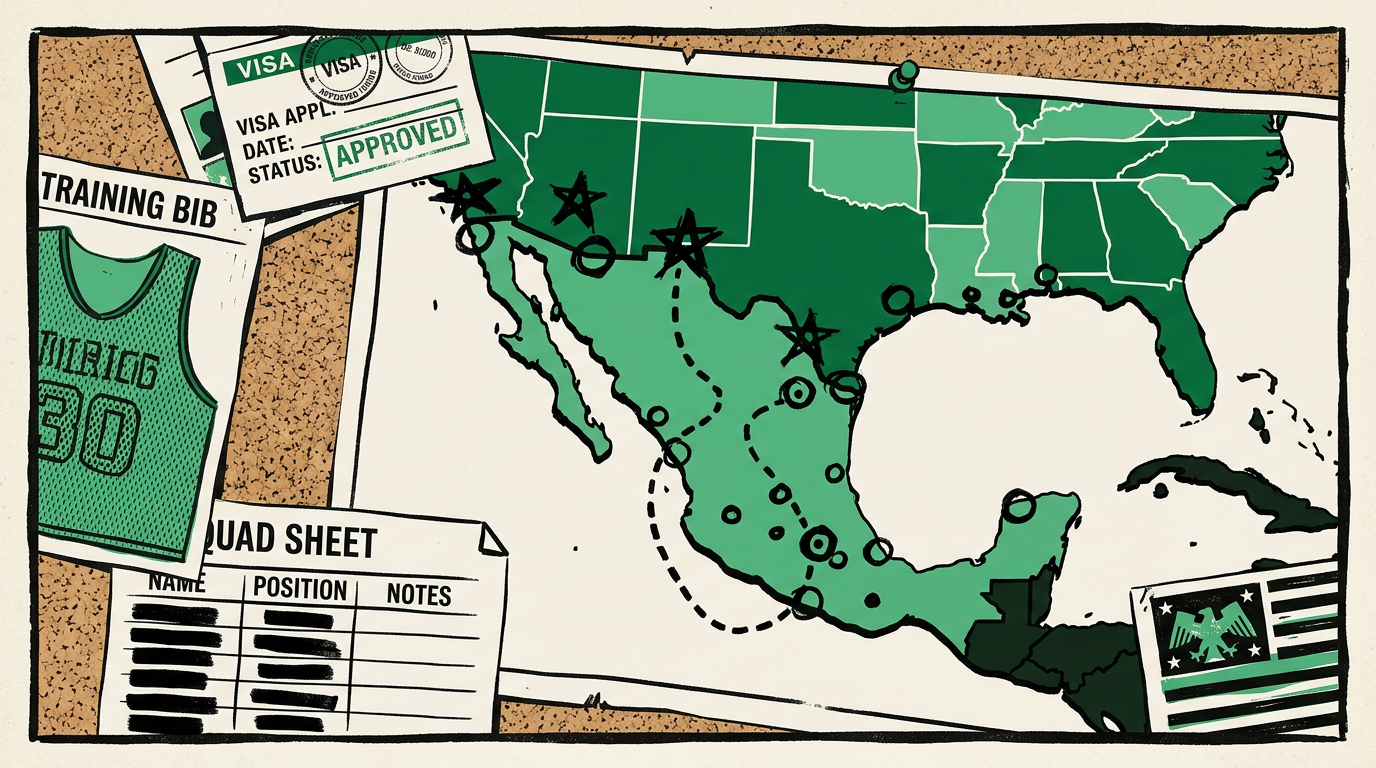
The most politically charged story of the week concerns Iran. Mehdi Taj, president of the Iranian Football Federation, announced on Saturday that the team’s World Cup training base has been relocated from the United States, specifically Arizona, to Tijuana, Mexico, with the move said to have received FIFA approval. The federation issued the statement through its media relations office. FIFA, for its part, has not confirmed anything. That gap between a federation’s press release and governing body confirmation is worth noting before anyone draws firm conclusions.
The context, as the Guardian reports is the ongoing conflict involving Iran, which has created genuine uncertainty around visa processing for the Iranian squad and staff wishing to enter the United States. Tijuana sits directly on the US-Mexico border, which means Iran can theoretically train in Mexico while remaining close enough to their group-stage venues without navigating the American immigration system. It is a pragmatic solution to an extraordinary situation, assuming the logistics of crossing into California for matchdays are as straightforward as the federation implies.
What remains unclear is whether FIFA formally sanctioned this arrangement or whether the federation is moving ahead and expecting ratification to follow. The governing body’s silence is conspicuous. There is also the small matter of what this means for Iran’s preparation, Tijuana is not Tucson, and a last-minute base camp change six weeks before your opening fixture is not ideal regardless of the political circumstances that necessitated it.
Pochettino’s USMNT Roster: The Choices That Will Define His Tournament
Meanwhile, the host nation’s squad is taking shape, or rather, it has already taken shape, and the Guardian got hold of it before the official Tuesday announcement in New York. Mauricio Pochettino’s 26-man roster, authenticated by multiple sources with knowledge of the selections, contains a few decisions that will generate debate well into the group stage.
The headline inclusions and omissions: Club América winger Alejandro Zendejas is in; Lyon’s Tanner Tessmann, a defensive midfielder who has been one of the more consistent performers in Ligue 1 this season, is out. Borussia Mönchengladbach’s Gio Reyna makes the cut, a selection that will either look inspired or optimistic depending on how his body holds up over a tournament. Real Salt Lake’s Diego Luna, despite what the Guardian describes as strong recent form does not.
The Tessmann omission is the one that puzzles most. A holding midfielder with genuine European pedigree who has been playing regularly at a reasonable level, the sort of profile that tends to be invaluable in tournament football when you need someone to protect a lead or slow the game down. Pochettino has clearly decided he wants something different in that position, and he may well be right. But it is the kind of call that gets revisited sharply if the United States concede from midfield transitions in the knockout rounds.
The Zendejas inclusion tells you something about Pochettino’s attacking priorities. A winger who has thrived in Liga MX, comfortable in tight spaces, capable of the unexpected, he fits a profile of player who can hurt teams in short bursts rather than dominate possession phases. Whether that suits the demands of a World Cup group stage against opponents who will be well-scouted and organised is another question. For more on how this summer’s major decisions are reshaping club and country the picture is still forming.
Brazil, Neymar, and the Messi Problem That Never Goes Away
Carlo Ancelotti has included Neymar in Brazil’s World Cup squad. Neymar is 34. He has played somewhere in the region of 400 minutes of competitive football over the past two seasons due to a serious knee injury sustained in October 2023. Ancelotti is the most decorated manager in Champions League history. These facts exist simultaneously, and they do not entirely reconcile.
Jonathan Wilson’s analysis in the Guardian frames this as Brazil’s enduring Messi problem, the compulsion to construct a narrative around a single transcendent figure, to find their own version of the Argentine’s last-dance arc at Qatar 2022. Messi was 35 in Qatar and had, at least, been playing regularly at the highest level for PSG. Neymar’s situation is materially different. The body of evidence from the past 18 months suggests a player who is not yet match-fit in any meaningful sense.
And yet. Ancelotti is not a romantic. He is a pragmatist who has won four European Cups by understanding what his best players need and building systems around them. If he has selected Neymar, it is presumably because he has seen enough in training to believe there is something there, or because the political pressure from within Brazilian football to include the country’s most recognisable name was simply too great to resist. Wilson’s piece leans towards the latter reading, and it is difficult to argue with the logic. Brazil’s football federation has a long history of making selections that serve narrative purposes as much as tactical ones.
The more interesting tactical question, which tends to get lost in the Neymar discourse, is what Brazil’s system actually looks like under Ancelotti. He has historically favoured a 4-3-3 or 4-4-2 depending on personnel, but Brazil’s squad depth in wide areas and the presence of Vinicius Jr. as the primary attacking threat suggests the structure may be more fluid than his Real Madrid sides. Where a partially fit Neymar fits into that, if he fits at all beyond cameo appearances, is something Ancelotti will have worked out. Whether it works is a different matter.
Congo, Houston, and the Ebola Advisory
The least-discussed but arguably most sobering story in this cycle concerns the Democratic Republic of Congo. The Independent reports that Congo’s World Cup preparations remain unchanged despite a US government warning about an Ebola outbreak. The Congolese squad is set to be based in Houston for their Group K matches.
The US advisory does not constitute a travel ban, and Congo’s federation has apparently assessed the risk and decided to proceed as planned. That is their prerogative, and it would be wrong to catastrophise on the basis of an advisory rather than a confirmed health emergency. But it is another reminder that this tournament, spread across 16 host cities in three countries, carries logistical and public health complexities that no previous World Cup has had to manage at this scale. FIFA’s operational challenge is not merely sporting.
The Bigger Picture: A Tournament Already Defined by Its Margins
What connects Iran’s base camp, Tessmann’s omission, Neymar’s recall, and Congo’s Houston plans is that none of them are primarily about football. They are about geopolitics, federation politics, injury management, and public health. The 48-team format was always going to amplify these peripheral pressures, more nations means more variables, more political sensitivities, more logistical moving parts.
That is not necessarily a criticism. The World Cup has never been purely about football, and pretending otherwise is its own form of naivety. But it does mean that the six weeks between now and the opening match will be defined as much by press conferences, federation statements, and visa offices as by training ground footage and tactical previews.
For Iran, the immediate priority is getting their players to Tijuana and establishing some semblance of routine before their group stage begins. For Pochettino, it is managing the noise around his squad selections while building cohesion in a short preparation window. For Ancelotti, it is deciding how much of his tactical structure he builds around a player who may or may not be physically capable of delivering it. For Congo, it is simply getting their squad to Houston safely and focusing on football.
None of these are problems that xG models or pressing metrics can solve. They are human problems, political problems, logistical problems. The football, when it eventually arrives, will almost feel like a relief. You can find out how to watch every fixture as the tournament approaches, and if you want to follow the full World Cup coverage as squads finalise and group draws take shape, that is where the analysis will be.
For now, the most honest summary of where we are: six weeks out, the tournament’s most compelling storylines are all happening off the pitch. That will change. It usually does.
FAQ
Why has Iran moved its World Cup 2026 base camp to Mexico?
Iran’s football federation says the move from Arizona to Tijuana, Mexico was approved by FIFA and is intended to resolve potential visa complications arising from the ongoing conflict involving Iran. FIFA has not publicly confirmed the arrangement. Tijuana’s location on the US-Mexico border allows Iran to train in Mexico while remaining close to their group-stage venues in the United States.
Who did Mauricio Pochettino leave out of the USMNT World Cup squad?
The most notable omissions from Pochettino’s 26-man roster, as reported by the Guardian, are Lyon midfielder Tanner Tessmann and Real Salt Lake attacker Diego Luna, the latter despite strong recent form. Club América winger Alejandro Zendejas and Borussia Mönchengladbach’s Gio Reyna are among the notable inclusions.
Is Neymar fit enough to play at the 2026 World Cup?
That is the central question. Neymar has played very limited competitive football since suffering a serious knee injury in October 2023. Carlo Ancelotti has selected him regardless, which suggests either that Ancelotti has seen encouraging signs in training or that the political pressure within Brazilian football to include the country’s most famous player proved difficult to resist. Whether he can contribute meaningfully across a tournament remains genuinely uncertain.
What is the concern about Congo’s World Cup base camp in Houston?
The US government issued an advisory regarding an Ebola outbreak, but this does not constitute a travel ban. Congo’s federation has confirmed their preparations are unchanged and the squad will be based in Houston for their Group K matches. The situation is being monitored but has not, as yet, altered their plans.
Has FIFA confirmed Iran’s base camp move to Tijuana?
As of the time of writing, FIFA has not publicly confirmed the move. The announcement came from Mehdi Taj, president of the Iranian Football Federation, via the federation’s own media relations office. The discrepancy between the federation’s claim of FIFA approval and FIFA’s silence is worth watching as the situation develops.
Where can I watch World Cup 2026 matches in the UK?
Broadcast rights and streaming options for the 2026 World Cup are covered on our watch page where you can find the most current information on how to follow every group-stage and knockout fixture.
