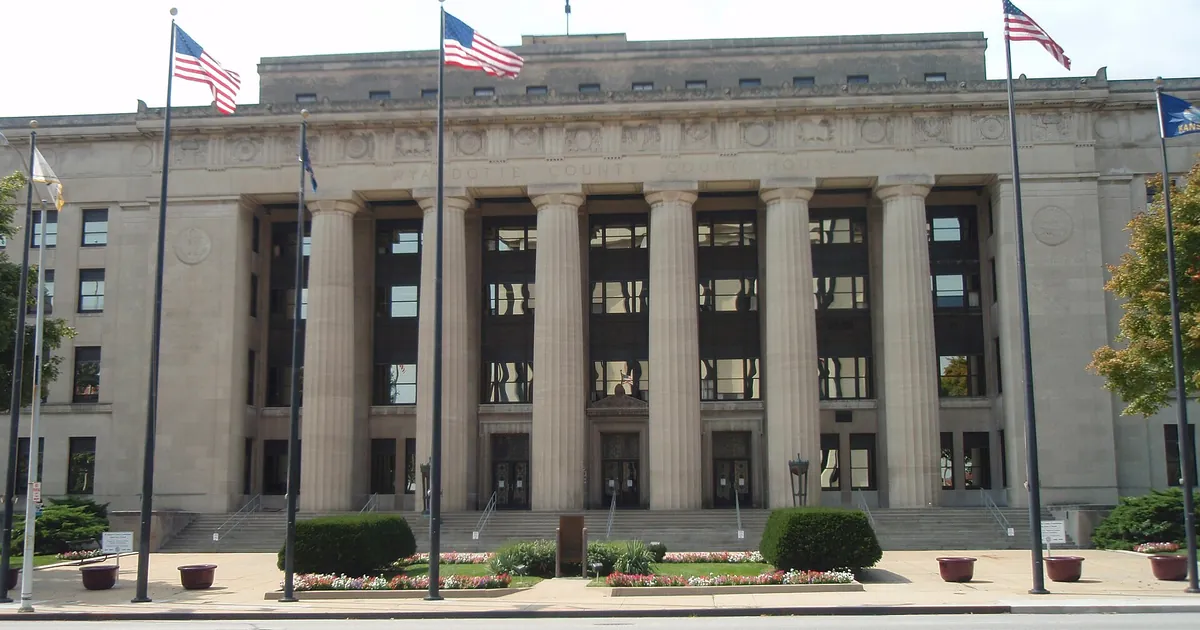
Wyandotte County Courthouse, Kansas City, Kansas. Photo: Ichabod / Wikimedia Commons, CC BY-SA 3.0
5 min read · 936 words
Thirty people. Three weeks. One host city that still had matches left to play.
Kansas City hosted World Cup matches at GEHA Field at Arrowhead Stadium from 16 June through its quarterfinal on 11 July. For a chunk of that run, 15 June to 3 July, immigration agents arrested at least 30 people across the metro, according to a count kept by the KC Community Defense Coalition and reported by KCUR. Enforcement didn’t stop when that count did, either: two more incidents landed in the days immediately after, still inside Kansas City’s hosting window. The tournament didn’t slow enforcement in its own host community. If anything, the numbers suggest it kept pace with a national surge, right through the eve of Kansas City’s own last match.
What actually happened in Kansas City during the World Cup 2026 ICE arrests
Most of the activity concentrated in Wyandotte and Johnson counties on the Kansas side, and in Northeast Kansas City on the Missouri side, three of the metro’s most densely Hispanic and Latino neighborhoods. Wyandotte County is 74.6% Hispanic or Latino by the latest county figures; Johnson County is 29.9%. On 6 July, a resident was arrested at 7:40 a.m. while mowing his lawn, according to KCUR’s reporting; as of 10 July, one day before Kansas City’s quarterfinal, he was still in detention. On 9 July, two days before that quarterfinal, federal agents detained workers, reports put the number between six and eight, at La Fontanella Foods, a food-manufacturing warehouse in Northeast Kansas City. Around the same window, the CoreCivic detention facility in Leavenworth took in roughly 1,000 new intakes over two to three weeks, more capacity pressure than a single metro’s enforcement activity usually produces on its own.
None of this happened in a vacuum. Missouri Highway Patrol has held a 287(g) agreement with ICE, letting state and local officers perform federal immigration enforcement functions, since 2008. The Kansas Bureau of Investigation signed its own 287(g) agreement in February 2025. Nationally, KCUR counted 2,070 active 287(g) memoranda across 39 states as of 2 July, and separate reporting put the same week’s nationwide arrest total at roughly 10,000, part of a White House enforcement target of 2,000 arrests a day. A new Kansas law, HB 2372, took effect 1 July, in the middle of the tournament, expanding officer discretion around arrests and establishing a buffer zone at enforcement scenes; Kansas Attorney General Kris Kobach has been a public advocate for the stricter posture. Kansas City Mayor Quinton Lucas has not announced any coordinated local response tied to the World Cup dates.
Advocates on the ground describe a visible shift. “They really amped up,” Tyra Chantelle of the KC Community Defense Coalition told KCUR, of the enforcement pace in the weeks the world was watching Kansas City for other reasons. Edgar Galicia of the Central Area Betterment Association, whose neighborhood absorbed some of the arrests, put the frustration more bluntly: “Why are we not being appreciated? We’re part of the society. We’re part of the economy.” Immigration attorney Scott Girard, who has represented several of the detained, said the compressed timelines make it worse for families: “Detained cases are even more difficult because you’re looking at a short time period.”
The gap our own June coverage flagged, and what just filled it
This is not a new worry for readers of this site. In June, FootyGazette reported that UNITE HERE’s wave of World Cup 2026 worker strikes was driven partly by fear that FIFA’s mandatory accreditation and background-check regime for stadium and hotel staff would force workers to disclose immigration status, opening a door to ICE data-sharing union leaders couldn’t verify was closed. A few days later, this site’s reporting on the FinCEN financial-surveillance build-out around the tournament showed a parallel federal apparatus, bank reporting requirements tied to an immigration executive order, that risked flagging ordinary travelling fans rather than the trafficking it was framed around.
Both of those pieces were about mechanisms that might catch people connected to the tournament: stadium workers, fans moving money. What happened in Kansas City is different, and in a way that matters more. The 30-plus arrests documented by KCUR mostly weren’t stadium staff or ticket-holders. They were metro residents, warehouse workers, a man mowing his lawn, caught by enforcement infrastructure, the 287(g) partnerships, the new state law, the national arrest quota, that had nothing to do with FIFA credentials or bank reporting rules and everything to do with which host city they happened to live in. The tournament didn’t create this enforcement wave. But it also didn’t pause it, redirect it, or shield the neighborhoods hosting the world’s biggest sporting event from it. FIFA’s host-city agreements cover stadium security, transit and permitting. They say nothing about what happens to a host city’s own residents while the enforcement calendar keeps running underneath the match calendar.
That silence is the story. FIFA has spent 2026 fielding open questions about heat policy, ticket pricing and stadium access. It has never been asked, on the record, whether hosting a World Cup carries any expectation about immigration enforcement in the neighborhoods absorbing the tournament’s low-wage labor. Kansas City’s answer, thirty arrests into its own hosting window, is that no such expectation exists.
What residents can actually do
KC Community Defense Coalition and Entre Nos KC are running know-your-rights sessions and rapid-response hotlines for the Wyandotte and Johnson county communities most affected; Asylum Clinic KC is taking new intake for detained cases. None of that infrastructure existed because of the World Cup, and none of it is going away when the tournament leaves for its next host city on 19 July. For a fuller picture of how Kansas City’s hosting window is playing out beyond the pitch, see FootyGazette’s World Cup 2026 guide.
