
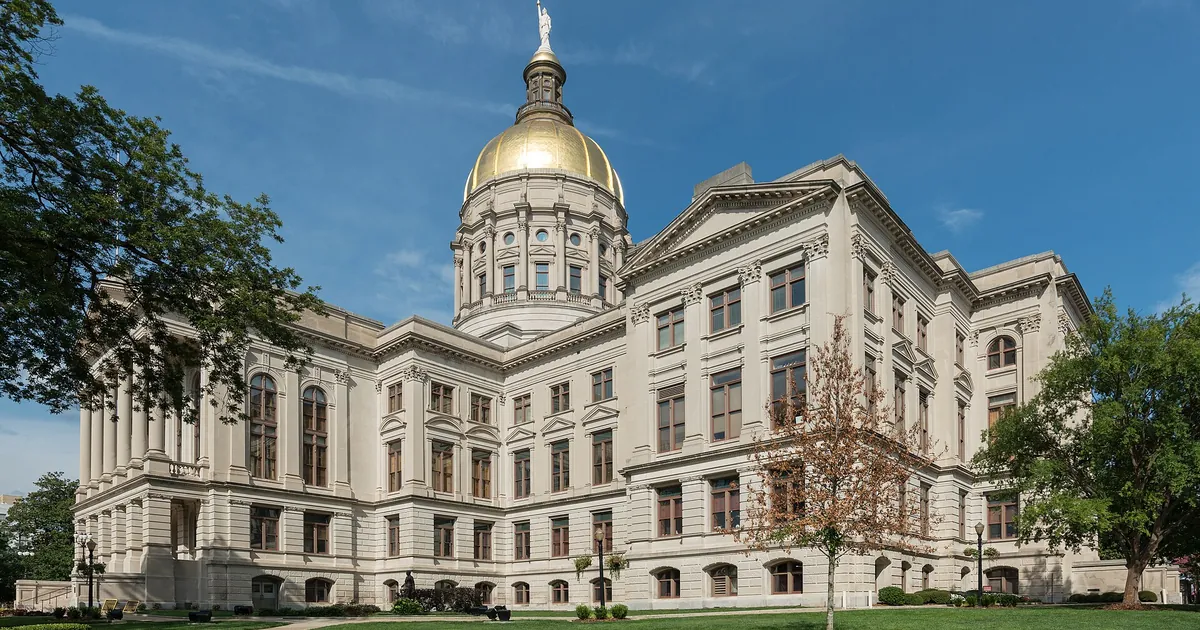
Georgia State Capitol, Atlanta. Photo: DXR / Wikimedia Commons, CC BY-SA 4.0
5 min read · 960 words
Atlanta is trying to do two contradictory things in the same six weeks. Clear its downtown of visible homelessness before the World Cup arrives, gently enough to avoid another death. And do it without triggering a Georgia law, signed weeks before kickoff, that lets property owners sue the city for not cracking down harder. There is no version of Atlanta’s World Cup 2026 homelessness policy that satisfies both pressures at once, and nobody elected is saying so out loud.
The World Cup 2026 Atlanta homeless policy squeeze, explained
Start with the number the city keeps repeating: at least 1,000 people sleeping unsheltered in Atlanta, according to the latest Point-in-Time count cited in Atlanta Civic Circle’s reporting on an April city council work session, with nearly 2,000 more in shelters. Since 2015, the city says it has permanently housed more than 15,000 people through Partners for Home, with a 96% housing-stability rate, and its Atlanta Rising campaign delivered 500 rapid-rehousing units by this spring. Those are real numbers, and they are the ones Mayor Andre Dickens’s office points to when it says Atlanta is choosing housing over arrests.
But the same council session surfaced the tension underneath the talking points. District 4’s Jason Dozier told colleagues “there’s a concern that we are at risk of criminalizing homelessness,” warning that state law creates legal exposure for the city either way. District 2’s Kelsea Bond pressed on whether the city’s own encampment-clearing protocol was being followed, citing a Freedom Park sweep where residents were displaced into a nearby alley rather than housed. Camille Russell of Partners for Home told the council plainly: “We don’t want to see our neighbors criminalized for homelessness.” Play Fair ATL, the advocacy group pushing for an outright moratorium on sweeps and quality-of-life arrests through the tournament, has made the same argument from outside city hall for months.
Dickens has tried to hold both positions publicly. In June 2025, he pledged the city would “make sure those unsheltered individuals don’t come anywhere downtown” before international visitors arrived. He has also said, of anyone who breaks the law during an encampment clearance, “we have measures to deal with that.” Read together, those are two different promises to two different audiences, and the World Cup calendar is forcing Atlanta to keep both at once.
Why this squeeze is legally real, not just political
The pressure toward a harder crackdown isn’t only Dickens’s pledge. On 12 May, Governor Brian Kemp signed HB 295 into law, a bill that passed the Georgia Senate 34-19 and House 93-76, almost entirely along party lines. It lets property owners and renters sue a local government for lost property value or added expenses if that government has a “policy, pattern, or practice” of not enforcing laws against illegal camping, loitering, panhandling or public drug use, the exact quality-of-life offenses Play Fair ATL wants suspended. The Georgia Latino Alliance for Human Rights called it an incentive for harsher enforcement dressed up as accountability. Supporters, including the bill’s backers at the Goldwater Institute, called it exactly that: a mechanism to make cities enforce laws already on the books. Either reading points the same direction, toward more sweeps and more arrests, right as the tournament puts Atlanta’s downtown on television.
The pressure toward restraint is just as concrete, and it has a name: Cornelius Taylor. On 16 January 2025, a Department of Public Works bulldozer crushed his tent during a sweep of an Old Wheat Street encampment in Sweet Auburn, timed ahead of the MLK Day parade. He died at a hospital soon after. His family filed a wrongful-death suit against the city in Fulton County Superior Court that July, reported by Atlanta Civic Circle, alleging no one checked the tent before it was destroyed; his estate filed a second suit that January against the sweep’s supervisors. The city’s response was a 90-day Homelessness Task Force and a new protocol requiring checks of tents before any clearance, the kind of procedural safeguard that slows sweeps down rather than speeding them up. A subsequent clearance of the Bell Street encampment, near Grady Memorial Hospital under the I-85 overpass, was carried out under those tightened rules. Every sweep the city runs between now and the 19 July final happens with an active wrongful-death suit still working through Fulton County court, on a downtown stage this time watched by the world rather than local television.
That is the squeeze national coverage has missed. Sports outlets covering World Cup 2026 have written about ticket prices, transit and stadium bottle bans in half a dozen host cities. None of them have connected a state tort-liability law to an active wrongful-death lawsuit to produce the actual bind Atlanta’s council is debating in public session: a city that gets sued by property owners if it under-enforces, and sued by families if it over-enforces, with the same six-week deadline attached to both risks. FootyGazette’s own reporting on Guadalajara’s pre-tournament “social cleansing” sweeps in June showed a Mexican host city choosing the crackdown side of that trade-off with little legal check on it at all. Atlanta is the mirror case: a host city where the law pulls in both directions simultaneously, and where nobody has publicly admitted that no clean choice exists.
What happens between now and the final
City Council member Bond is reportedly drafting legislation to create a moratorium on clearing homeless camps of people or possessions while a storage-and-notice policy is worked out, an attempt to buy Atlanta room to maneuver between the two legal threats before the 19 July final at MetLife Stadium puts the tournament, and the argument over what Atlanta did with its own downtown to prepare for it, to rest. For more on how Atlanta’s hosting window has unfolded beyond the pitch, see FootyGazette’s World Cup 2026 guide and its earlier look at Atlanta’s transit story for the tournament.
