
7 min read · 1,333 words
Graeme Souness lost a stone in weight during a single World Cup match. One game. Against West Germany at Querétaro in 1986, in stifling heat and at altitude, one of the most physically imposing midfielders of his generation was reduced to crouching on his haunches, struggling to breathe. If the Mexican climate could do that to Souness, it is worth asking, with some seriousness, what the North American summer of 2026 will do to a generation of footballers considerably less battle-hardened than he was.
The 2026 World Cup is spread across three countries, the United States, Canada and Mexico, with venues ranging from sea-level coastal cities to high-altitude inland stadiums, and kick-off times that will, in certain cases, be dictated more by television schedules than by any concern for player welfare. The environmental variables are not a footnote. They are, arguably, the central tactical challenge of the tournament. The Guardian’s newsletter framed it neatly: quick starts, keeping the ball and banking on the bench will separate finalists from early exits.
The Environmental Problem Is Not Uniform
What exactly are teams walking into?
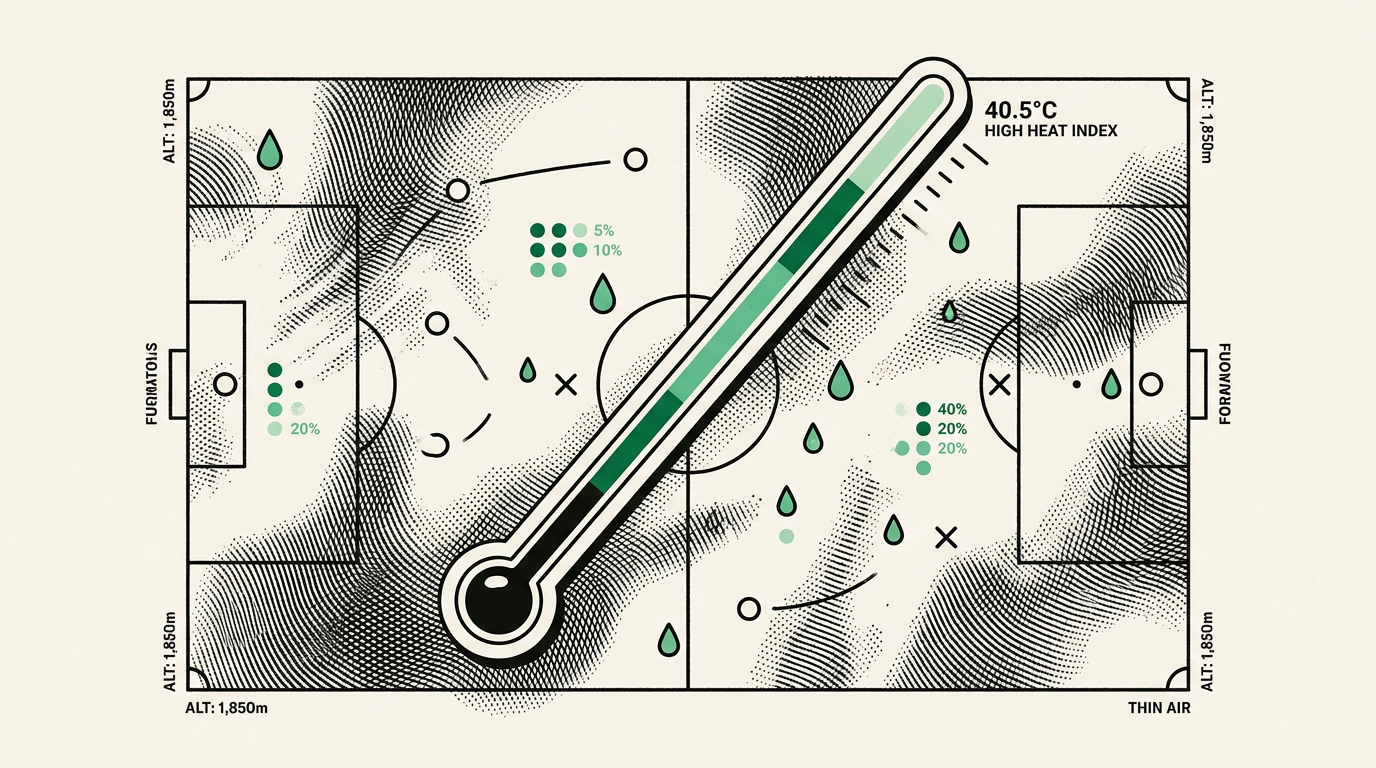
The mistake is to treat the 2026 tournament as a single climatic entity. It is not. A group-stage match in Vancouver is a fundamentally different physiological proposition to one played in Guadalajara or Dallas in June. Wet-bulb globe temperature, the measure that combines heat, humidity and solar radiation, will vary enormously between venues. FIFA’s scheduling decisions will determine how much of a lottery this becomes. In 1986, Souness played at altitude in afternoon heat. In 2026, some group matches are expected to kick off in the early afternoon local time in venues where temperatures routinely exceed 35°C. That is a choice with consequences.
Why altitude compounds everything
Mexico City’s Estadio Azteca sits at roughly 2,240 metres above sea level. At that altitude, oxygen availability drops by approximately 25 per cent compared to sea level, which means aerobic capacity, the engine of any high-press system, is meaningfully compromised from the opening whistle. Teams that rely on sustained intensity, relentless pressing and high defensive lines will find their tactical identity challenged not by an opponent’s shape but by the thin air. Pep Guardiola’s sides, for instance, have historically pressed with extraordinary discipline; as BBC Sport’s Guillem Balague explored in his recent piece on Guardiola the Catalan’s genius lies in controlling every variable, but altitude is one variable no training methodology fully neutralises.
Tactical Adaptations That Will Define the Tournament
The case for keeping the ball
Possession football, for all the criticism it attracts from those who find it aesthetically unadventurous, is a legitimate heat-management strategy. A team that controls the ball forces the opposition to press, to cover ground, to work. The defending side does the running; the attacking side does the thinking. Spain, historically the most accomplished practitioners of this approach at international level, understand this intuitively. Their 2010 World Cup victory in South Africa, another tournament where climate was a factor, was built substantially on the principle that the ball does not get tired. In 2026, that logic applies with even greater force.
Quick starts as a competitive weapon
The Guardian’s analysis highlights the value of scoring early in conditions where energy depletion accelerates as the match progresses. This is not a novel observation, teams have always benefited from leading at half-time, but the heat context makes it more pronounced. A side that goes a goal down in the 10th minute at a humid coastal venue faces a physiologically brutal task: pressing higher, working harder, covering more ground, all while the body’s cooling mechanisms are already under strain. Expected goals models do not currently weight for temperature, which is a gap worth noting. The xG from a chance created in the 89th minute of a 32°C match is not the same as one in the 15th minute of a 22°C one. Conversion rates will be affected.
Squad depth as the decisive factor
The 48-team format means more matches, more recovery challenges, and a longer path to the final. A squad of 26 players is no longer a luxury provision, it is a structural necessity. The teams with genuine quality in positions 12 through 26 will have a meaningful advantage in the knockout rounds, when cumulative fatigue compounds the environmental stress. This is where the Premier League’s depth of talent becomes relevant: The Independent’s 2025-26 season review noted Brentford’s overachievement and Newcastle and Liverpool’s capacity to rotate effectively, precisely the kind of squad intelligence that translates to tournament football.
Which Nations Are Best Equipped?
Brazil and Argentina have the obvious advantage of acclimatisation history. South American football is played in heat and humidity as a matter of routine. Brazilian players, in particular, develop their game in conditions that would constitute a public health advisory in Manchester. Their physiological adaptation is not merely psychological, repeated exposure to heat stress produces genuine cardiovascular and thermoregulatory changes over years of development. This is a structural advantage that no pre-tournament training camp in Florida fully replicates for a European side.
European nations, and England specifically, will rely on meticulous preparation. The FA’s sports science infrastructure has improved considerably since the chaotic preparations of the early 2000s, but the fundamental challenge remains: a player who has spent nine months in the Premier League’s temperate conditions cannot fully simulate what awaits in a Dallas afternoon kick-off. Acclimatisation camps, heat chambers and careful scheduling of pre-tournament friendlies will all matter. So will the draw. A European side fortunate enough to play their group games in Seattle or Toronto faces a categorically different opening fortnight to one assigned to Miami or Monterrey.
The Bench and the Manager
Tournament management in extreme conditions is as much about substitution timing as it is about formation. The five-substitution rule, now standard at major tournaments, was introduced partly in response to player welfare concerns during the pandemic-compressed 2020-21 season. In the heat of North America, it becomes a genuine tactical instrument. A manager who reads the physiological state of his players accurately, who brings on fresh legs at 60 minutes rather than waiting for the obvious signs of exhaustion at 75, will gain a compounding advantage across a knockout tournament. This is where experience at the highest level matters. Managers who have navigated Champions League knockout football, where the margins are similarly fine, tend to read these moments better. The Champions League is, in this sense, the best preparation ground for World Cup management.
There is also the question of tactical flexibility under duress. A team trailing by a goal in the 70th minute of a match played in 34°C heat cannot simply press as they would in October at Anfield. The manager who has pre-planned for this scenario, who has a genuine Plan B that does not simply demand more of already-depleted legs, will have an edge. England’s recent tournament history suggests this kind of in-game adaptability remains a work in progress. That is not hyperbole. It is the record.
What to Watch For
The 2026 World Cup will produce its share of upsets, and a meaningful proportion of them will be attributable not to tactical genius but to environmental mismanagement. A fancied European side, jet-lagged and under-acclimatised, losing a group game to a South American or CONCACAF nation that has prepared more intelligently for the conditions, this is not a far-fetched scenario. It is, historically, a fairly reliable one. Mexico 1986 produced exactly this kind of disruption. The heat does not care about FIFA rankings.
For a fuller breakdown of the tournament’s structure and what the expanded format means for qualification and progression, the 48-team format guide is worth your time. And if you are planning to follow the matches from home, the how-to-watch guide for 2026 covers your broadcast options. For streaming, FootyGazette’s watch page has the relevant details.
The teams that win the 2026 World Cup will be the ones that treat the environment as a tactical variable from day one of preparation. The ones that lose early will be the ones that assumed fitness and quality would be sufficient. Souness had both. The heat did not care.
