
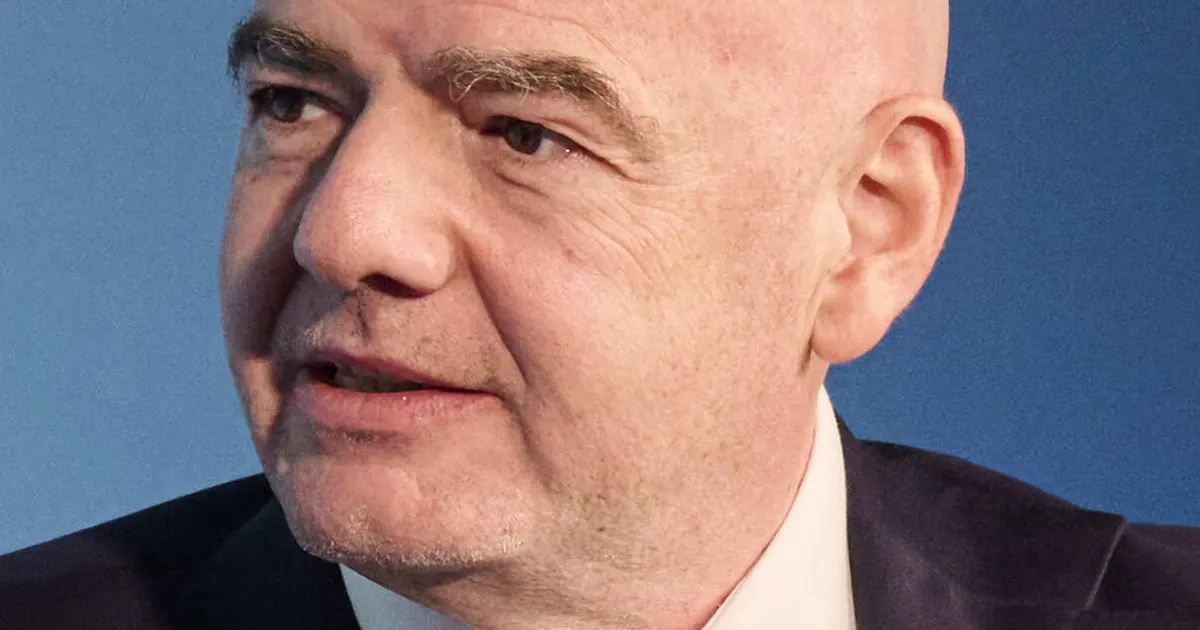
Gianni Infantino, FIFA President. Photo: World Trade Organization / Wikimedia Commons, CC BY-SA 2.0
5 min read · 970 words
Gianni Infantino has spent five weeks insisting FIFA is politically neutral. On July 9, a human rights group announced it is taking that claim to the International Olympic Committee, a body FIFA doesn’t control.
FairSquare’s complaint didn’t start this month. The rights group first filed it with FIFA’s own Ethics Committee back in December 2025, days after Infantino handed Trump a newly invented FIFA Peace Prize at the World Cup draw, arguing the prize and Infantino’s public praise for Trump’s policies already breached FIFA’s neutrality rules. That complaint sat for seven months. What changed on July 9 was the addition of a second, sharper example, and the decision to stop waiting on FIFA and escalate to the IOC instead. On July 4, Trump told reporters he had personally asked Infantino to review a red card shown to USMNT forward Folarin Balogun for a studs-up challenge on Bosnia-Herzegovina’s Tarik Muharemovic. FIFA reversed the automatic one-match ban within a day, citing Article 27 disciplinary review powers, and Balogun started against Belgium three days later. The Belgian federation appealed on different grounds, Article 66.4, which makes a one-match ban automatic once a red card is shown, and the appeal was denied. USA lost 4-1 to Belgium anyway, in Seattle. UEFA called the reversal a decision that put “the integrity of the game at stake.” Fifty members of the European Parliament wrote to FIFA’s own ethics committee backing a formal complaint. Norway’s football federation joined them within days.
None of that produced consequences, because FIFA’s ethics committee answers to FIFA. FairSquare’s move is different. It goes over Infantino’s head to the IOC, where he has sat as a member since 2020 and where a separate body, one FIFA cannot staff, fund or dismiss, has jurisdiction over him personally. The complaint alleges a breach of Article 15 of the FIFA Code of Ethics, the neutrality clause, and asks the IOC to also examine whether the tournament’s new Peace Prize, awarded to Trump at the World Cup draw in December, was authorized by the FIFA Council or invented unilaterally by Infantino himself. IOC president Kirsty Coventry says no complaint has landed yet, but confirmed the IOC would examine one once it’s filed. The maximum penalty on the books is a fine starting at 10,000 Swiss francs and up to a two-year ban from any football-related activity.
FIFA’s political neutrality problem, mapped
Al Jazeera, PBS, Sky Sports and CNBC have all covered the Balogun reversal and the IOC complaint thoroughly, and it is a genuine story on its own terms: the clearest documented case yet of a sitting head of state altering an in-tournament FIFA disciplinary outcome by phone. But treated in isolation, as every outlet above has treated it, this reads as one bad week for Infantino. Read against five weeks of this tournament’s own record, it is the fourth confirmed neutrality failure of World Cup 2026, and the first one that isn’t passive.
The first three were absorption, not action. Iran’s federation filed a formal complaint on June 19 after visa rejections and a ticket-allocation cut hit its delegation, a problem created entirely by ordinary U.S. immigration enforcement that FIFA’s neutrality pledge turned out to have zero power over, because host-country sovereignty sits above FIFA’s own statutes inside the hosting agreement itself. On June 30, Homeland Security Secretary Markwayne Mullin celebrated Iran’s elimination on camera at an official security briefing, and FIFA issued no response of any kind. Weeks earlier, FIFA’s own ethics machinery proved it had no mechanism at all for a national team captain like Achraf Hakimi facing a rape trial mid-tournament, because the Code of Ethics governs administrators, not players. In each case FIFA’s failure was structural: a gap the organization couldn’t close even if it wanted to.
Balogun breaks that pattern entirely. Nobody forced Infantino’s hand this time. A foreign head of state called him about one specific disciplinary ruling involving that government’s own team, mid-tournament, and the ruling changed within roughly 24 hours, using a review clause written for genuine officiating errors rather than head-of-state phone calls. Where Iran and Hakimi exposed what FIFA’s rulebook doesn’t cover, Balogun shows what happens the first time someone actually tests whether the rules that do exist will hold under direct pressure from a government FIFA needs. They didn’t hold.
That’s exactly why the IOC route matters more than the FIFA Ethics Committee complaint that has already gone nowhere. FIFA investigating a decision FIFA’s own president personally made is a closed loop, the same closed loop that let the Hakimi gap sit unaddressed all tournament and let the Mullin briefing pass without a statement. The IOC has genuine leverage here that FIFA’s internal process doesn’t: Infantino’s Olympic membership is a personal credential the IOC can suspend on its own authority, independent of anything FIFA’s Council decides to do about its own president. It’s a mechanism built for exactly this failure mode, and it exists in this story only because FairSquare and fifty MEPs went looking for a door that FIFA itself doesn’t own the key to.
What happens next
Coventry’s statement leaves the timeline open; the IOC won’t move until a complaint is formally filed, and FairSquare hasn’t confirmed a filing date. If it lands before the July 19 final at MetLife Stadium, it will do so inside the same tournament window where Iran’s complaint, the Hakimi trial and the Mullin briefing all still sit unresolved, three separate tests FIFA has already failed to answer on its own. Whether an outside body with actual teeth changes that calculus, rather than one more red card getting reversed and forgotten, is now the real story here. It is bigger than Balogun, and this tournament’s neutrality pledge was already failing before Trump ever picked up the phone.
Further reading: FootyGazette’s full World Cup 2026 guide, our coverage of Iran’s FIFA charter complaint, and the DHS Secretary’s “happy dance” after Iran’s exit.
