
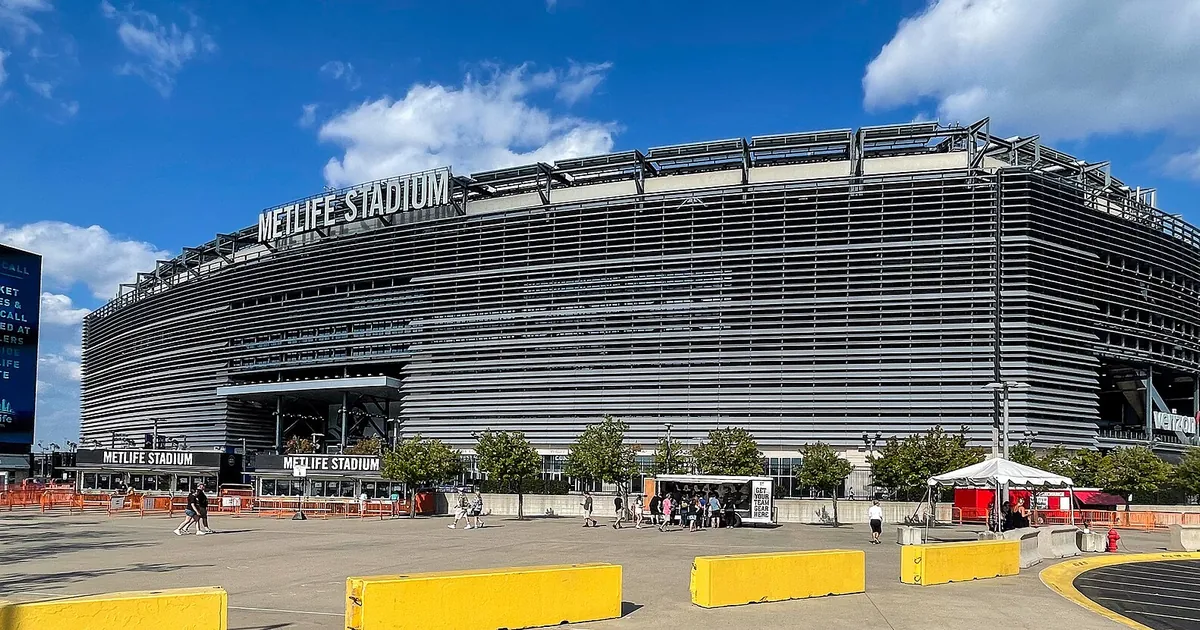
MetLife Stadium, host of the World Cup final. Photo: Kenneth C. Zirkel / Wikimedia Commons, CC BY-SA 4.0
7 min read · 1,536 words
New Jersey committed more than $307 million in taxpayer money to get ready for the World Cup, covering a loan to the host committee and a list of FIFA-required changes to MetLife Stadium and the infrastructure around it. Now FIFA’s retail arm is cutting up the actual World Cup final pitch, sourced from Sunday’s Argentina-Spain match at MetLife Stadium, and selling the pieces for up to $11.2 million total. New Jersey isn’t getting a share of that money, and according to Governor Mikie Sherrill’s office, that isn’t sitting well in Trenton.
“New Jersey paid for the vast majority of the total expense for the pitch at MetLife Stadium, so New Jersey taxpayers should share in any proceeds from this latest money grab,” Sean Higgins, a spokesperson for Sherrill, told Politico this week, in the first on-the-record New Jersey pushback on FIFA’s grass-patch program.
What FIFA Is Actually Selling
The pitch memorabilia comes in four branded tiers: the Foundation Edition, Stadium Edition, Legacy Edition and Hero Edition. Foundation is a 2.5-inch cube of turf encased in acrylic for $450. Stadium and Legacy run $900 and $1,200 respectively, and FIFA hasn’t clearly explained what separates them beyond the price tag. Hero, the top tier at $3,000, bundles a 3-inch cube with a gold-etched metal souvenir ticket, a mini replica of the World Cup final ball and a crystal-cut glass trophy replica. If every piece sells, Fast Company’s estimate puts total revenue at $11.2 million. None of it is earmarked for New Jersey, and FIFA has not publicly responded to Sherrill’s office as of this writing.
The $307 million figure covers more than sod. New Jersey’s spending included a loan to the New York New Jersey host committee and stadium and infrastructure upgrades FIFA required as a condition of hosting, on top of more than $100 million spent separately on a temporary bus terminal to move fans between Secaucus Junction and the stadium. The grass itself is a smaller, unspecified line item inside that broader number, but Higgins’ claim is specific: New Jersey, not FIFA, paid for most of what’s now being sold back to fans in pieces. No state agency has published an itemized figure for the pitch alone, which means neither Trenton nor FIFA has put a number on the table that the public can check against the $11.2 million FIFA stands to collect.
Toronto Already Found the Actual Playbook, and New Jersey Can’t Use It
New Jersey isn’t the first host government to look at FIFA’s revenue and ask for a piece of it, but the mechanism that’s actually worked elsewhere doesn’t apply here. Toronto’s city government bought more than 3,500 general-admission tickets to matches at BMO Field, plus additional hospitality packages, and resold them as what the mayor’s office called “one of several avenues pursued by the City to avoid spending property tax dollars” on the tournament. By late June, the city said fewer than 70 of those tickets remained unsold. It worked because Toronto controlled an actual, ownable asset, a block of tickets it was entitled to buy as host, and turned it into a revenue stream on its own terms.
New Jersey has no equivalent lever over turf memorabilia, because the grass was never New Jersey’s to sell. The state paid for infrastructure and improvements under a host-city agreement, but ownership of what happens to the field itself, including the right to dig it up and market it as merchandise, sits with FIFA. That total commercial control isn’t limited to the grass. FIFA’s clean-venue policy stripped the MetLife name from official tournament branding for the final, with FIFA’s own materials referring to the venue as “New York New Jersey Stadium” even though the stadium’s actual owners, the naming-rights sponsor and most of the local press still call it MetLife. New Jersey didn’t get a say in that rebrand either. It’s the same underlying arrangement playing out twice: FIFA’s host-city agreements hand it near-total authority over what happens inside the stadium footprint during the tournament window, from what the building is called to what gets cut out of its field afterward, while the host government’s role is limited to paying for the upgrades that make the building usable in the first place.
The grass sale is also proving to be a genuine commercial hit, which sharpens the fairness argument rather than softening it. FIFA’s entry-level Foundation Edition sold out within days, according to reporting from NBC News and Al Jazeera, and each patch ships with a USB drive containing an authenticity film, on top of the acrylic case. The sales come against the backdrop of final tickets priced as high as $32,970 for general seating and above $34,000 for hospitality packages, numbers that have already drawn social media accusations that FIFA has turned “profiteering” into the defining theme of the tournament’s closing week. None of that public reaction changes New Jersey’s legal position, but it does mean Sherrill’s office is raising its complaint at the exact moment FIFA’s pitch-and-ticket pricing strategy is already under public scrutiny for reasons that have nothing to do with the state’s specific ask.
New Jersey’s own transit agency ran into a version of the same asymmetry earlier this tournament, absorbing the cost of running near-empty matchday trains at $98 a fare while FIFA contributed nothing toward transit. Houston’s city government hit it from a different angle, discovering that FIFA’s fan-festival mandate comes with no revenue share attached at all, just an obligation to foot roughly $1 million a day for a free event FIFA still keeps all the ticketing, media and sponsorship revenue from. Three different cities, three different assets, and in each case FIFA ends up holding the one that actually generates money.
The Pattern Is About Timing, Not Just Money
What connects these fights is the point at which they happen: after the public money is already spent and the infrastructure is already built. Host-city agreements assign FIFA close to total control over stadium-based commercial rights during the tournament window, a standard clause set years earlier at the bidding stage, long before any state government has run the actual numbers on what hosting will cost its taxpayers. Toronto only found its workaround because tickets happened to be an asset the host-city agreement let it buy and control outright. Nothing in New Jersey’s agreement gives it a comparable claim over the pitch, the merchandising rights, or anything else FIFA decides to monetize after the final whistle. By the time officials like Higgins are pushing back in public, the leverage is already gone. FIFA doesn’t need to negotiate turf revenue with New Jersey because the contract that would have required it was never written that way in the first place.
A Request With No Contractual Teeth
There’s no indication New Jersey has any legal claim here beyond a public request. Unlike Toronto’s ticket-resale scheme, which worked within the terms of an agreement the city actually controlled, host-city infrastructure agreements typically don’t include revenue-sharing provisions over game-day merchandise, because “merchandise” wasn’t the category anyone was negotiating when a $450 patch of dirt turned into a marketable product. Sherrill’s office is making a fairness argument, not a contractual one, and fairness arguments made after a stadium is already built tend to generate headlines rather than checks.
That’s also the honest limitation in this story: as of publication, nobody has reported a mechanism by which New Jersey could actually force FIFA to share the proceeds, only a public ask that FIFA has so far ignored. If the state wants precedent instead of a press quote, the more useful comparison is Toronto’s approach of controlling an asset outright before the tournament starts, not a request for a cut of a product line that didn’t exist until FIFA invented it a week before the final. Whether Trenton pushes this into an actual negotiation, or lets it fade the way most post-tournament fairness complaints do once the cameras leave, is the open question nobody in Sherrill’s office has answered yet. There’s also a practical clock on this: FIFA is reportedly moving fast on fulfillment, and by the time any negotiation could happen, the physical grass may already be sold, shipped and out of New Jersey’s jurisdiction entirely.
None of that means Sherrill’s office is wrong on the merits. New Jersey really did carry most of the direct cost of putting a playable World Cup surface at MetLife, and it’s a fair question why the state that paid the bill has no contractual right to any of what gets made from cutting that surface into souvenirs. It’s just that being right on the merits and having a way to enforce it are two different things. Toronto, and Vancouver with a similar buy-and-resell play on its own ticket allotment, are the only host governments that have actually converted a fairness argument into real dollars this year, and both did it by controlling an asset before the tournament started, not by asking FIFA for a cut after the fact.
The final itself kicks off Sunday at MetLife. Whatever’s left of the pitch afterward belongs, for now, entirely to FIFA, and New Jersey’s best leverage over that outcome expired the day it signed a host-city agreement that never mentioned turf.
For the full run of FootyGazette’s World Cup 2026 host-city money coverage, see our World Cup 2026 hub.
