
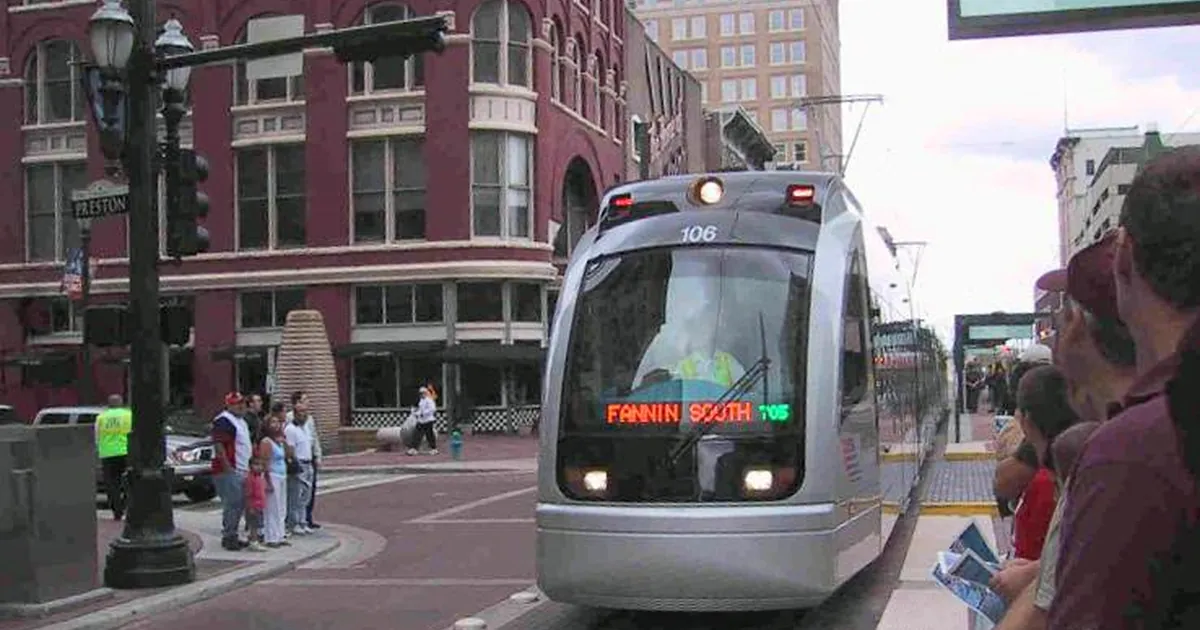
Houston METRORail Red Line train. Photo: WhisperToMe at en.wikipedia / Later version(s) were uploaded by SCEhardt, Mulad at en.wikipedia. / Wikimedia Commons, Public domain
6 min read · 1,218 words
Houston’s newest city council member wants something most World Cup host cities never ask for: to keep the extra trains running after FIFA leaves town. The question of the World Cup 2026 transit legacy, whether any of the extra buses and rail hours cities added for the tournament survive it, has a real answer in Houston already taking shape. METRO has run its Red Line every six minutes through the tournament, kept buses moving past 2 a.m. on match nights, and stretched the Green and Purple lines to 12-minute headways. Transit advocacy group LINK Houston is now pushing to make that service permanent, and Metro’s own board chair says the agency is genuinely weighing it, not just brushing the request aside.
Three weeks earlier and 700 miles north, Kansas City reached the opposite conclusion before a ball was even kicked. The city leased 225 buses for a summer-only shuttle network to Arrowhead Stadium, then quietly confirmed it will cut roughly a quarter of its regular bus routes once the World Cup 2026 transit legacy question answers itself the hard way: the temporary system goes away, and so does some of what was there before it.
Same tournament, same federal funding pot, two cities heading in opposite directions. That split is the real story here, and it says more about how the 2026 World Cup will actually change American cities than any single ridership number does.
The $100 Million That Arrived Too Late to Matter Much
According to a detailed comparative review by the Eno Center for Transportation, the Federal Transit Administration distributed $100 million in World Cup transit support across eleven host metro areas through the Consolidated Appropriations Act of 2026. The catch: the money landed in March, five months before kickoff, which the report calls too late to fund anything beyond service tweaks and short-term leases. Houston’s share was $9 million, confirmed in local reporting back in March by Houston Public Media.
There’s a second detail buried in the Eno report that explains why every host city has been improvising: American host cities received zero financial support from FIFA itself for transit. The federation collects roughly $7 billion in ticket revenue and an estimated $10 billion in total tournament income, by figures FootyGazette reported in its host-city economics review, and none of it is earmarked for getting fans to and from the stadium once they leave the ticketed perimeter. Every rail extension, every extra bus, every all-night train is a state or local budget decision, funded out of farebox revenue and whatever federal scraps arrive in time.
Why the World Cup 2026 Transit Legacy Splits Houston and Kansas City
The Eno Center’s analysis lands on three factors that predict whether a host city’s World Cup transit investment survives the tournament: how much lead time the city had, whether the stadium sits somewhere people already go, and whether there’s a funding plan for after the cameras leave. Houston and Kansas City sit on opposite sides of all three.
NRG Stadium isn’t downtown, but it’s inside Houston’s existing METRORail Red Line corridor, a fixed piece of infrastructure the city was always going to keep running because commuters use it every day regardless of football. FootyGazette covered this in detail in our NRG Stadium transit breakdown: Houston’s problem was never the rail line itself, it was that a 600-square-mile, car-built metro can’t be reached by one corridor. Extending hours on a line that already runs 365 days a year is a genuinely marginal cost. That’s why Metro can plausibly weigh permanence: the hard infrastructure was already sunk.
Kansas City never had that option. Arrowhead Stadium sits seven miles from downtown with no rail connection at all, so the ConnectKC26 network was built from scratch this summer using leased vehicles that were never going to belong to the city’s regular fleet. As FootyGazette reported when the system launched, the arrangement was struck to disappear after July 13, and the routes lost to fund it don’t come back with it. There was no existing spine to extend, only a temporary patch stretched over a gap that reopens the moment the patch is removed.
Seattle and Atlanta Show What “Permanent” Actually Looks Like
The cities that got a genuine, no-debate legacy out of this tournament didn’t get there by advocacy pressure after the fact. Sound Transit accelerated completion of its Crosslake Connection light rail bridge, which opened March 28 and carries the 2 Line across Lake Washington on what the agency says is the world’s first electric rail line to cross a floating bridge, specifically to beat the World Cup deadline. The Eno Center review credits that hard deadline with turning a long-delayed project into a permanent piece of Seattle’s rail network years ahead of its original schedule. FootyGazette’s own reporting on Seattle’s car-free match-day zone found the same pattern: the city’s advantage wasn’t a World Cup gift, it was existing rail infrastructure the tournament simply forced into an earlier finish date.
Atlanta did something similar with its NextGen Bus Network, launched in April with dedicated lanes and level boarding that will carry commuters long after the trophy is handed out, a point that lines up with what FootyGazette found reporting on MARTA’s rail-to-the-door access at Mercedes-Benz Stadium. Both cities used the tournament as a hard deadline to finish projects that were already funded and already planned. Houston is trying to do the reverse: turn a temporary schedule bump into a funded plan after the fact, with no accelerated project sitting behind it.
The Catch Nobody’s Saying Out Loud
Here’s the honest limitation in Houston’s push, and Metro isn’t hiding it. Spokesperson Kaila Contreras-Aradillas told Axios Houston the agency is still “assessing operational and budget considerations” and that it’s “too early to speculate on potential service changes or associated costs.” That’s not stonewalling, it’s the real constraint: extended service costs money every single day, and the $9 million federal grant that paid for six weeks of it doesn’t renew itself. The Eno Center’s own conclusion is blunt about this pattern nationally: operating a stadium’s transit service outside major events “can prove less financially sustainable” once the one-time funding dries up, especially for stadiums that aren’t downtown.
That doesn’t make LINK Houston’s ask naive. Ridership data from the tournament itself is the strongest argument the group has, and Metro’s board has committed to reviewing it rather than dismissing the idea outright. But wanting a legacy and funding one are different problems, and Houston is the only host city this month publicly wrestling with the gap between them in real time.
What to Watch
Metro hasn’t set a timeline for its decision, and Houston’s push will likely play out over budget cycles long after the final whistle. Kansas City’s route cuts, by contrast, are already scheduled. The two cities make a useful control pair for anyone trying to judge whether the World Cup 2026 transit legacy claims host cities are making now will still be true in 2027: one city extended existing rail and is asking to keep the extension, the other built a shuttle system with an expiration date stapled to it from day one. Only one of those setups was ever going to outlive the tournament, and the difference has nothing to do with which city wanted it more.
This piece is part of FootyGazette’s ongoing World Cup 2026 host-city coverage. See the full World Cup 2026 guide for match schedules and venue-by-venue logistics.
