
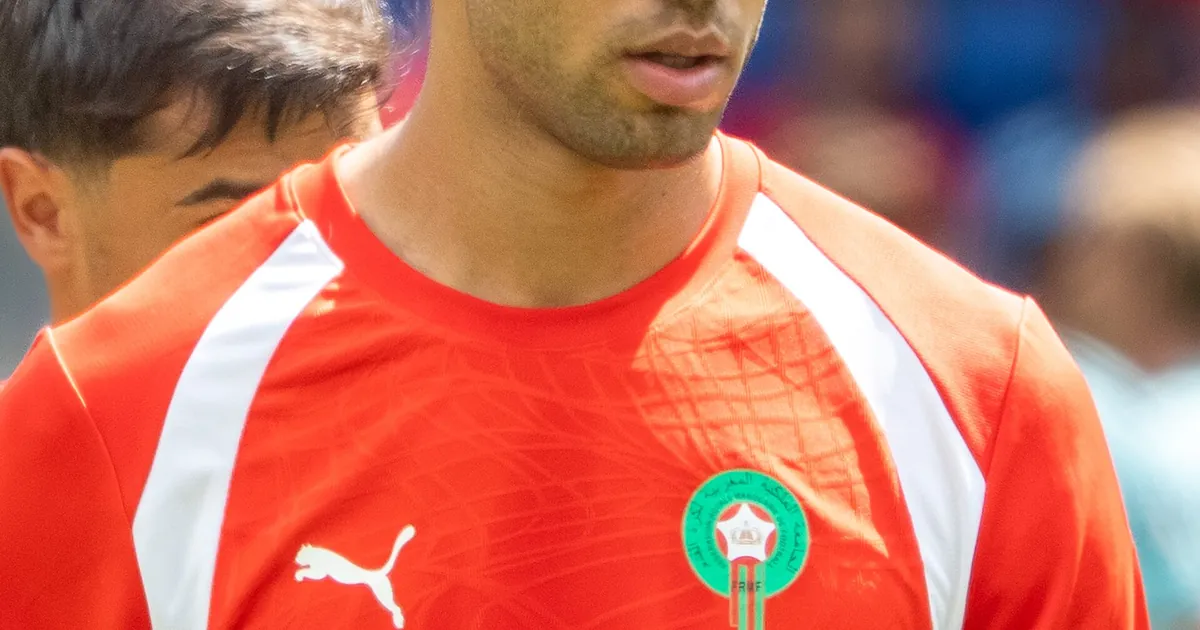
Achraf Hakimi in action for Morocco, June 2026. (Wikimedia Commons). Photo: Bryan Berlin / Wikimedia Commons, CC BY-SA 4.0
6 min read · 1,158 words
On Monday, Achraf Hakimi will captain Morocco in the World Cup Round of 32 against the Netherlands in Guadalupe, Mexico. He is his country’s best player. He is also confirmed, since June 19, to stand trial for rape in a French criminal court.
FIFA has said nothing. Morocco’s coach backs him. Sections of the crowd in Foxborough booed every time he touched the ball on the day the Versailles ruling came down, with ESPN’s match report noting the hostile reaction when Morocco’s lineup was announced.
The silence from football’s governing body isn’t spin, and it isn’t evasion. It is an accurate answer to a question the FIFA Code of Ethics was never built to answer — and understanding why reveals a structural gap at the heart of football’s player conduct rules during major tournaments.
The Legal Position
The Versailles appeals court confirmed on June 19 that Hakimi will face trial at the criminal court of Hauts-de-Seine. The case stems from a January 2023 complaint by a 24-year-old woman who told French police she was sexually assaulted by Hakimi at his home in Boulogne-Billancourt after they connected on Instagram. Investigative judges formally ordered the case to proceed in February 2026; Hakimi’s legal team appealed, and the Versailles court dismissed that appeal definitively.
No trial date has been set. Hakimi denies the allegations. In a statement released after the ruling, he said: “The court looked me in the eye and said, if you weren’t famous, there would never have been a case.” He has not been convicted of anything.
Morocco beat Scotland 1-0 on the same day the ruling landed. Coach Mohamed Ouahbi was direct in backing his captain: “We don’t have to say anything. We’re behind him. He’s very relaxed, and hopefully he’s going to show he’s the best wingback in the world.”
What FIFA’s Rules Actually Cover
FIFA’s Ethics Committee opened 156 investigations in 2024-25, according to the body’s published annual disciplinary and ethics report. Browse the committee’s published list of sanctioned individuals and you’ll find federation presidents, agents, match officials, and former FIFA executives. You will not find a national team player sanctioned for off-field criminal conduct.
That is not an accident.
The FIFA Code of Ethics is designed primarily to govern administrators: those who run the game, manage its finances, and make decisions about hosting, contracts, and regulatory appointments. The Ethics Committee investigates infringements of those rules. Its authority over what happens inside stadiums and within football’s commercial ecosystem is extensive. Its authority over what a player does at home on a January evening in 2023 is close to zero.
For players, FIFA’s disciplinary reach runs to conduct within football: on-field behaviour, doping, age falsification, match-fixing, bribery. The FIFA Disciplinary Code covers the business of playing football. It does not create a framework for what governing bodies should do when a national team captain faces a serious criminal trial in a member association’s domestic court system.
The Architecture Behind the Silence
When an off-field criminal allegation involves a player rather than an administrator, the responsible parties are the criminal justice system, the player’s club under contractual terms, and the national federation under selection discretion. FIFA sits at none of these points.
PSG did not suspend Hakimi. They’re entitled to make that call. Morocco selected and captained him. They’re entitled to make that call too. What neither of them has access to is a shared standard — a framework that defines what clubs and federations owe when a player faces criminal proceedings above a certain threshold.
That gap is visible in contrast to North American sports. The NFL’s personal conduct policy grants the commissioner authority to suspend players during live investigations, before any conviction. The NBA’s constitution authorises action for “conduct prejudicial or detrimental to the association.” Football’s governance model has no equivalent, because players are employed by clubs, not by FIFA or UEFA. Building a personal conduct policy that applies to national team selection would require FIFA to make substantive judgements about criminal proceedings across 211 jurisdictions, under different legal standards, in dozens of languages.
The political and legal difficulty isn’t an excuse for the gap’s continued existence, but it does explain why it’s been there quietly for decades and why no reform wave has touched it. The post-2015 ethics overhaul that followed FIFA’s corruption crisis was aimed at the people who ran football. Nobody thought to extend it to the people who played it.
What Discretion Actually Looks Like
The practical consequence of the governance gap is that nothing regulates how consistently national federations behave in situations like this. Ouahbi’s decision to stand behind Hakimi is his alone to make. Had another coach, in another federation, made the opposite call for the same reason, there would be no mechanism to compare, challenge, or even register that two players in identical legal circumstances were treated differently.
That isn’t a criticism of the choice Morocco made. It’s a description of what FIFA’s silence actually means: not neutrality but unmanaged discretion. The parallel is instructive: when Iraq’s Aymen Hussein was detained for seven hours at O’Hare despite holding a valid FIFA-approved exemption, the lesson was the same. A FIFA document doesn’t override national sovereign authority, and FIFA has no enforcement mechanism when that authority acts arbitrarily. The Hakimi situation is a parallel from the opposite direction: FIFA’s documents don’t constrain national federation authority either, even when the conduct in question involves a serious criminal allegation.
The Forward Problem
FIFA is preparing for 2030, co-hosted by Morocco, Spain, and Portugal. The 2034 edition goes to Saudi Arabia. Both tournaments will bring players from legal systems with different protections, different criminal procedures, and different standards for what constitutes sufficient grounds to act.
Morocco’s candidacy for 2030 runs partly on the legacy of Qatar 2022, when the Atlas Lions became the first African side to reach a World Cup semifinal. Hakimi was central to that run. He’s central to this one. Whether FIFA uses the 2026 tournament to start thinking about a consistent player conduct standard is a separate question from whether Morocco should have picked him. But the case makes it harder to avoid the institutional problem: the world’s most-watched sporting event has governance machinery built for its administrators and almost nothing designed for the people on the pitch.
The Honest Answer
FIFA’s silence on Hakimi is the honest answer to a question the rules don’t give it authority to answer.
The harder question is whether they should have that authority. Football has spent a decade rebuilding its institutional integrity frameworks after the corruption crisis, adding ethics committee oversight and transparency requirements for the people who run it. For the players, the framework is still mostly the pitch and the penalty box.
What happens off it — and how football’s governing bodies respond — is still largely a matter of who’s making the selection that week.
For full 2026 World Cup coverage, see our complete fan and travel guide. For more on the governance and security landscape surrounding the tournament, see our piece on host-city security and surveillance.
