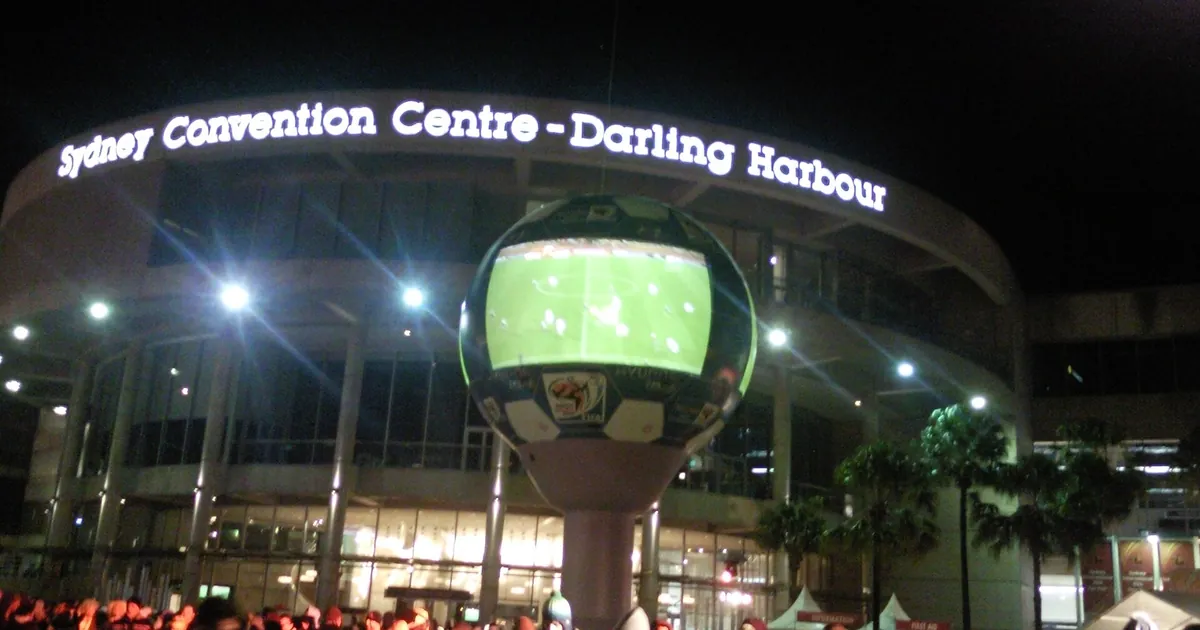
A FIFA Fan Festival crowd; host cities have split on how much of one to fund. Photo: Nath1991 at English Wikipedia / Wikimedia Commons, Public domain
5 min read · 1,054 words
Houston is running a free World Cup 2026 fan festival for 39 days, a 275,000 square-foot build in East Downtown that its host committee expects to draw more than half a million visitors across 34 match days, and which local outlets have reported reaching capacity and pausing entry on busy nights. That makes Houston the outlier. Across the rest of the host map, the World Cup 2026 fan festival has been quietly cut, shortened, scattered or, in one telling case, put behind a paywall. The gap between those two outcomes is not about civic generosity. It is about who got handed the bill.
The mandate without the money
Start with the structure, because it explains everything downstream. FIFA requires host cities to stage a fan festival. FIFA does not meaningfully pay for it. Front Office Sports put the running cost at roughly $1 million per city per day, and the host cities absorb the security and infrastructure spend while having no access to the revenue streams the tournament generates: no ticketing, no media rights, no sponsorship pool. The party is mandatory. The income from it flows the other way.
That is the shape of the whole story. A fan festival is an unfunded mandate dressed as a gift. The city stages a month-long free event, eats the cost, and the commercial upside is collected elsewhere. When money is tight, an unfunded mandate is the first thing a budget committee reaches for, and that is exactly what has happened.
How the others cut
The retreat has been steady and, in places, blunt. New York and New Jersey cancelled the central fan fest at Liberty State Park. A Jersey City spokesperson framed it plainly, saying it had become clear there was “no workable, cost-effective way to manage the influx.” New Jersey’s governor committed $5 million toward scattered alternatives, street fairs and smaller zones rather than one signature site. Seattle took a planned 500,000-fan event and broke it down into smaller venues. Boston trimmed its fan fest to 16 days, less than half the tournament, with planning stalled while it waited on state funding, and Foxborough officials reportedly demanded a $7.8 million security-cost commitment before granting an entertainment license.
Then there is the detail that tells you where this is heading. In the New York market, by the same Front Office Sports reporting, some abridged events became the first organizers to charge admission, around $10 a head. A fan festival is, by its own branding, the free public face of the World Cup, the part that is supposed to belong to people who will never afford a ticket. The moment one appears with a turnstile and a price, the category has changed. The free celebration is becoming a paid one, and the paywall is as clear a signal as any that some cities have run out of room to absorb the cost.
Why Houston could say yes
So why is Houston different? Not because it cares more. Because it could carry the bet, and chose to treat the festival as an investment rather than a cost line.
Houston’s host operation leaned on a committee-and-sponsorship model and a city tourism strategy that reads the 39 days as a marketing spend with a return, exposure, hotel nights, restaurant traffic, a global broadcast backdrop, rather than a charitable obligation to be minimized. That is a defensible bet, and the reported capacity nights suggest the demand was real. It is also a bet only some cities are positioned to make. A privately backed host committee can commit to scale in a way a tax-funded line item, scrutinized by a council facing the same $1-million-a-day math, cannot.
The honest caveat is that the return is unproven. Our own reporting has been skeptical of host-city economics, and the evidence that these events generate net new spending rather than simply shifting local money around is thin, as we set out in detail when we explained why the economic boom is largely a wash for host cities. Houston may be making a smarter bet than the cities that cut, or it may simply be making a more expensive one with the same uncertain payoff. The difference is that Houston had the balance sheet and the appetite to find out.
The federal money is not for the party
It is tempting to ask why the festivals are starving when Washington has poured money into the World Cup. The answer is that the federal money is pointed somewhere else entirely. FEMA has awarded hundreds of millions of dollars to host jurisdictions, and a separate counter-drone grant program adds hundreds of millions more, but those dollars are security dollars: policing, perimeters, screening, airspace. They backfill the cost of protecting the event. None of it is there to keep a fan zone free.
That creates a quiet displacement. The security bill is the one part of hosting that has been partly socialized onto the federal taxpayer. The celebration bill has not. So as security spending gets federal cover, the discretionary, fan-facing spend, the festival, the free zone, the thing ordinary supporters actually touch, is left fully exposed on the city ledger and becomes the easiest thing to cut. The public investment in the World Cup is real. It just isn’t aimed at the public’s experience of it.
What it means for fans
For supporters planning around the tournament, the practical takeaway is to check the current status of a city’s fan festival rather than assume the version announced last year still exists. Several have shrunk, moved or split into smaller sites since they were first promoted, and at least one now charges. Houston aside, the safe assumption is less, not more.
The broader lesson sits with the model. A tournament that mandates a free public celebration, keeps the revenue that celebration helps generate, and leaves the cost with cities is a tournament that should expect those cities to cut when budgets bite. Houston kept the lights on this time. The structure that made keeping them on a gamble has not changed, and the next host that wants a month-long free party will be making the same bet with the same odds. For the full picture of how the host cities are handling the World Cup, from costs to crowds, our World Cup 2026 guide tracks each of them, including the very different job of getting fans to the stadium in Atlanta.
