
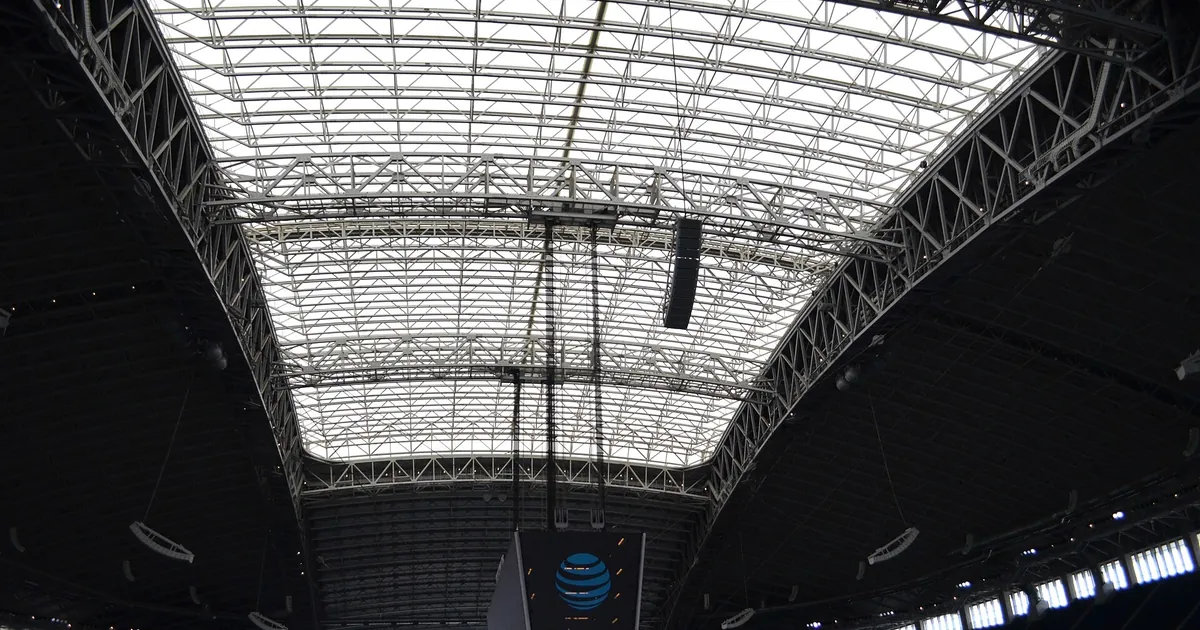
AT&T Stadium, one of four climate-controlled World Cup 2026 venues. Photo: edwarddallas / Wikimedia Commons, Public domain
5 min read · 1,081 words
Four of the 16 World Cup 2026 stadiums are sealed, air-conditioned boxes held around 22C while the football is played. The other twelve are open to a North American summer that has already pushed afternoon temperatures into the 30s Celsius across several host cities. That split is not a footnote about fan comfort. It is a competitive variable, handed out by the fixture computer rather than earned on the grass, and it is quietly shaping which teams get to play their game and which have to ration their running.
The air-conditioned venues are easy to name. AT&T Stadium in Arlington is expected to keep its retractable roof closed through the tournament and, by the venue guides tracking the enclosed stadiums, holds the bowl at roughly 72F, around 22C, even as Arlington sits near 92F outside. Mercedes-Benz Stadium in Atlanta, NRG Stadium in Houston and BC Place in Vancouver complete the set, and reporting on which 2026 venues are climate-controlled describes all four as able to lock out the weather and deliver a sealed environment where coaches can plan without the heat as a variable. Everywhere else, the variable is the opponent you cannot substitute.
What air conditioning actually changes on the pitch
Heat does not slow a team evenly. It taxes the things that win modern tournaments. A high press needs repeated sprints, and sprint capacity collapses fastest when core temperature climbs. Quick passing combinations rely on players arriving in support a half-second early, and that half-second is the first thing fatigue steals. The hydration break, now a fixed feature rather than a discretionary one, exists precisely because the open-air heat is severe enough to force a structural pause in play.
So the climate-controlled venue is not a luxury. It is a setting in which a possession-heavy, high-tempo side can run its full plan for 90 minutes. Drop that same side into the low-to-mid 30s Celsius and afternoon humidity and the plan compresses: fewer presses, deeper blocks, more conservative use of the ball, longer recovery between bursts. The football that emerges is not the football the coach designed. It is the football the thermometer permitted.
This is why the empty-stadium framing misses the point. The interesting inequality at this World Cup is not which fans are cool. It is that two teams of equal quality can be asked to play under conditions that reward opposite styles, and neither chose its allocation.
The draw was also a thermal draw
Here is the part nobody seeds into a group-stage preview. When the bracket was drawn, it did not only allocate opponents. It allocated climates. A group routed through AT&T, Atlanta and Vancouver is a fundamentally different physical assignment from one routed through Kansas City’s Arrowhead, Foxborough and a mid-afternoon kickoff in the Texas sun. Same tournament, same 90 minutes, radically different demand on the legs.
The schedule compounds it. A side that draws indoor venues for its toughest fixtures preserves the legs it will need in the knockout rounds. A side that draws open-air heat for the same fixtures arrives at the Round of 32 having spent more, with less in reserve. None of that shows up in a result line. All of it shows up in the 78th minute.
It is worth being precise about scale here, because it is easy to overstate. No team plays all of its group games indoors, and the matches are spread to limit the most extreme draws. But the effect does not need to be large to matter at this level. A tournament is decided by margins, and a recurring few-percent tax on one team’s running economy, applied across a month, is exactly the kind of margin that separates a side that holds its shape in extra time from one that does not.
SoFi is the trap, and indoor grass is the catch
Two honest caveats keep this from being a tidy “indoor good, outdoor bad” story.
The first is SoFi Stadium in Inglewood. It has a permanent roof, so it looks like it belongs in the cool column. It does not. By the same venue-climate reporting, SoFi is not air-conditioned, and its open sides let outside air in. A team walking into Los Angeles expecting Arlington’s conditions is walking into a hidden third category: covered, but not controlled. The roof is a tell that means nothing here, and anyone modelling player load on venue type alone will get SoFi wrong.
The second is the surface. Climate control trades a heat problem for a grass problem. The air-conditioned venues are artificial-turf buildings, so FIFA lays temporary natural pitches over the top, at AT&T a raised natural-grass field installed over the permanent artificial turf, a detail set out in local match-day guides. Grass grown to order and dropped under a closed roof, away from natural sun and airflow, does not always behave like a settled pitch. We have already seen players complain about the firmness and slowness of a temporary surface at MetLife, in our reporting on the pitch problems slowing the game down. The indoor venues swap the variable they removed for one they imported. “Climate-controlled” is not the same as “neutral.”
What to watch as the groups close out
The practical read for the rest of the group stage is simple. When a technical, press-heavy side plays indoors, expect it to look closer to its club form: more sustained pressure, more late-game intensity, fewer passengers. When the same profile of side is sent out into open-air heat for an afternoon kickoff, expect a flatter, more cautious version, and do not mistake that caution for decline. It may just be thermoregulation wearing a tactical disguise.
It also sharpens how to read a venue switch in the knockout rounds. A side that has banked its group games indoors and then meets a heat-tested opponent outdoors may find the legs it saved are not the only thing that matters; conditioning earned in the heat is its own asset. The advantage is real, but it is not all one way.
For a fuller map of the venues, the schedule and the talking points, our World Cup 2026 guide tracks each city as the tournament unfolds, including how the host cities differ on everything from heat to getting fans to the gate, as we covered for Atlanta’s Mercedes-Benz Stadium, itself one of the four sealed boxes. The football at this World Cup is being played in two different climates. The table will not tell you which teams paid the heat tax. The legs will.
