
6 min read · 1,280 words
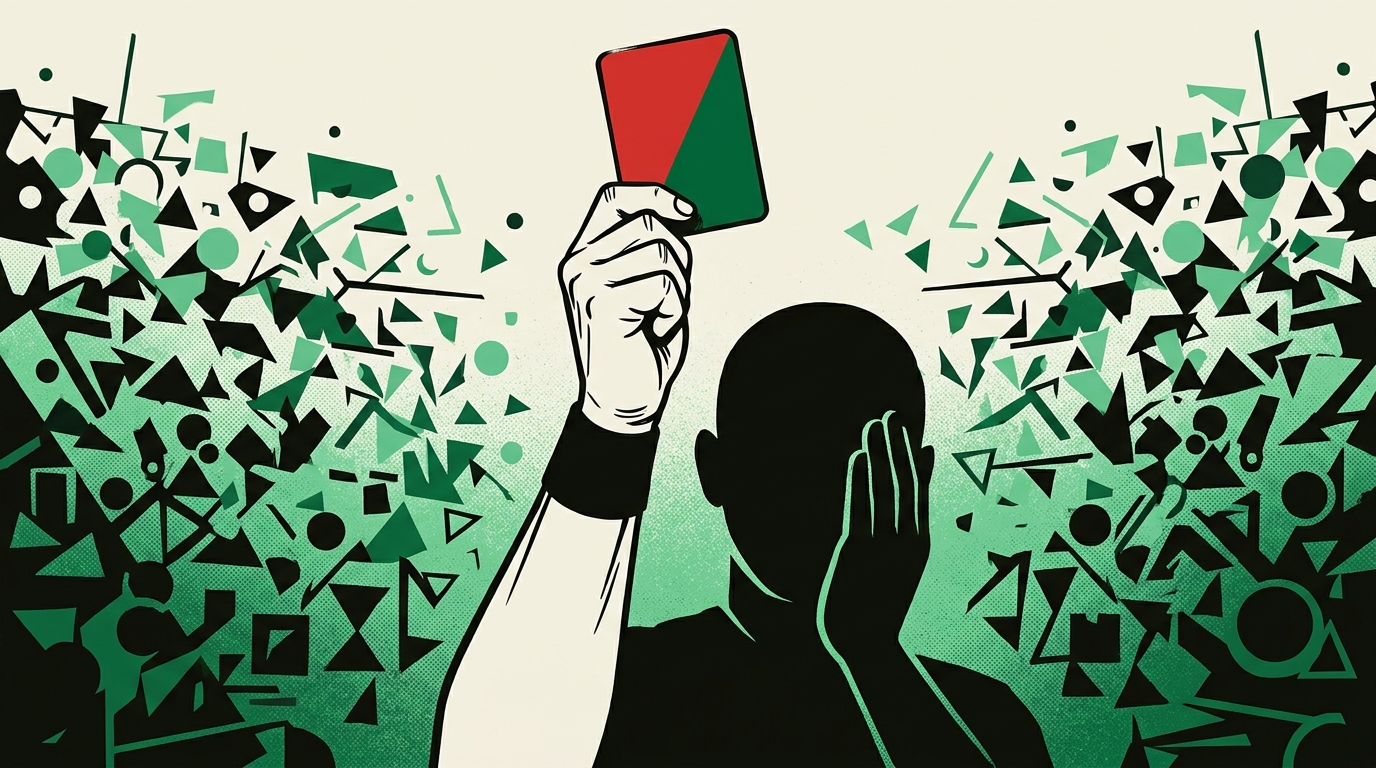
There is a particular kind of footballing moment that stops a press box dead. Not a wonder goal, not a controversial penalty, but something that makes everyone reach for their rulebook simultaneously. Miguel Almiron provided exactly that at the 2026 World Cup when, during Paraguay’s match against Turkey, he became the first player in history to receive a red card for covering his mouth while speaking to an opponent.
It is, on the surface, a peculiar thing to be dismissed for. Almiron has spent years in the Premier League doing considerably more dramatic things without seeing red. Yet here we are, at a tournament already generating more talking points per fixture than most editions manage across an entire group stage, and the conversation has turned to lip-reading protocols and referee discretion. Welcome to North America 2026.
What Actually Happened Against Turkey
The incident itself was straightforward enough in its mechanics, even if the implications are anything but. According to BBC Sport, Almiron covered his mouth while directing words at a Turkish opponent, a gesture FIFA had explicitly outlawed ahead of the tournament in an attempt to prevent players from concealing abusive or discriminatory language from lip-readers and broadcast cameras. The referee, applying the new directive, produced a straight red.
Paraguay, it should be noted, won the match regardless, which softens the sporting consequences if not the broader debate. But the incident raises a question that will follow this tournament for weeks: how consistently will the rule be enforced, and what counts as covering your mouth versus simply shielding your face from the sun or turning your head mid-sentence?
The intent behind the regulation is not difficult to understand. FIFA has faced persistent criticism over its handling of discriminatory language on the pitch, and a rule that removes the ability to conceal speech from cameras is, in principle, a reasonable deterrent. The execution, however, hands referees an enormous amount of interpretive responsibility in real time, at pace, in matches of the highest pressure. That is a significant ask.
A Tournament Already Full of Talking Points
Almiron’s dismissal did not arrive in isolation. The 2026 World Cup has already accumulated an unusual density of off-ball narratives for a competition still in its group stages. Hydration breaks, introduced to manage the heat across various American venues, have drawn their own commentary. Emma Hayes, writing in The Guardian, offered a characteristically thoughtful take: she dislikes the stoppages on instinct but acknowledges the tactical value they hand to coaches, noting that momentum has visibly shifted after several breaks in a way that suggests bench intervention is working.
Hayes draws the comparison to American football’s timeout structure, where a head coach can deploy stoppages as a strategic tool. Football has never operated that way, and there is a reasonable argument that removing the game’s continuous flow changes something fundamental about its character. But her point about momentum swings is worth taking seriously as data rather than dismissing as anecdote. If multiple breaks across multiple matches are producing measurable tactical adjustments, that is a pattern, not a coincidence.
The 48-team format was always going to generate logistical novelty, and some of that novelty was always going to feel uncomfortable. The question is whether the rule changes and tournament conditions are improving the product or simply adding friction.
Brazil’s Struggles and the Bigger Picture
Meanwhile, the football itself has been producing its own storylines. BBC Sport reports that Brazil, despite a 3-0 win over Haiti, have failed to convince in the way their rivals have. Argentina and France, the report notes, have looked considerably more coherent in the United States. A 3-0 scoreline against a team of Haiti’s resources tells you relatively little about a side’s readiness for the knockout rounds, and xG-based analysis of Brazil’s performances so far suggests the underlying numbers are not matching the surface results.
This is a familiar Brazil problem at major tournaments. The expectation of a particular style, a particular fluency, creates a perceptual gap whenever the side grinds rather than glides. Whether that gap reflects genuine structural issues or simply the normal turbulence of a group stage is something the next two or three fixtures will clarify. For now, the watching brief continues.
Argentina and France, by contrast, appear to have arrived with clearer tactical identities. That is not a surprise in either case. Both squads have experienced coaches working with settled systems, and both have had the benefit of relatively straightforward early opponents. The real test, as ever, comes when the bracket tightens.
Van Hecke, Tottenham, and the Club-Country Overlap
Not every World Cup story is purely about the tournament. Jan Paul van Hecke, who recently completed a £52 million move to Tottenham Hotspur, has spoken publicly for the first time since the transfer while on international duty with the Netherlands in North America, according to The Independent. The timing is interesting: a player processing a significant club move while simultaneously competing at a World Cup is not an unusual situation, but it does create a particular kind of split focus that managers on both sides of the arrangement have to manage carefully.
For Tottenham, the upside is obvious. Van Hecke arrives with World Cup minutes in his legs and, if the Netherlands progress, potentially a deep tournament run that will sharpen him before the Premier League 2026-27 season begins. The risk, equally obvious, is fatigue or injury during a period when his new club has no influence over his workload. It is the standard tension of summer tournaments and summer transfer windows overlapping, and it never quite resolves itself cleanly.
The broader Premier League interest in this World Cup is considerable, with a significant number of players from English clubs featuring across the 48-nation field. The tournament’s expanded format means more matches, more minutes, and more exposure for players who will return to their clubs in various states of physical condition come August.
Where the Almiron Rule Goes From Here
The mouth-covering rule is unlikely to disappear, but its application will almost certainly evolve as the tournament progresses. Referees will calibrate their thresholds based on the reaction to early decisions, and FIFA’s match officials committee will be watching the Almiron case closely to assess whether the instruction needs refinement.
The underlying logic remains sound. If you cannot see what a player is saying, you cannot hold them accountable for discriminatory language, and broadcast technology has made lip-reading a genuine tool for post-match review. Closing that loophole is a legitimate aim. The implementation, though, needs to account for the reality that players gesture and turn and shield their faces constantly during matches, often for reasons entirely unrelated to concealment.
What Almiron’s red card has done, usefully, is force the conversation into the open at the earliest possible stage of the tournament. Better to have the debate now, with weeks of group football remaining, than to arrive at a quarter-final dismissal with no established precedent. Referees, players, and coaches now know the rule is being enforced. The adjustment period, uncomfortable as it is, is probably the right time for it.
For those following the tournament closely, the options for watching World Cup football online have expanded considerably, and FootyGazette’s watch guide covers the main legitimate routes for viewers in various territories.
The 2026 World Cup is, by any measure, a tournament in conversation with itself about what football should look like. Hydration breaks, mouth-covering rules, a 48-team bracket, summer transfers running in parallel: none of these are small adjustments. Whether they add up to an improved competition or simply a noisier one is a question that will take the full tournament to answer. Almiron, sitting in the stands for Paraguay’s next match, probably has views on at least one of them.
