
8 min read · 1,733 words
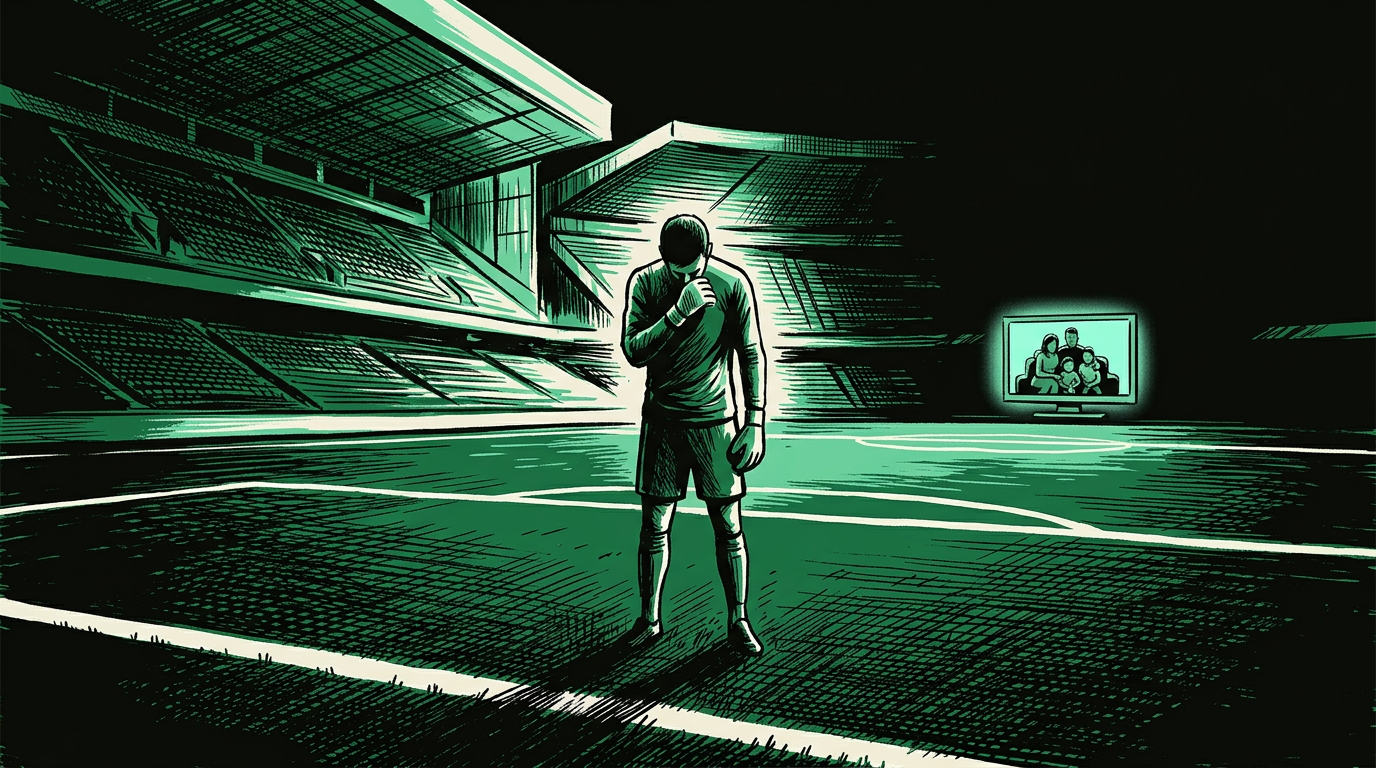
There is a particular kind of grief that lives inside joy, the grief of the person who should have been there and wasn’t. When the final whistle blew in Atlanta on Sunday and Cape Verde had held Spain, the European champions, to a goalless draw in their first-ever World Cup match, Vozinha stood in the centre of the pitch and wept. His mother was watching from an island in the Atlantic. She could not afford the visa to the United States.
“I have worked my whole life for this moment,” the 40-year-old goalkeeper told reporters after being named player of the match, as reported by The Guardian. He also spoke of his late grandparents, wishing they could have witnessed what he described as the culmination of an entire life’s work. It was, in the most literal sense, a moment that cost everything, and yet still came at a price not everyone could pay.
That tension, between the euphoria of the result and the structural inequalities that frame it, is what makes Cape Verde’s debut on the world stage so much more than a football story. This was a nation of roughly 600,000 people, scattered across ten volcanic islands off the west coast of Africa, holding one of the most technically accomplished sides on the planet to a result that sent the streets of the capital, Praia, into scenes of extraordinary celebration. According to the BBC the capital shook with wild celebrations as the result filtered through.
Seven Saves, 2,500 Passes, and a Tactical Masterclass
The numbers tell a story of near-total domination in terms of possession and territory, and yet complete failure in terms of the only metric that ultimately matters. Spain, the reigning European champions and pre-tournament favourites to lift the trophy in this expanded 48-team format were reduced to frustration by a goalkeeper who made seven saves across 90 minutes. Vozinha’s performance was not merely competent; it was, by any reasonable measure, extraordinary.
Perhaps the most damning statistical indictment of Spain’s afternoon came from BBC Sport’s post-match data analysis which revealed that Spain had now gone 2,500 passes since their last World Cup goal. That is a figure that speaks not just to Cape Verde’s defensive organisation but to a creeping sterility in Spain’s attacking play, a side that can move the ball with hypnotic fluency but has, at least in this tournament so far, struggled to translate that movement into decisive action in the final third.
Luis de la Fuente’s side had 75 per cent possession across the ninety minutes. They had the ball constantly, probed from wide areas, rotated through midfield with their characteristic patience, and found Vozinha immovable. At 40, he is the oldest goalkeeper to start a World Cup match in the modern era, a fact that has sent him viral on social media and turned him, overnight, into one of the tournament’s most compelling figures.
Who Is Vozinha? The Career Behind the Moment
His full name is Vozinha, born Marco Soares, and his story is one that the Anglo football press has scrambled to tell in the 48 hours since the final whistle. BBC Sport’s profile captured the broad strokes: a career spent largely in the lower reaches of Portuguese football, a man who kept playing when most peers had long since retired, sustained by a belief that this moment, a World Cup, might still come.
What the English-language coverage has been slower to contextualise is what Cape Verde means as a footballing nation. The islands have long exported talent to Portugal and, through the Portuguese diaspora, to clubs across Europe. The likes of Nélson, Ryan Mendes, and the Semedo family tree have all carried Cape Verdean heritage into professional football. But the national team itself, known as the Blue Sharks, has historically operated in the shadow of more prominent African football nations. Qualifying for this World Cup, in the expanded format that gave Africa nine guaranteed berths, represented a historic breakthrough.
Vozinha’s age, then, is not simply a quirky detail. It is a symbol of how long Cape Verde has been waiting. He has been part of this project for years, serving as understudy and then first choice as the squad gradually improved. That he should be the man standing between the posts when Spain came calling, and that he should be the reason Spain left without a goal, carries a weight that transcends sport.
The Visa Question Nobody Wants to Answer
The detail about Vozinha’s mother is the one that lingers. It is not, in isolation, a surprising story, the cost of travelling to a World Cup in North America, including visa fees, flights, and accommodation, is prohibitive for families from lower-income nations. But it is a story that the tournament’s organisers, sponsors, and governing bodies rarely address with any seriousness.
Cape Verde is classified by the World Bank as a lower-middle-income country. The US visa application process for citizens of many African nations carries both financial and bureaucratic burdens that are, in practical terms, insurmountable for many ordinary people. A World Cup is supposed to be a global celebration. The reality is that it is a global celebration to which access is unevenly distributed in ways that map almost perfectly onto existing global inequalities.
Vozinha did not make this point polemically. He made it personally, in tears, on the pitch in Atlanta. That is, in some ways, more powerful than any formal critique. His mother watched on a screen thousands of miles away while her son produced one of the saves of the tournament. The joy and the injustice were inseparable.
Group H: What Comes Next for Spain and Cape Verde
The draw leaves La Liga‘s most celebrated export, the Spanish national team, with work to do in Group H. The Independent’s group guide had framed Spain as clear favourites ahead of Uruguay, Saudi Arabia, and Cape Verde, with the expectation that the Blue Sharks would be competitive but ultimately outclassed. One match in, that framing requires revision.
Spain face Uruguay next, a match that now carries considerably more pressure than anticipated. A second draw, or worse, would leave them in a precarious position heading into the final group game. Uruguay, with their own proud footballing tradition and a squad built around experienced South American campaigners, will not be sympathetic opponents. For a full breakdown of how the group could unfold, our World Cup 2026 guide has the detail.
Cape Verde, meanwhile, face Saudi Arabia in their second match, a game that, on paper, represents their best opportunity to secure a second point, or potentially three. The Blue Sharks will be buoyed by what they achieved against Spain, but they will also be aware that the physical and emotional toll of Sunday’s performance was considerable. Holding Spain for 90 minutes requires a level of defensive concentration that is difficult to sustain across multiple matches.
The tactical question for Pedro Brito’s side is whether they can replicate the same low-block discipline against opponents who may approach the game differently. Saudi Arabia, under their own technical staff, are unlikely to simply play into Cape Verde’s hands in the way Spain’s patient possession game did. A more direct approach could test a defence that was, on Sunday, largely shielded by the fact that Spain’s build-up play was so predictable.
A Story the World Cup Needed
There is a version of this story that gets filed under “giant-killing” and moved on from within the news cycle. Cape Verde hold Spain; Spain regroup; the tournament continues. The Blue Sharks, in this version, are a charming footnote, the kind of story that makes for good television but doesn’t fundamentally alter anything.
That version misses the point. What happened in Atlanta on Sunday was not simply a tactical upset. It was a demonstration that the expansion of the World Cup to 48 teams, whatever its commercial motivations, has the capacity to produce exactly this kind of moment: a nation that has never before competed at this level, producing a performance of genuine quality against the best team in Europe, with a 40-year-old goalkeeper at its heart who cried at the final whistle because his mother couldn’t afford to be there.
Football, at its best, is supposed to do this. It is supposed to make visible the stories that would otherwise remain invisible. Vozinha’s tears did more for Cape Verde’s global profile in ninety minutes than any diplomatic initiative or tourism campaign could achieve in years. The Blue Sharks are, for now, one of the most talked-about teams on the planet.
For those wanting to follow Cape Verde’s remaining group matches, and Spain’s attempts to recover, details on how to watch are available on our how to watch football online guide with streaming options outlined at FootyGazette’s watch page.
The World Cup 2026 broadcast guide has full fixture and channel information for every group stage match.
FAQs
How old is Vozinha, the Cape Verde goalkeeper?
Vozinha, full name Marco Soares, is 40 years old, making him one of the oldest goalkeepers ever to start a World Cup match. He was named player of the match after making seven saves in Cape Verde’s 0-0 draw against Spain.
Why wasn’t Vozinha’s mother at the Spain vs Cape Verde match?
According to The Guardian, Vozinha’s mother could not afford the cost of a US visa to travel to Atlanta for the match. Vozinha was visibly emotional at full time and said he wished she could have been there to share the moment.
What group are Cape Verde in at the 2026 World Cup?
Cape Verde are in Group H alongside Spain, Uruguay, and Saudi Arabia. Their opening 0-0 draw against Spain was their first-ever World Cup match.
How many saves did Vozinha make against Spain?
Vozinha made seven saves against Spain, earning the player of the match award in Cape Verde’s historic 0-0 draw in Atlanta.
How long has Spain gone without a World Cup goal?
Following the draw with Cape Verde, BBC Sport reported that Spain had gone 2,500 passes since their last World Cup goal, a statistic that underlines their struggles to convert possession into decisive attacking play at this tournament.
Can Cape Verde qualify from Group H at the 2026 World Cup?
With one point from their opening match, qualification is possible but will require results against Saudi Arabia and potentially Spain. In the 48-team format, third-placed teams can advance, which gives Cape Verde a realistic pathway if they can build on their opening draw.
