
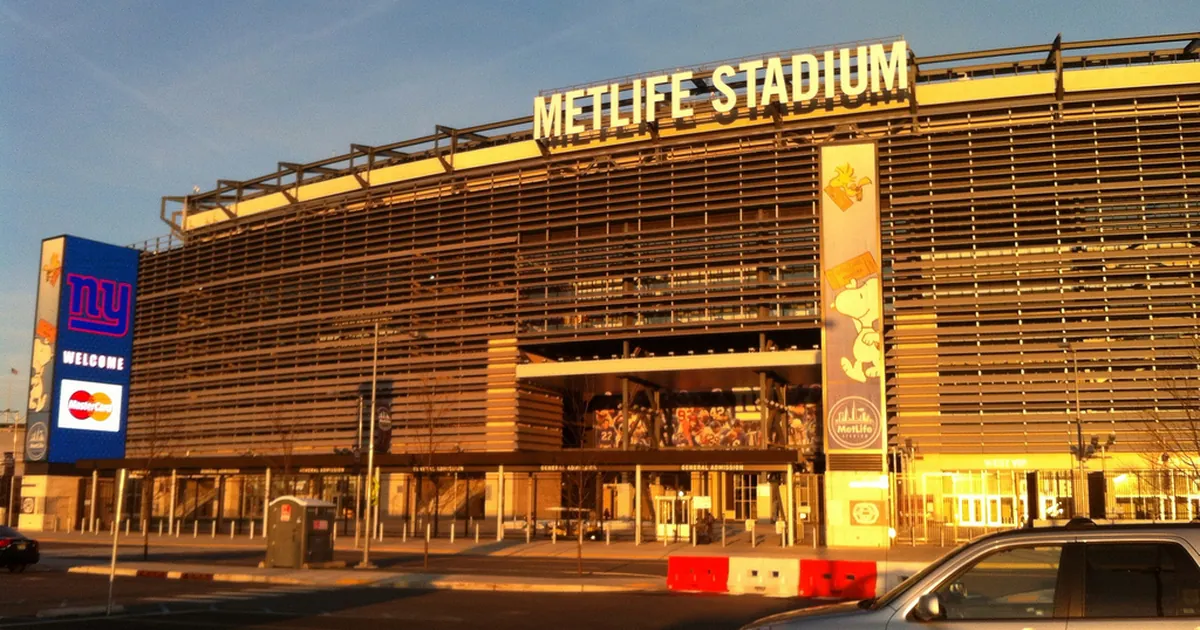
MetLife Stadium. Photo: gargudojr / Wikimedia Commons, CC BY-SA 2.0
6 min read · 1,240 words
The World Cup opens on Thursday, and if you want to get to MetLife Stadium for the World Cup 2026, the most important thing to understand is this: almost every way in now requires a match ticket and an advance purchase. In the final week before kickoff, New Jersey and FIFA have locked in an access plan that turns the busiest stretch of the New York rail network into a closed loop. Walk-up is effectively dead. This is the honest guide to how you actually reach the gate — and why the plan tells you so much about who this tournament is built for.
MetLife is, on paper, the best-connected stadium of the eight United States host venues: a major NFL site wired into one of the densest commuter-rail regions on earth. Yet the operating plan now confirmed for all eight matches here does something none of the other host cities have attempted. It does not just move fans. It rations the region’s transit and gates every sanctioned mode behind a turnstile that begins miles from the stadium.
What changed this week
The headline development, confirmed in the run-up to the opener, is the Penn Station lockout. NJ Transit will close New York Penn Station to everyone except fans holding specially printed World Cup match tickets, starting four hours before each kickoff at MetLife. Penn Station serves more than 64,000 ordinary commuters a day; for eight match days they are pushed onto PATH, ferries and buses while the rail hall is reserved for the tournament.
NJ Transit’s plan is built to move roughly 40,000 fans per match day, with about 70 percent — some 28,000 people — funnelled through that single restricted station. “The plan aims to safely transport 40,000 fans to and from the FIFA matches, while also minimizing impacts to regular riders as much as possible,” NJ Transit chief executive Kris Kolluri said. The agency is telling ticketholders to arrive at Penn Station two to three hours before kickoff to clear the crowds and screening.
Alongside the rail lockout came the final piece of the road plan: strict new limits on Uber, Lyft and private charter buses at the American Dream complex next door, the only place left to park or be dropped near the stadium.
Every sanctioned way to get to MetLife Stadium, ranked
1. The match-day train ($98 round trip). The flagship option runs only between Penn Station and the Meadowlands, only on match days, and only for ticketholders. The round-trip fare started at $150, was cut 30 percent to $105 after a public backlash, then trimmed again to $98. It is still the cheapest fast route, and the closest thing to a walk-on experience — but you cannot buy it at the gate, and the seats are capped. We covered the economics of that fare and why so many of those seats sat empty in our look at the $98 World Cup train.
2. The official stadium shuttle (~$80 round trip). Coach buses run from four hubs — Midtown North, Midtown East, the Port Authority Bus Terminal and the Hackensack Meridian School of Medicine. Tickets are advance-only and non-transferable. For groups coming from Manhattan without rail access, this is often the simplest door-to-door option.
3. Driving and parking ($225–$300 per space). There is no general spectator parking on stadium property; under the official NYNJ stadium-access plan, vehicle access is limited to FIFA-permitted vehicles. The only nearby option is the American Dream lot, where a pass must be bought ahead of match day and runs between $225 and $300 per space. Accessible J Lot passes are sold separately in advance.
4. Rideshare (and a 1.3-mile walk). Uber and Lyft still operate, but they cannot drop on stadium property. The designated drop-off is at Meadowlands Racing and Entertainment — a 1.3-mile, 2.1-kilometre walk from the gates. It is the only mode that does not require a pre-bought, ticket-linked pass, which is exactly why it leaves you furthest from the turnstile.
The closed loop: a turnstile that starts miles away
Put the four options side by side and the design becomes obvious. The three modes that actually deliver you to the gate — train, shuttle, sanctioned parking — all require two things at once: a valid match ticket and an advance, non-transferable purchase, checked before you board. The single mode that anyone can use on the day, rideshare, deposits you over a mile out. There is no walk-up, pay-at-the-gate path into MetLife for the World Cup. The stadium turnstile has effectively been extended outward across the whole metro: your ticket is checked not when you enter the stadium, but when you board the train in Manhattan.
That is a different failure mode from the other host cities we have examined. Kansas City had to invent a temporary bus network from scratch because Arrowhead has no rail at all. Santa Clara’s Levi’s Stadium is a car-first NFL site whose light-rail line tops out around 15,000 riders a match. MetLife’s problem is the opposite of scarcity: it sits on abundant rail and chose to ration it, shutting 64,000 daily commuters out of Penn Station so the tournament can run a clean, ticket-gated pipeline. The best-connected venue in the country has been operated as the most tightly controlled.
For fans, the practical consequence is that spontaneity is priced out. The cheapest, easiest route — the $98 train — is also the one you must commit to before you have left home. Show up at MetLife without a pre-bought sanctioned mode and your fallback is a paid rideshare plus a 1.3-mile walk in summer heat. This is the same pattern we flagged when we asked whether you can even walk to MetLife Stadium after the final whistle: the egress was never solved, and now the ingress has been gated to match.
What to actually do for opening weekend
If you have a match ticket, buy your travel the moment you read this: the train if you can get a Penn Station departure, the shuttle if you are coming from Midtown without rail. Do not assume you will sort it on the day — the train seats are capped and the shuttle is advance-only. If you are driving, secure the American Dream parking pass now and budget $225 or more. If your only plan is to hail an Uber, accept that you are signing up for a 1.3-mile walk and surge pricing, and leave early. And if you are an ordinary NJ Transit or Penn Station commuter on a match day, route yourself through PATH, the Port Authority buses or the ferries — the main hall will not be yours for those four hours.
For the wider picture on tickets, host cities and getting around all three host nations, start with our World Cup 2026 guide.
Frequently asked questions
Can I just drive to MetLife and park for a World Cup match? No. There is no general spectator parking on stadium property. The only nearby lot is at American Dream, and it requires an advance pass costing $225 to $300 per space.
Will Uber drop me at the stadium? No. Rideshare drop-off is at Meadowlands Racing and Entertainment, a 1.3-mile walk from the gates. Private charter buses face similar limits at American Dream.
Is Penn Station open on match days? Only to fans holding World Cup match tickets, starting four hours before kickoff. Regular commuters are diverted to PATH, buses and ferries during that window.
What is the cheapest way in? The $98 round-trip match-day train from Penn Station, but it is ticketholder-only, capped, and must be bought in advance.
