
7 min read · 1,398 words
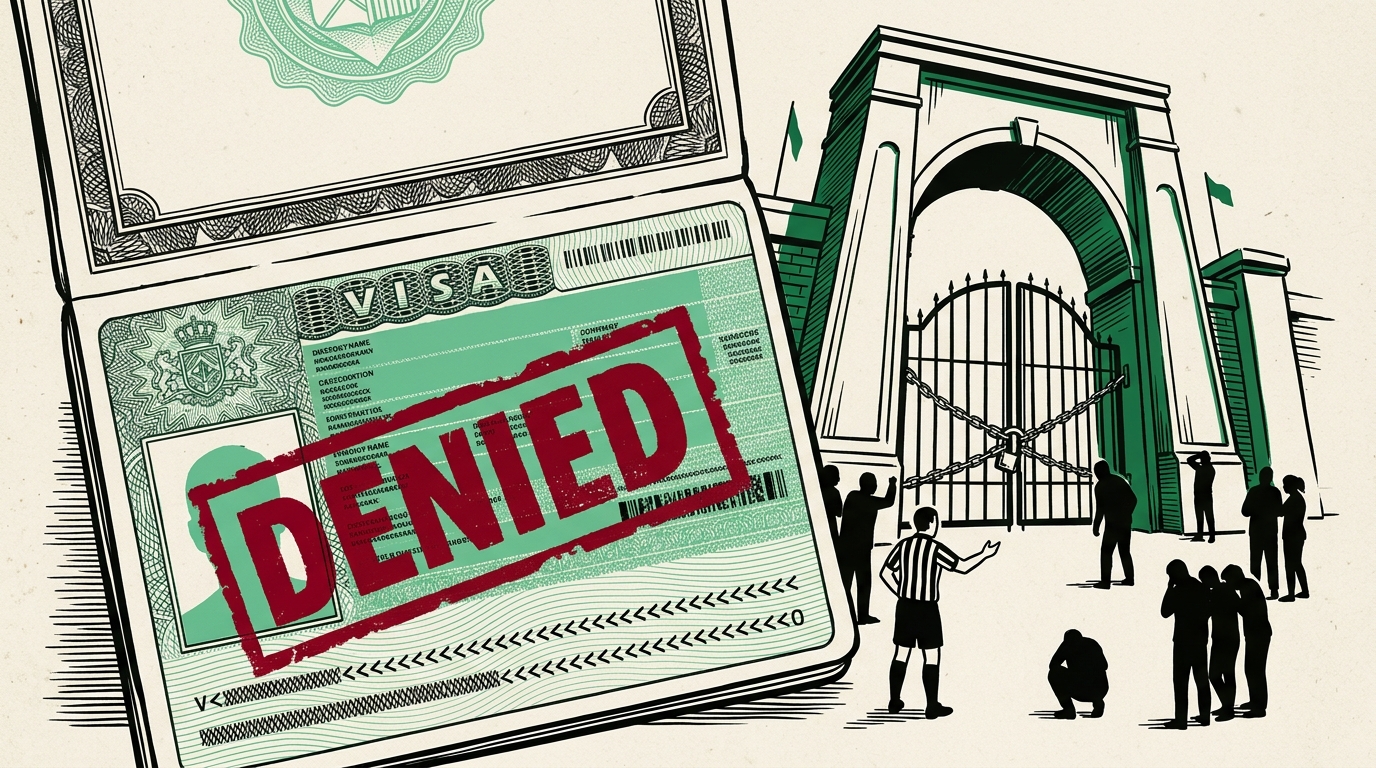
Two days before the opening whistle of the 2026 World Cup, the most pressing story in football had nothing to do with formations, fitness or transfer fees. It concerned whether people with valid documents, valid visas and valid reasons to be in the United States could actually get through the door. In a number of cases, they could not.
The situation has escalated rapidly, and the list of affected individuals is still growing. Somali referee Omar Artan was subjected to an 11-hour immigration interview before being denied entry despite holding what he described as the “right papers” and the “right visa,” according to the BBC. Iran’s football federation confirmed that its allocation of supporter tickets for the group stage had been revoked entirely. Officials, journalists and coaching staff from multiple nations have reportedly encountered difficulties at US ports of entry. Ian Wright, watching all of this unfold from afar, posted an Instagram video in which he described the tournament as a “World Cup of chaos”, a phrase that, for once, did not feel like hyperbole.
The Omar Artan Case: A Referee Without a Match
Artan’s situation is the most symbolically loaded of the lot. A FIFA-appointed referee from Somalia, he arrived in the United States carrying documentation that, by any conventional reading, should have granted him entry. Eleven hours of questioning later, he was turned away. The BBC reported that Artan himself expressed bewilderment at the outcome, stating plainly that he had the correct credentials.
FIFA has not yet publicly confirmed whether Artan will be replaced on the officiating roster or whether any formal diplomatic intervention has been sought. What is clear is that his exclusion represents a significant operational embarrassment for a governing body that spent years negotiating a host agreement with the United States, Canada and Mexico. The optics of a qualified African official being barred from a tournament his continent helped qualify for are, to put it mildly, not ideal.
Wright’s response, frustrated, direct, genuinely upset, reflected a sentiment that has spread across football social media in the days leading up to the tournament. “It’s embarrassing,” he said in the video flagged by The Independent. For a pundit not typically given to understatement, the subdued tone was telling.
Iranian Fans: Tickets Revoked Before a Ball Is Kicked
The Iran situation adds a different dimension. The Iranian football federation confirmed that its group-stage ticket allocation had been revoked, meaning supporters who had presumably made travel arrangements, flights, accommodation, the whole logistical undertaking of following a national team to a World Cup, are now in limbo. BBC Sport reported the federation’s confirmation without any accompanying explanation from US authorities or FIFA as to the precise legal basis for the revocation.
Iran are in the tournament. Their players will cross the border, train on American soil and compete in front of crowds. Whether any of those crowds will include their own compatriots is now an open question. The distinction between allowing athletes to compete and allowing their supporters to watch them is one that FIFA’s host agreement presumably addressed, though the specifics of what was agreed and what is being enforced appear to diverge considerably.
A Structural Problem FIFA Has Navigated Before, Until Now
It is worth placing this in context. The Guardian noted that FIFA has historically found ways to smooth over border friction at major tournaments. Brazil legislated temporary visa-free entry for ticket holders in 2014. Russia and Qatar deployed Fan ID and Hayya card systems respectively, which served as de facto entry documents while also providing free public transport, a neat piece of soft-power packaging that sidestepped conventional immigration bureaucracy entirely.
None of those mechanisms are available in 2026. The United States operates under a different political administration to the one that originally bid for and won the tournament, and the second Trump administration’s approach to border enforcement has been, by any measure, more aggressive than what FIFA’s planning assumptions likely accounted for. The governing body finds itself hosting a tournament inside a sovereign state whose immigration policy it cannot control and whose current posture it evidently did not fully anticipate.
That is not a small problem. FIFA’s ability to guarantee access to accredited officials, ticketed supporters and credentialled media is fundamental to the basic functioning of the event. If a FIFA-appointed referee cannot enter the country, the question of what the host agreement actually guarantees becomes rather urgent.
Who Else Has Been Affected?
The Independent reported that the list of affected individuals extends beyond Artan and Iranian supporters, encompassing officials and other figures connected to national teams and football organisations. The precise number remains unclear, in part because not all cases have been publicly confirmed and some individuals may have chosen not to speak on the record.
What is clear is that the pattern of affected individuals skews heavily toward nationals of countries subject to US travel restrictions or heightened scrutiny, a category that has expanded considerably under current policy. The intersection of that policy with the practical requirements of running a 48-team World Cup is producing friction that no amount of diplomatic goodwill appears to be resolving quickly.
FIFA’s Position and What Happens Next
FIFA has issued statements expressing concern and indicating it is working with US authorities to resolve individual cases. The language has been careful, measured to the point of near-invisibility. The governing body is in an awkward position: it needs the cooperation of the US government to run the tournament, which limits the forcefulness with which it can publicly criticise that government’s actions.
The tournament begins regardless. Matches will be played, goals will be scored, and the spectacle will proceed more or less as planned for the vast majority of participants. But the entry crisis has already done reputational damage that will be difficult to quantify and harder to undo. For the nations whose supporters cannot attend, for the officials whose appointments have been disrupted, and for the broader principle that a World Cup should be accessible to the world, the opening days of this tournament have not been encouraging.
For a fuller picture of how the 2026 edition was structured from the outset, the 48-team format explained piece covers the expansion decisions that made this the largest World Cup in history. Whether the infrastructure, diplomatic as much as physical, was ever truly ready for that scale is now a live question. You can also follow all the broader World Cup 2026 guide coverage as the tournament unfolds, and for those looking at how to follow the football itself, our guide to watching football online in 2026 covers the options available.
FAQ
Why was referee Omar Artan denied entry to the United States?
Artan, a FIFA-appointed Somali referee, was subjected to an 11-hour immigration interview before being refused entry despite holding what he described as valid papers and a valid visa. No official explanation has been provided by US immigration authorities. FIFA has indicated it is seeking to resolve the situation.
Why have Iran fans had their World Cup tickets revoked?
Iran’s football federation confirmed that its group-stage ticket allocation was revoked ahead of the tournament. The precise legal basis cited by US authorities has not been publicly detailed. Iranian nationals face heightened entry restrictions under current US immigration policy, which appears to have affected supporter access even for a FIFA-sanctioned event.
Has FIFA done anything to resolve the World Cup 2026 visa crisis?
FIFA has issued statements saying it is working with US authorities on individual cases. The governing body’s room for manoeuvre is constrained by its dependence on US government cooperation to run the tournament. No systemic resolution equivalent to the Fan ID or Hayya card arrangements used at previous World Cups has been announced.
Which other individuals have been affected by US entry restrictions at World Cup 2026?
Beyond Omar Artan and Iranian supporters, The Independent has reported that officials and other football figures connected to various national teams have encountered difficulties. The full scale of the problem remains unclear, as not all cases have been publicly confirmed.
Could the entry crisis affect the on-pitch conduct of World Cup 2026 matches?
Artan’s exclusion from the officiating roster is the most direct operational consequence so far. FIFA maintains a pool of referees and will appoint replacements where necessary, so individual matches are unlikely to be delayed or cancelled. The longer-term question is whether further officials, coaching staff or support personnel face similar issues as the tournament progresses.
