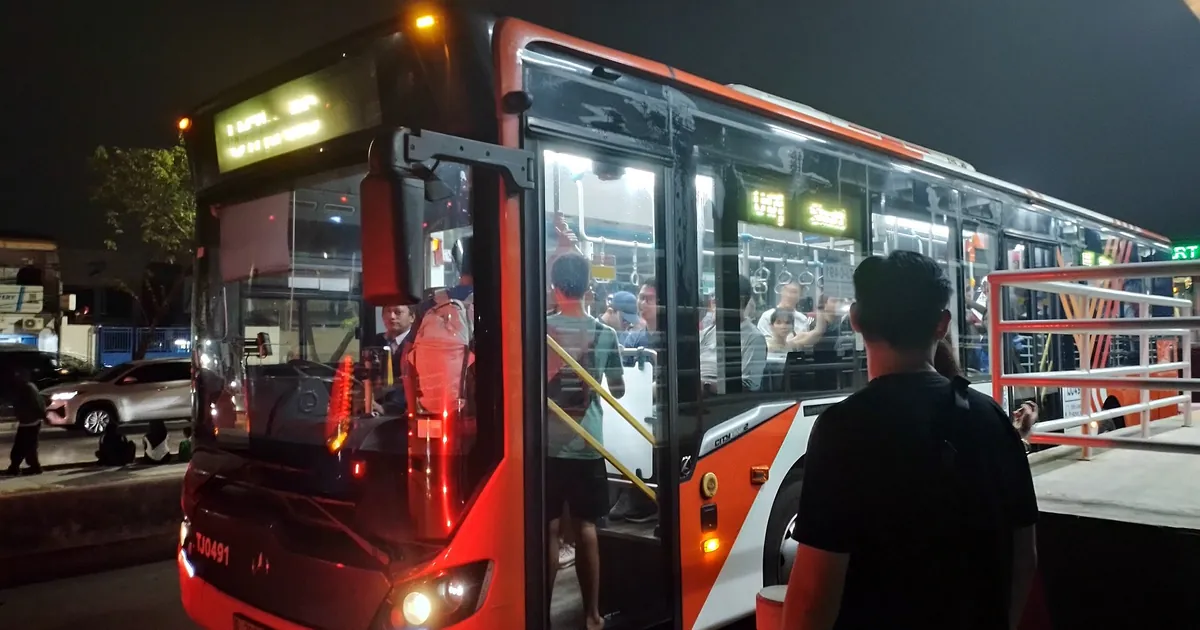
A World Cup shuttle bus service for match-day fans. Photo: RasyaAbhirama13 / Wikimedia Commons, CC BY-SA 4.0
13 min read · 2,709 words
Getting to a World Cup stadium is a solved problem, every host city has spent two years publishing maps and adding shuttle lanes. World Cup 2026 post-match transport is the part nobody fixed, and it is the part that will define how the tournament actually feels: 60,000 people trying to leave the same car park at the same minute, in the dark, after a result that has left half of them euphoric and half of them flat. This week Uber stepped into that gap with a paid shuttle product, and the shape of its offer tells you more about the host cities’ transport planning than any official guide will admit.
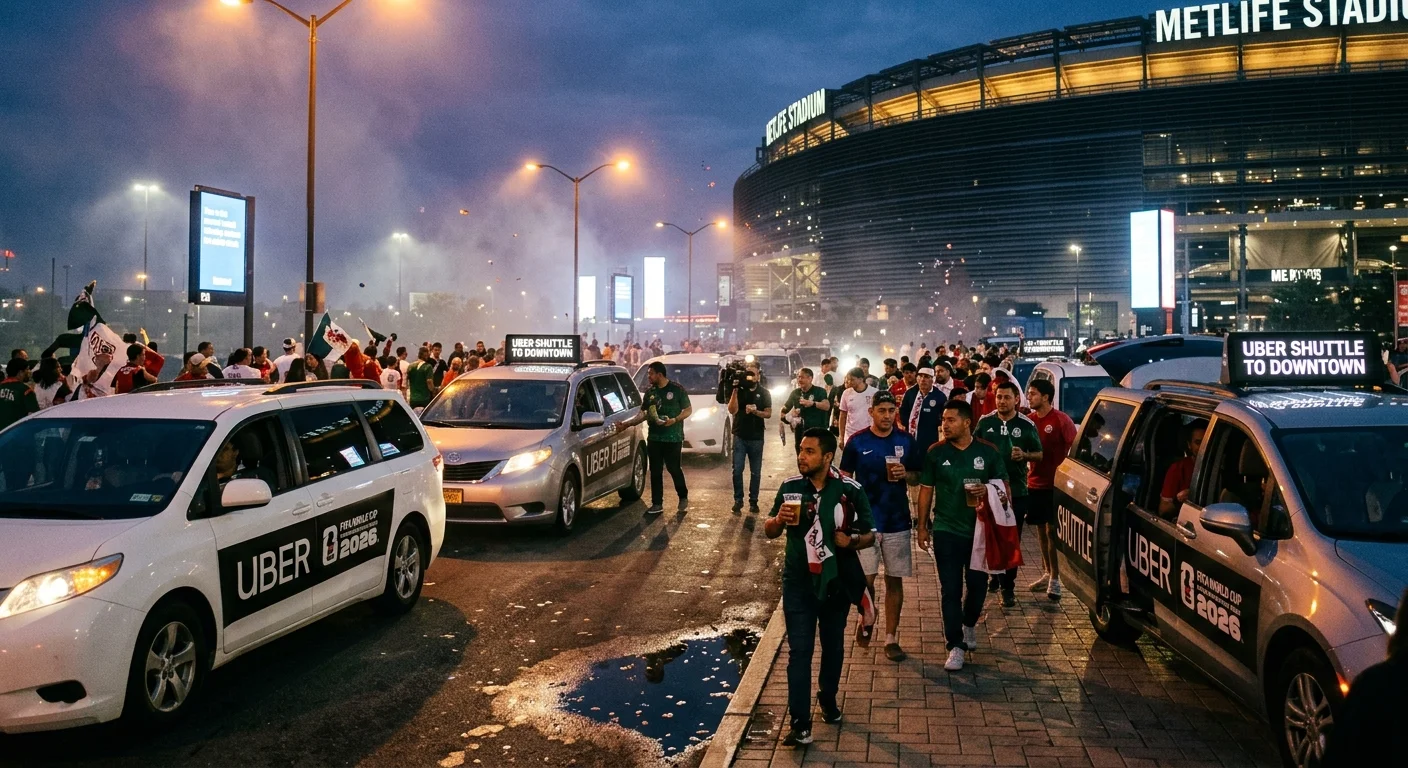
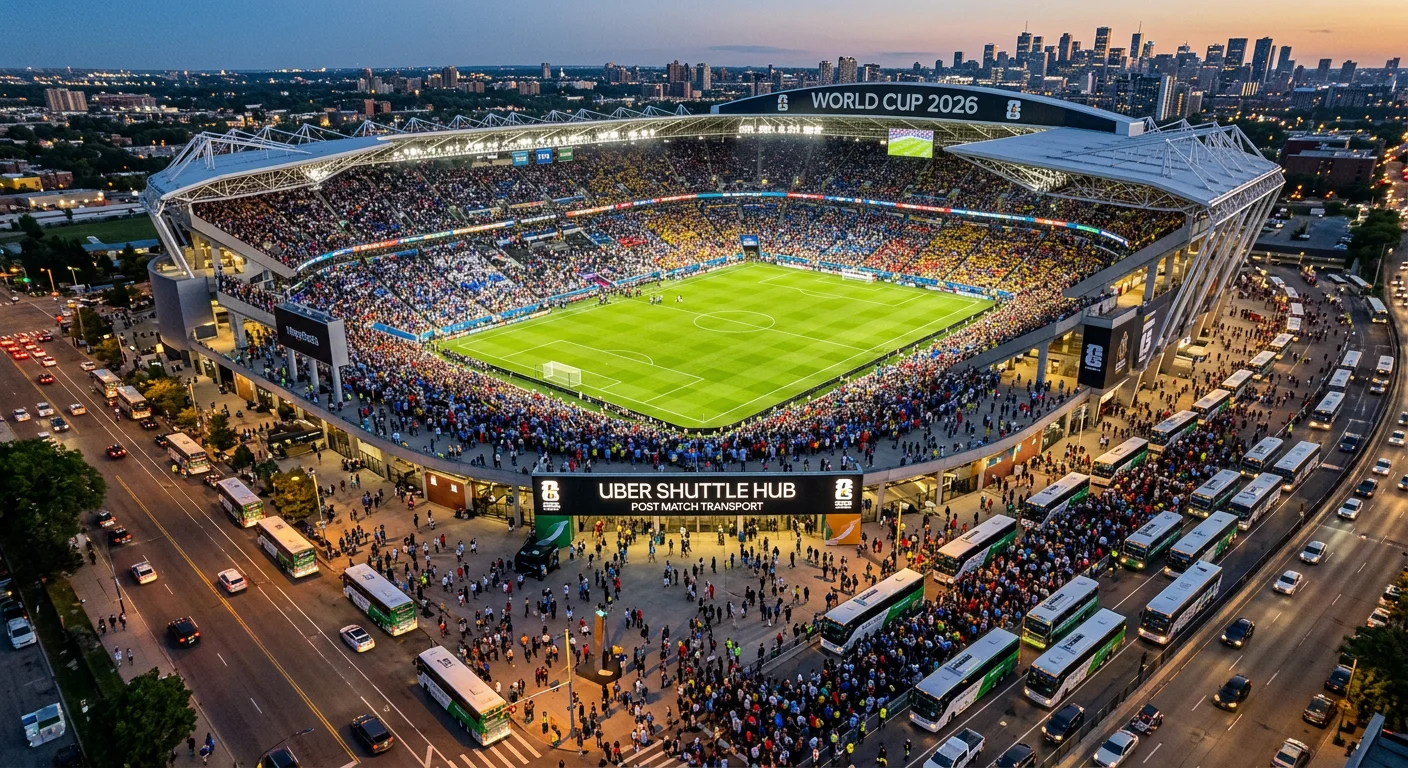
The announcement, detailed by The Points Guy and first reported by The Washington Times is a post-match Uber Shuttle running “immediately after games” from a handful of stadiums. The pitch is flat-rate, no-surge seats booked through the app: $45 in Miami, Dallas and Boston, $49 in the New York/New Jersey area, with reporting putting capacity at roughly 50 seats per vehicle. For a fan staring down a two-hour egress, an upfront fare with no surge is a genuinely good product.
Why World Cup 2026 post-match transport is the unsolved problem
Leaving a stadium is harder than arriving, and the maths is simple. Fans trickle in across a two-to-three-hour window before kickoff; they all leave inside fifteen minutes of the final whistle. That spike is what overwhelms rail platforms, swamps rideshare pickup zones, and turns car parks into hour-long crawls. It is the same structural problem we documented in Kansas City, where the route to the stadium depends on a temporary transit system bolted onto a venue with almost no permanent transit and the same one behind the “can I just walk it?” debate around getting to and from MetLife Stadium.
Uber’s own framing gives the game away. The company says the shuttles will help “reduce the volume of single-occupancy vehicles around the stadium.” That is a transport-planning objective, the kind of sentence a transit authority writes. When a rideshare company is the one publishing it, you are looking at a private patch over a public-infrastructure gap.
Think about why the exit spike behaves the way it does. Arrival is staggered by choice. Some fans want to soak up the build-up and turn up three hours early; others slide into their seats as the anthems play. Departure has no such spread. The whistle blows, the result is final, and tens of thousands of people stand up at once with the same single thought: get out. There is no incentive to linger. Concessions are closing, the celebrations or the sulking happen on the move, and the crowd compresses into the same exits, the same stairwells, the same handful of station platforms and pickup lanes within a few minutes of each other. Engineers call this a demand spike. Fans experience it as a wall of people that simply will not move.
Two more factors sharpen it at a World Cup specifically. First, many of these matches end late, so the egress happens after dark, when wayfinding is harder and last trains start to matter. Second, the crowd is disproportionately made up of travelling fans who do not know the city, cannot picture the street grid, and have no muscle memory for “the quiet exit on the far side.” A local leaving a regular-season game knows the back route to a side-street pickup. A visiting supporter from Buenos Aires or Lagos is reading signage in a second language while being swept along by the crowd. That information gap is exactly where post-match planning pays off.
Follow the map: four cities, not eleven
Here is the analysis the launch coverage skipped. Uber is running post-match shuttles in four metros, Miami, Dallas, Boston and New York/New Jersey. The United States is hosting matches in eleven. So which cities got the shuttle, and which got a press release about “enhanced pickup directions”?
Uber hasn’t said why it picked these four, but the likeliest read is commercial rather than civic. Shuttles go where post-match rideshare demand is densest and most lucrative, big-market metros with stadiums set away from a usable rail spine, where a guaranteed $45 seat sells itself. The cities left off the shuttle list, per The Points Guy’s rundown, among them Seattle, Atlanta, San Francisco and the venue with arguably the thinnest permanent transit of all, Kansas City, get app wayfinding and discount codes instead. If that read is right, the place that most needs an organised way to move 70,000 people away from the stadium is the place that didn’t get an organised service. The product follows the money, and the money is not in solving the hardest egress problem; it is in skimming the easiest ones.
That is not a knock on Uber, a company is allowed to chase margin. It is a verdict on the host cities. A flat-fare shuttle is a fine convenience layered on top of functioning public transport. It is a warning sign when it is the most credible option a fan has. For a Kansas City or an Atlanta knockout night, the absence of even a commercial operator’s shuttle should tell ticket-holders to plan their exit before kickoff, not after the whistle.
The four ways home, and what goes wrong with each
Strip away the marketing and every fan has roughly four ways to leave a stadium. Each one has a failure mode, and knowing the failure mode is what lets you pick a backup before you need it.
Rideshare (Uber, Lyft, and the post-match shuttle)
This is the option most travelling fans reach for first, and it is the one most likely to disappoint right at the final whistle. Two things tend to go wrong. The first is surge: rideshare surge is common after any big event, because demand spikes while supply stays fixed, and a stadium emptying 60,000 people is about as concentrated as demand gets. The second is the pickup zone itself. Direct stadium drop-offs and pickups are prohibited on matchdays at several World Cup venues, with designated rideshare hubs pushed out to restricted lots that can sit a long walk from the gates. So even after you have paid, you queue, on foot, in a crowd, to reach a car that is also stuck in the same exit traffic.
The flat-rate post-match shuttle sidesteps the surge problem cleanly, which is its real selling point. What it does not sidestep is the where: you still have to reach the boarding point and the vehicle still has to thread the same gridlock out. Treat it as a good seat on a slow road, not a teleport.
Official and event shuttles
Several host cities are running matchday-only shuttle or express services that are separate from anything a rideshare app offers. In the New York/New Jersey area, the plan routes ticket holders through Secaucus Junction onto matchday-only trains and buses direct to the stadium, with no general spectator parking on site. Boston is running express stadium trains from South Station out to Foxborough and back after the match. These services are built for the spike, which is their advantage. The catch is capacity and queueing: everyone funnels through the same official channel, so the line to board after a match can be long, even if it moves. The failure mode here is rarely “no ride,” it is “a forty-five-minute wait in an orderly line.” Bring patience and a charged phone.
Public transit (rail and bus)
Where it exists at the gate, fixed rail is usually the fastest way out of a post-match crush, because a train moves thousands of people on a schedule that traffic cannot block. Seattle is the standout, billed as the most transit-accessible venue of the tournament, with light rail and bus dropping fans close to the gates and a goal of most spectators arriving without a car. The San Francisco Bay Area venue sits a short walk from a light-rail station with Caltrain connections. The thing that goes wrong with transit is timing, not capacity: last trains. A late knockout match plus a long stoppage-time and a celebratory crowd can push your exit past the final scheduled departure, and a missed last train in an unfamiliar suburb is a genuinely bad night. Check the last service before kickoff, every time.
Walking
Underrated, and often the smartest first move even if it is not your whole journey. Walking out of the immediate stadium cordon to a calmer pickup point, a station one stop down the line, or a quieter street, lets you skip the worst of the crush while everyone else stands still. In genuinely transit-friendly or compact downtown settings, walking part or all of the way back is realistic. In a sprawling US metro built around a stadium ringed by parking lots and highway ramps, walking is a tactic to escape the bottleneck rather than a route home. Know which kind of venue you are at.
Sprawl versus transit: why the host city decides your night
The single biggest variable in your post-match experience is not the app you use; it is the city you bought a ticket in. The host venues fall roughly into two camps, and they behave completely differently after a match.
On one side are the transit-friendly venues, places like Seattle and the Bay Area, where fixed rail reaches the stadium and a meaningful share of the crowd never touches a car. Here the exit is a question of queueing and last-train timing, and the system is designed to absorb a spike. On the other side are the sprawling metros where the stadium sits in a sea of parking off a highway, and the regional transit network was never built to surge tens of thousands of people in fifteen minutes. Dallas is the sharp example: the Arlington venue has no direct public transit, with the regional plan routing fans through a connecting bus and a long ride from downtown. At MetLife in the Meadowlands there is no on-site spectator parking at all, which forces everyone onto official transit, rideshare, or chartered buses by design.
Neither camp is automatically better for you as a fan, but they demand different plans. A transit-friendly city rewards knowing the schedule and being willing to walk to a less crowded boarding point. A car-dependent metro rewards booking your exit in advance, whether that is a shuttle seat, a pre-reserved off-site park, or a clear plan to ride a designated bus or train, and accepting that the leaving will simply take a while. The mistake is to arrive in a sprawl city expecting it to behave like the transit one you flew in from.
The cost question fans should ask
Frame the $45–$49 fare against the alternative and the value gets clearer, and the inequity sharper. Uber’s wider World Cup package, the same coverage notes, includes a $4.99 Travel Pass for 20% off airport pickups and 10% off city rides, plus an Uber Max group option for up to 14 passengers in New York, Miami and Los Angeles. Split four ways, a shuttle seat is competitive with a single surge-priced car. Travelling solo to a less-served city, it is not even on the menu.
So the real distribution is this: fans in four well-chosen markets get a predictable, surge-proof ride home. Everyone else gets the same gridlock the host cities failed to design out, dressed up with a discount code. Post-match transport is where convenience and planning quietly become a question of which city you happened to buy a ticket in.
There is a regulatory tell buried in all of this. Hosting agreements run for years and come with detailed mobility commitments; egress capacity is not a surprise that materialised in June. When the most visible post-match solution in four cities is a private app launching weeks before kickoff, and in seven cities there is no equivalent at all, it suggests the public planning either assumed the problem away or quietly handed it to the market. Either way, the fan absorbs the gap.
A post-match exit checklist
If you are heading to a non-shuttle city, treat the exit as the part of the day to over-plan. Identify your route out before you leave the hotel, not after the final whistle: the rail or bus line and its last departure, a designated rideshare pickup point well away from the stadium crush, and a walking leg to a quieter pickup zone if the official one seizes up. The fans who move fastest after a World Cup match are the ones who decided how they were leaving before they arrived.
Work through this before kickoff, not after:
- Confirm your primary route out and one backup. Decide now whether you are taking transit, a shuttle, rideshare, or walking, and what you switch to if it falls apart.
- Look up the last train or bus for your line and write the time down. Assume the match runs long and the platform is crowded, so aim to be moving well before the final departure.
- Find the official rideshare hub on the venue map in advance. It is often a long walk from the gates and not where you would guess, so you do not want to be searching for it in the dark in a crowd.
- If a flat-rate post-match shuttle is offered in your city, consider booking it ahead. Seats are finite and the value is in the no-surge fare, not in skipping the traffic.
- Agree a meeting point with your group away from the immediate exit crush, in case the signal drops and you get separated. Mobile networks struggle when 60,000 phones hit them at once.
- Charge your phone and screenshot your route. A dead battery or a dropped connection at the whistle turns a simple exit into a long night.
- Build in a walking option. Even one stop down the line or a few blocks to a calmer street can save you the worst of the bottleneck.
- Pre-reserve parking if you must drive, since on-site spectator parking is extremely limited or banned at several venues and you can be turned away at the security perimeter.
Frequently asked questions
Is the Uber post-match shuttle worth it?
If you are in one of the four cities offering it and travelling solo or as a pair, the flat fare with no surge is a strong deal, because it removes the single biggest rideshare risk after a match. Split across a group it competes with a single surge-priced car. What it does not do is skip the traffic, so judge it as a fairly priced seat, not a fast exit.
Why is leaving the stadium harder than getting there?
Arrivals spread across two or three hours; departures compress into roughly fifteen minutes after the final whistle. That concentrated spike overwhelms platforms, pickup zones and car parks all at once, which is why the exit, not the entrance, is the genuinely hard part of matchday.
Which World Cup 2026 cities have the best post-match transit?
Broadly, the transit-friendly venues like Seattle and the San Francisco Bay Area are built to move large crowds on fixed rail, so the exit is mainly about queueing and catching the last train. The sprawling, car-dependent metros are the ones to over-plan, and Kansas City and Arlington are the standout challenges.
What if rideshare surges or the pickup line is chaos?
Have a fallback ready before you need it. Walk out of the immediate cordon to a quieter pickup point or one stop down a transit line, then re-book. The fans who get caught are the ones with no plan B once their first option fails.
Can I just walk back from the stadium?
It depends entirely on the venue. From a compact downtown or transit-adjacent stadium, walking part or all of the way is realistic. From a stadium ringed by parking lots off a highway, walking is best used as a tactic to escape the bottleneck and reach a calmer pickup or station rather than as your whole route home.
If you are mapping your matchday end-to-end, factor the exit in as hard as the entry, our full World Cup 2026 guide and the driving-between-cities breakdown both assume the leaving is the hard part. Because it is, and Uber’s selective shuttle map just proved it.