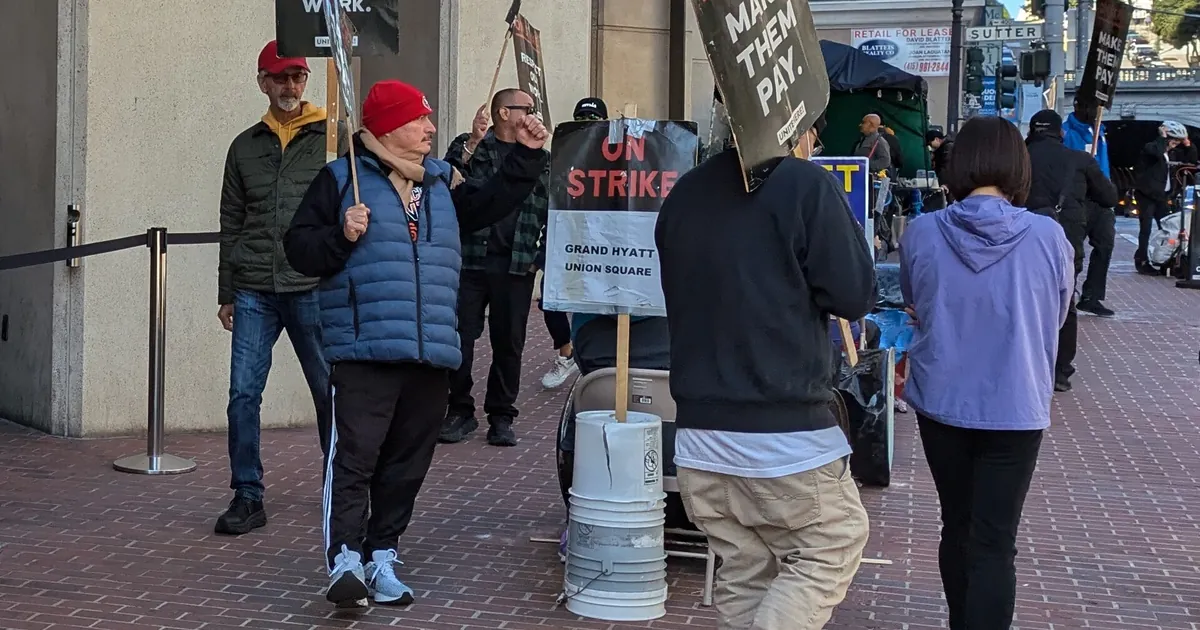
UNITE HERE hotel workers picket during an earlier dispute; the same union is organising World Cup 2026 host-city strikes. Photo: Mx. Granger / Wikimedia Commons, CC0
12 min read · 2,461 words
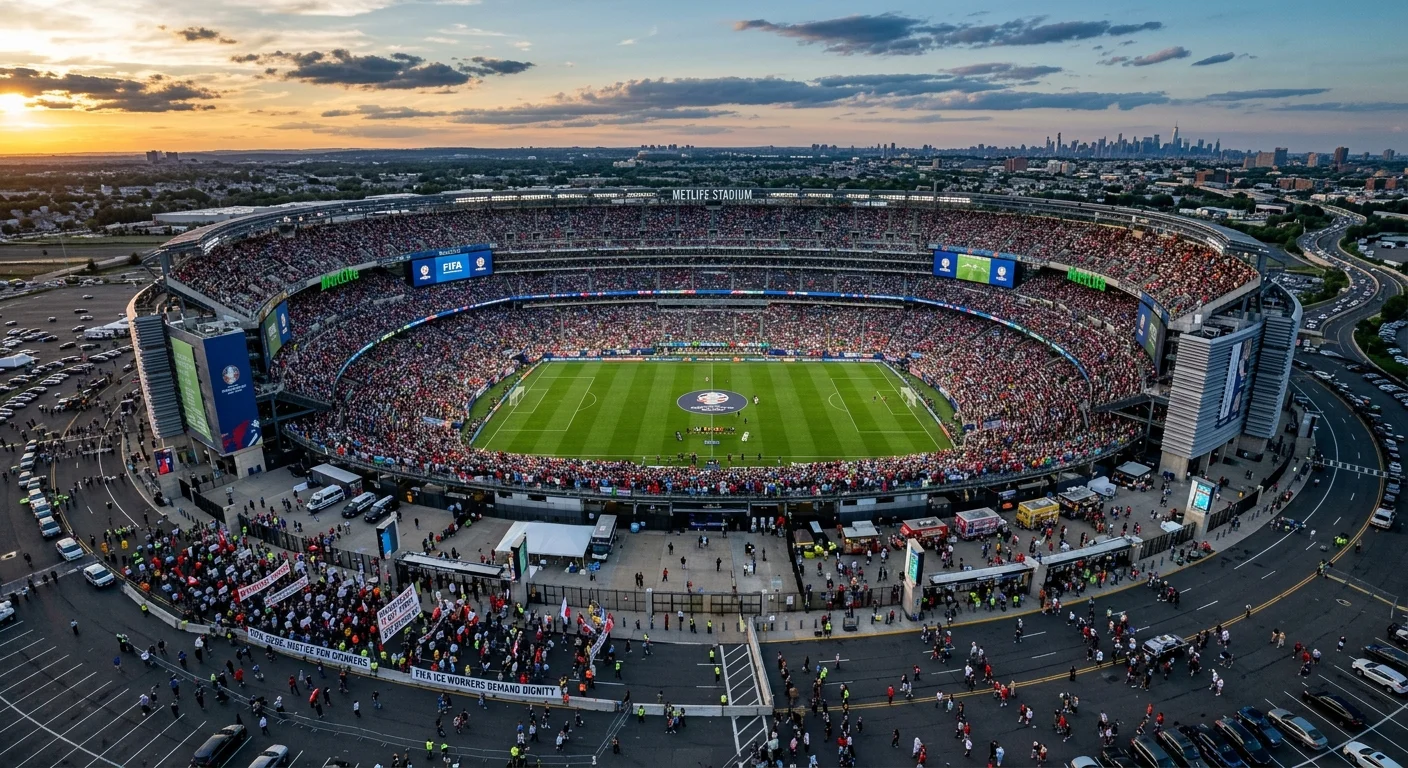
The first United States match of the World Cup 2026 kicks off at SoFi Stadium on 12 June, when the USMNT face Paraguay. The people who will pour the beer, plate the food and turn over the hotel rooms for the visitors arriving to watch it have spent the past week voting to walk out. The wave of World Cup 2026 worker strikes now building across host cities is not a coincidence of separate local disputes. It is one fight, with one trigger, aimed at the one deadline FIFA cannot move.
Read the coverage city by city and it looks like noise: concession staff in Inglewood here, hotel housekeepers in Seattle there. Read the union’s own paperwork and a far more deliberate picture emerges, a federated labour body using the most reputationally exposed sporting event on earth as a lever, and a FIFA-imposed rule as the thing it is levering against.
What the World Cup 2026 worker strikes actually are
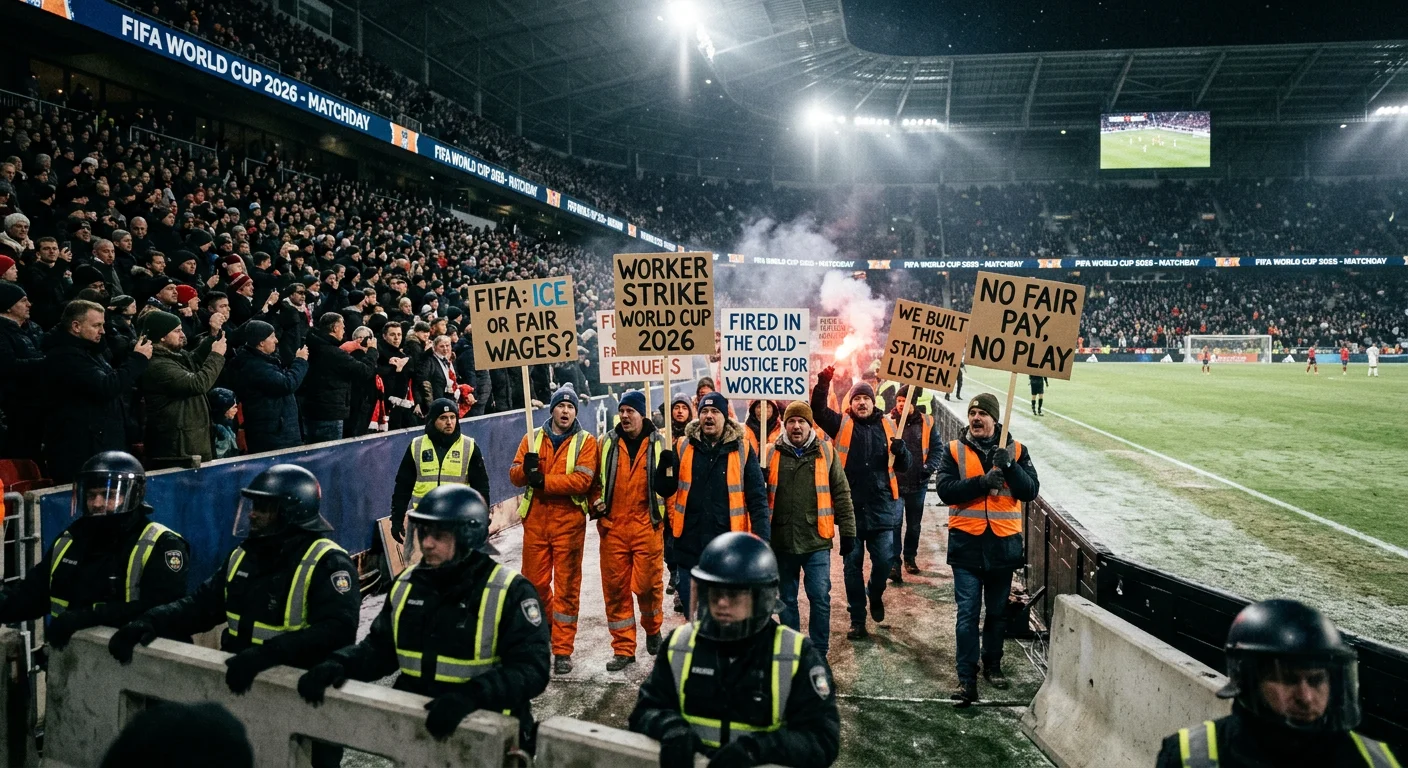
At SoFi Stadium, more than 2,000 hospitality workers represented by UNITE HERE Local 11, cooks, dishwashers, bartenders, servers and suite attendants, voted overwhelmingly to authorise a strike, the union reporting roughly 96% in favour. Their demands read like a standard hospitality dispute: raises for the lowest-paid kitchen staff, no wage freezes for tipped suite and bar workers, and protection against the subcontracting that quietly erodes union jobs. SoFi is scheduled to host eight World Cup matches.
“If we’re forced to strike, those $100,000 FIFA suites will have nothing but bottled water and Doritos,” Local 11 co-president Kurt Petersen warned. He put the deeper grievance more bluntly: “What good is the World Cup for Los Angeles when workers don’t earn enough to pay the rent and must choose between showing up and being kidnapped by ICE?” Bartender Cesar Zamora framed it as dignity: “The FIFA World Cup will generate enormous profits, but we are still fighting for basic respect and security.” Legends Global, the hospitality operator at SoFi, said only that it looks forward to “delivering an outstanding hospitality experience.”
Some 1,150 miles north, about 113 workers at the Embassy Suites beside Seattle’s Lumen Field, a Hilton property, organised under UNITE HERE Local 8, voted on 5 June to authorise their own strike. Their contract expired on 31 May. The union says management offered annual raises of under a dollar an hour while rejecting proposals on healthcare, a return to pre-pandemic staffing, and a clause requiring the hotel to notify staff when ICE or DHS agents enter the property. Seattle expects roughly 750,000 visitors and will stage six matches.
These are not the only two. In a 2 June statement, UNITE HERE flagged active or looming disputes at host-city stadiums, hotels and airports across the country, Local 274 hotel workers in Philadelphia (where banquet server Maciah Magloughlin said members were “prepared to strike all the way through the World Cup”), Local 23 stadium workers in Houston, where 22-year veteran Rubie Garza said she still earns ten dollars an hour. New York, where 27,000 hotel workers had been a strike risk, reached a contract and stood down. The pattern is national; the union is one.
How one union ended up in every host city
To understand why these disputes line up so neatly, it helps to know who UNITE HERE is. It is the dominant hospitality union in North America, organising hotel housekeepers, cooks, bartenders, servers and stadium concession staff under a network of city-based locals: Local 11 in Los Angeles, Local 8 in Seattle, Local 274 in Philadelphia, Local 23 in Houston, and the Hotel and Gaming Trades Council, which carries the UNITE HERE banner in New York. Those locals bargain their own contracts on their own timelines. What they share is a parent body, a playbook, and a habit of moving together when a single issue cuts across all of them.
The World Cup hands that structure an unusual gift. Host cities are exactly the places where big hotels and major-league stadiums cluster, which means they are exactly where UNITE HERE is already strong. When a federation that is already embedded in Los Angeles, Seattle, Philadelphia, Houston and New York finds one grievance that lands the same way in each, it does not need a central order to act in concert. The contracts were always going to come up for renewal. The tournament simply drops a hard deadline and a global spotlight onto negotiations that would otherwise grind on in obscurity.
It is worth being precise about what is established and what is contested here. The strike authorisation votes, the contract expiry dates, the headline demands on pay and healthcare, these are matters the union has stated publicly and that local reporting has covered. The framing of a single coordinated campaign is the reading offered by the union’s own materials and by labour commentators. FIFA, the host operators and the venues describe the situation in narrower, dispute-by-dispute terms. Both pictures can sit in the same set of facts; the disagreement is about emphasis.
The trigger FIFA built itself
Here is the connective tissue the city-by-city coverage misses. By UNITE HERE’s own account, the grievance shared from Inglewood to Seattle to Philadelphia is not wages, wage fights are perennial. The union points to a FIFA requirement: a mandatory accreditation and background-check regime that, it says, obliges venue and hospitality workers to disclose immigration status to be cleared for World Cup work, and that it fears could route sensitive data toward third parties. UNITE HERE’s central demand is twofold: that FIFA drop the disclosure mandate, and that immigration enforcement be kept out of host venues entirely. FIFA has not publicly detailed the accreditation policy the union describes.
“We will not give FIFA the opportunity to share data with any third party, including ICE,” said Yolanda Fierro, a suites runner at SoFi. UNITE HERE general vice-president Enrique Fernández put the human cost plainly: workers “don’t need the added stress of tracking ICE agents at workplaces.” Union president Gwen Mills has tied the whole campaign to the same knot, a celebration of American hospitality that asks the most precarious hospitality workers to hand over the data that could end their lives in this country.
That is what turns a clutch of local labour disputes into a single coordinated front. FIFA did not just create a deadline; it created a shared grievance with its own paperwork. A union federated across cities does not need formal coordination to move in concert when every local is fighting the same rule on the same calendar.
What is reported about the accreditation rule
The accreditation question is the part of this story most worth handling carefully, because it sits at the intersection of labour law, data privacy and immigration enforcement, and because much of it is alleged rather than confirmed. According to the union’s public statements and reporting in outlets covering the Los Angeles dispute, workers seeking credentials to work match days have been asked to provide detailed personal information as part of a background-check process. The union has described this as including sensitive identifiers and a waiver of certain privacy protections. FIFA has not published the policy in the terms the union uses, and the worry that any of this data would be passed to immigration authorities is, as reported, a fear the union is raising rather than a documented practice.
That distinction matters. There is a difference between a credentialing process that collects personal data, which large events routinely do for security reasons, and a process that funnels that data to enforcement agencies, which is the outcome the union says it wants ruled out in writing. The reported legal challenges in California turn on exactly this ambiguity, with complaints arguing that the data collection conflicts with state privacy law. Until the policy is laid out publicly and the data-handling commitments are spelled out, the gap between “information is collected” and “information could be shared” is the space the whole dispute is being fought in.
The broader labour picture around the tournament
Step back from the credentialing fight and the World Cup is also driving a hiring surge across hospitality and stadium operations in host cities, the kind of short, intense demand spike that always strengthens the hand of the people who do the work. Cleaners, cooks, drivers, security staff and hotel teams are being recruited for a few weeks of peak load, and every one of those roles is harder to fill if a credible strike threat is hanging over it. That is the quiet economic engine under the headlines: a perishable, time-boxed labour market in which the workers know, for once, that they cannot easily be replaced.
This is not unique to 2026 or to the United States. Mega-events have a long record of putting host-city labour standards under a microscope, from construction conditions to the wages of the people who keep stadiums and hotels running once the cameras arrive. What is distinctive this time is the immigration overlay. A large share of the affected workforce is made up of immigrants, and the dispute folds a national debate about enforcement into what would otherwise be ordinary contract bargaining. That fusion is why a hospitality negotiation has drawn the attention of civil-liberties groups and immigration advocates rather than staying confined to the labour pages.
The immovable-deadline strike
Most strikes are tests of endurance: who can outlast lost wages against lost revenue. A World Cup strike inverts that maths. The event is fixed to the day, the service is perishable, an unpoured pint during the USMNT opener is revenue that never returns, a suite served bottled water and crisps is a humiliation broadcast to a global audience, and the reputational exposure sits with parties who are not even at the bargaining table: FIFA, the host committees, the politicians who staked civic prestige on a smooth tournament. The workers hold a window of leverage measured in weeks, and everyone knows the window slams shut on 19 July.
It is, in cold terms, the best hand hospitality labour has been dealt in a generation, and it exists only because the calendar cannot be renegotiated. The risk for the union is the same as its strength: public sympathy can curdle fast if fans who saved for years find their match-day experience held hostage. The risk for FIFA and the operators is that they wrote the trigger themselves, and a settlement that drops the disclosure mandate is cheaper than a strike that defines the tournament’s opening week.
What it means if you are going
For ticket-holders the practical stakes are concrete. An authorised strike is not a strike; it is a loaded gun the union can fire at any moment, including mid-tournament. If it fires, expect thinned concessions, skeleton suite service and disrupted housekeeping at affected hotels, Petersen’s “bottled water and Doritos” is the marketing-ready version of a real degradation. Less visible but more serious is the ICE question: the ambiguity over whether immigration agents could appear at venues is precisely the uncertainty the union wants resolved in writing, and until it is, it hangs over staff and fans alike. If you have booked a host-city hotel, it is worth checking whether it is a UNITE HERE property and whether its contract is current.
None of this guarantees a walkout. Authorisations are leverage, and most leverage is spent at the table, not on the picket line, as New York’s 27,000 settled workers showed. But the structure of this dispute is unusually stable: a fixed deadline, a shared grievance FIFA can resolve with a signature, and a union that has correctly read the one moment its members will ever have this much leverage. For the economics of who actually pays for a World Cup, see our look at the Infantino–Trump power game; for the fan-side trade-offs across venues, our ranking of the best host city for fans; and the full tournament picture in our World Cup 2026 guide.
How to follow the story without getting spun
Because this topic mixes confirmed votes with contested fears, it pays to read it carefully. When you see a number, ask who is reporting it: the strike-authorisation percentages and the worker counts come from the union, and operators rarely contest them, but the claims about how data might be used are allegations the union is pressing, not findings anyone has published. When you see a quote, note that the most vivid lines here come from union officials and members, while the venues and operators have mostly offered brief, non-committal statements. And when you see the word “strike,” remember the gap between an authorisation, which is a permission slip, and an actual walkout, which may never come. The New York settlement is the reminder that the loud part of a labour fight and the resolved part are often weeks apart.
Frequently asked questions
Will World Cup 2026 stadium and hotel workers actually go on strike?
As of early June, workers at SoFi Stadium (UNITE HERE Local 11) and a Seattle hotel near Lumen Field (Local 8) have voted to authorise strikes, with disputes also flagged in Philadelphia and Houston. Authorisation lets a union call a strike at any time but does not mean one is certain; many are settled at the bargaining table, as New York’s hotel contract was.
Why are FIFA accreditation rules part of the dispute?
UNITE HERE objects to a FIFA requirement that venue and hospitality workers disclose immigration status for background checks, fearing the data could reach immigration authorities. Its core demands are that FIFA drop the disclosure mandate and that ICE be kept out of host venues.
How could a strike affect my match day?
A walkout at an affected venue could mean reduced concessions, minimal suite service and disrupted hotel housekeeping. Check whether your host-city hotel is a unionised property with a current contract.
Is the claim that worker data would be shared with ICE confirmed?
No. The concern that accreditation data could reach immigration authorities is, as reported, a fear the union is raising. FIFA has not publicly detailed the accreditation policy in the terms the union describes, and the data-handling questions are the unresolved core of the dispute rather than a documented practice.
Why does immigration enforcement come up in a labour negotiation at all?
A large share of the affected hospitality workforce is made up of immigrants, so a contract fight over pay, healthcare and staffing has become entangled with worries about enforcement at workplaces. That overlap is what has drawn attention from civil-liberties and immigration groups, not just labour reporters.
Could the disputes be resolved before the tournament ends?
Yes. Strike authorisations are commonly used as leverage and then resolved through bargaining, as the New York settlement showed. Whether any individual venue or hotel reaches a deal depends on its own negotiations, so the situation can change city by city and week by week.