
7 min read · 1,440 words
There is a particular kind of goal that has haunted football administrators for years. The striker peels away from his marker, the ball drops perfectly, he converts, and somewhere in the melee before kick-off, a teammate nudged a defender. The goal stands. The defender is furious. The administrator files it away as a problem to solve later. Later has apparently arrived.
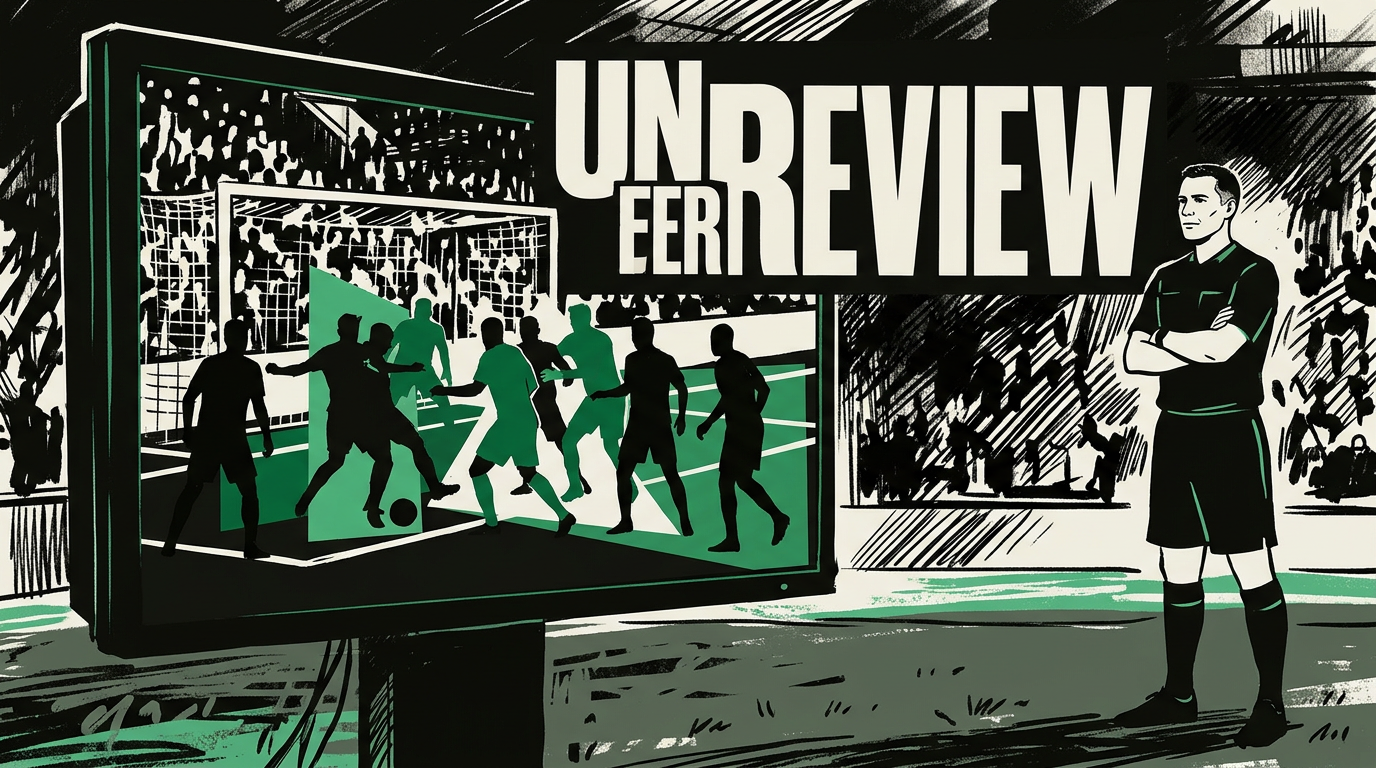
Ahead of the 2026 World Cup in the United States, Canada and Mexico, IFAB has sanctioned a rule change that brings fouls committed immediately before the ball is in play under the jurisdiction of VAR. In plain English: if a player commits a foul in the moments just before a corner, free-kick or throw-in is taken, and a goal subsequently results, the technology can now intervene. The Independent reports that this adjustment has been quietly confirmed ahead of the tournament, and it represents one of the more substantive tweaks to VAR’s operating parameters since the system was introduced at the 2018 edition in Russia.
Whether it will make the game fairer or simply add another layer of post-goal anxiety to an already overwrought review process is, as ever, a matter of perspective.
What the Rule Actually Changes
The technical detail
The existing framework for VAR intervention at set-pieces has always been somewhat selective. Offsides and handball in the build-up have been reviewable for years, to the considerable irritation of supporters who have watched perfectly good goals disallowed because a forward’s armpit was fractionally ahead of a defender’s kneecap. The new provision extends that scrutiny to physical fouls that occur in the seconds immediately before delivery. Think of the blockers who screen goalkeepers at corners, or the shirt-pulls that happen as a free-kick is struck. Previously, unless a referee spotted it in real time, it was gone. Now, VAR can go back.
The practical implication, as The Independent’s broader World Cup preview notes, is that goals scored from set-pieces, already one of the most analytically significant areas of the modern game, will face an additional checkpoint. Set-pieces account for roughly a third of all goals at major tournaments, so the volume of decisions potentially affected is not trivial.
Why now, and why here
The timing is deliberate. FIFA and IFAB have been under sustained pressure to address the kind of physical manipulation that has become routine at dead-ball situations. Elite teams employ specialists, call them blockers, screens, or whatever the coaching staff prefer, whose primary function is to impede opponents before the ball moves. It is not subtle, it is not particularly sporting, and it has been essentially unpunishable at pace. The World Cup, with its global audience and its tendency to be decided by fine margins, is the highest-profile possible stage to road-test an adjustment.
There is also a commercial logic, though nobody in Zurich will say so directly. The tournament expands to 48 teams this summer, as detailed in our guide to the new 48-team format and with more matches comes more scrutiny. Getting the officiating framework right, or at least being seen to try, matters enormously when you are selling a product to broadcasters across every time zone.
Who Stands to Gain and Lose
The teams built on set-piece aggression
England will be watching this development with particular interest. Gareth Southgate’s successor has inherited a squad that has leaned heavily on set-piece delivery and physical presence in the penalty area. The same applies to several of the tournament favourites: France, with their aerial threat from dead balls; Argentina, whose corner routines have become increasingly choreographed; and Germany, who have rebuilt their attacking identity partly around structured set-piece play. If VAR is now empowered to unpick the blocking patterns that create space for those routines, the tactical calculus shifts.
It would be an overstatement to say any team loses a decisive advantage overnight. Referees have always had the option to penalise this behaviour, the new rule simply gives them technological support to do so retrospectively. But the deterrent effect could be significant. Coaches who have spent months drilling elaborate corner sequences may find themselves redesigning them before the tournament begins.
The hosts and the pressure of expectation
The United States, as co-hosts, arrive with genuine momentum. Christian Pulisic scored and assisted in a warm-up victory over Senegal at the weekend, per The Independent and the USMNT carry real attacking threat through their AC Milan forward. The Americans are not a set-piece-dependent side in the way some European nations are, which may insulate them from the immediate consequences of the rule change. Their xG numbers from open play have been more encouraging than their dead-ball output in recent cycles.
What they cannot afford is to be on the wrong end of a high-profile VAR disallowance in front of a home crowd. The political and commercial stakes of this tournament are considerable, and a goal ruled out by a foul-before-delivery decision in a knockout match would generate the kind of controversy that tends to overshadow everything else. The rule is designed to improve fairness; the risk is that it becomes the story.
The Broader VAR Picture at This Tournament
A system still searching for consensus
VAR has now been operational at the World Cup for two full tournaments, and the verdict remains stubbornly mixed. The technology has corrected clear errors, the kind of howlers that used to define tournaments for the wrong reasons, but it has also introduced a new category of grievance: the marginal call, reviewed at length, that satisfies nobody. The offside lines drawn through players’ bodies have become a particular source of frustration, and the handball interpretations have varied enough between tournaments to suggest the laws themselves remain unsettled.
Adding another category of reviewable incident does not simplify this. It adds complexity, and complexity in a system that already struggles with public trust is not obviously helpful. The counterargument, that leaving blatant fouls unreviewable is worse, is reasonable, but it requires the technology to be applied consistently, which has not always been the case.
For a deeper look at how the tournament’s structure affects the pressure on officials, our World Cup 2026 guide covers the group stage format and the expanded knockout bracket in full.
South Africa’s visa saga as context
It would be remiss not to note that the tournament’s administrative competence has already faced questions before a ball is kicked. South Africa, who face co-hosts Mexico in the opening match, were reportedly delayed in travelling to the tournament due to visa complications, described by sources close to the squad as embarrassing. A nation preparing for one of the highest-profile fixtures of the group stage, the opening match of a 48-team World Cup, dealing with bureaucratic delays is not the image FIFA would have chosen. It does, however, provide useful context for evaluating the organisation’s capacity to implement a nuanced new VAR protocol smoothly.
Refereeing consistency across 104 matches, in three countries, with a new rule that requires officials to make rapid judgements about timing and intent, is a significant operational challenge. The rule may be correct in principle. The execution is the variable.
What to Watch For
The first high-profile disallowance under this rule, and there will be one, probably in the group stage, will tell us a great deal about how FIFA intend to apply it. If the foul is unambiguous and the goal clearly benefited from it, the decision will be defensible. If the foul is marginal and the connection to the goal tenuous, the backlash will be severe and the rule’s long-term credibility will take a hit from which it may not easily recover.
Managers will adapt, as they always do. The blocking routines will be modified, the timing of physical contact will shift, and within a tournament or two the rule will either become unremarkable background or will have been quietly revised. That is the pattern with VAR interventions: initial controversy, tactical adjustment, gradual normalisation.
In the meantime, supporters preparing to watch the tournament would do well to familiarise themselves with the new parameters. A goal going in at a corner is no longer necessarily a goal. There is now a brief window, the length of a VAR review, which is to say an indeterminate and occasionally geological period, during which anything remains possible.
For those planning to follow the action, our guide to watching football online in 2026 covers your options, and you can also check FootyGazette’s watch page for broadcast information.
The World Cup has always been the game’s grandest stage for unintended consequences. This summer, it will also be the stage for a rule that could, depending on your tolerance for post-goal uncertainty, either clean up football’s most persistent cheat or simply give us something new to argue about. Both outcomes seem equally plausible.
