
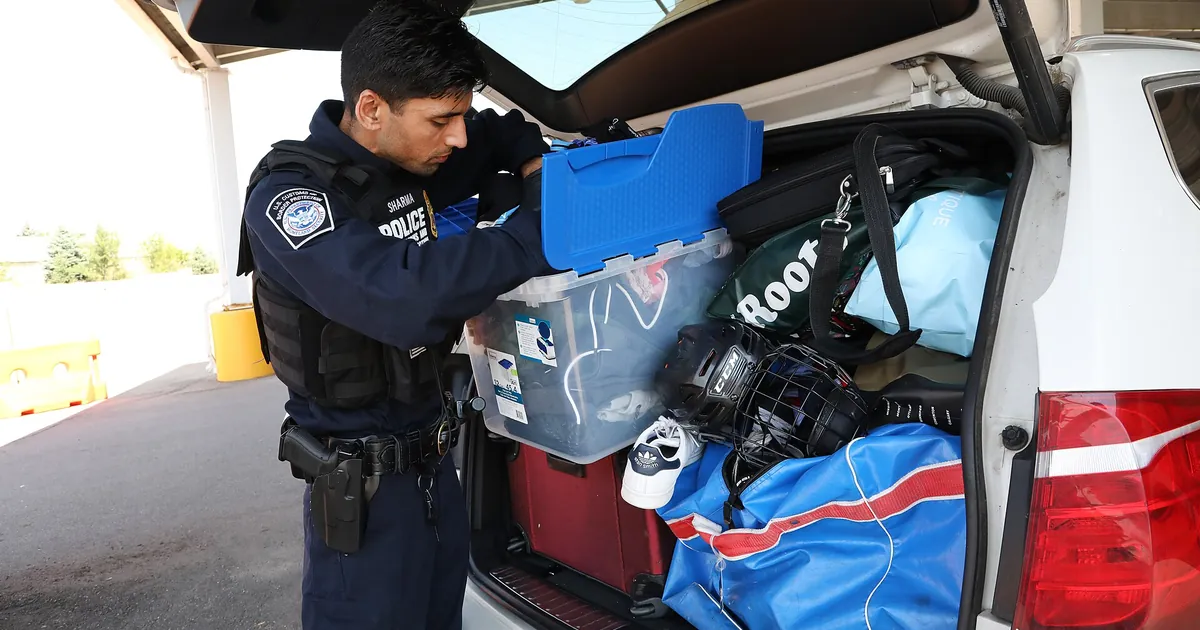
US Customs and Border Protection officers at the Detroit-Windsor port of entry. Photo: CBP Photography / Wikimedia Commons, Public domain
7 min read · 1,534 words
The short version. The 2026 World Cup is the first spread across three sovereign countries, but there is no single tournament visa covering all three. A fan who enters on a single-entry authorisation and crosses a border for a match can be barred from coming back, stranding them mid-tournament. The seamless travel the format markets is, at the immigration desk, three separate and non-transferable gates.
The phrase world cup 2026 visa re-entry single entry sounds like a niche search query, but it describes the single largest planning trap facing fans this summer. The tournament runs from 11 June to 19 July 2026 across the United States, Canada and Mexico, with 48 teams and 104 matches, and the organisers have sold it as a borderless continental festival. The immigration systems underneath it were never harmonised to match. A supporter who follows a team across the map, or simply buys tickets in two countries, is making multiple international entries, and each one is judged on its own terms.
That gap between the marketing and the machinery is where fans will get hurt. The danger is not that anyone is lying; it is that nobody with a megaphone is spelling out that a continental tournament does not come with continental documents. This piece sits within our complete guide to the 2026 World Cup, and it deliberately stays on the part of the trip the highlight reels skip: the desk, the officer, and the stamp that decides whether you see your second match.
Three countries, three immigration systems, no shared visa
The first thing to understand is that there is no “North America tournament visa.” Nothing you hold lets you move freely between all three host nations. The U.S. Department of State guidance on FIFA World Cup 26 visas is explicit that the United States issues and controls only entry to the United States; it says nothing about Canadian or Mexican admission because it cannot. Likewise, FIFA’s own travel, visas and FIFA Pass material directs fans to the immigration authority of each country they intend to enter, rather than to any tournament-wide credential.
The practical mechanics are set out clearly in Passport Index’s breakdown of 2026 World Cup visa requirements across the US, Canada and Mexico. A US visa or ESTA does not grant entry to Canada or Mexico; Canada’s electronic Travel Authorisation, the eTA, does not cover the United States. The American ESTA costs $21, covers travellers from the 42 Visa Waiver Program countries, and is valid for roughly two years; Canada runs a separate eTA with its own application, its own fee and its own eligibility list. Mexico applies its own rules again. Three systems, three gates, none of them transferable.
The re-entry trap nobody is warning fans about
Here is where the world cup 2026 visa re-entry single entry problem turns from paperwork into a ruined trip. Many visitor authorisations are issued for a single entry. That means the document is spent the moment you use it to enter the country. Leave to attend a match across the border, and the authorisation you came in on no longer admits you back. Unless you hold a multiple-entry visa, or qualify for a fresh authorisation on the way back, the return leg is not guaranteed.
Picture the ordinary itinerary the format invites. A fan flies into the United States on a single-entry visa, watches a group game, then takes the short hop to a fixture in Canada or Mexico. The outbound crossing is easy; countries rarely object to you leaving. The return is the cliff edge. The US entry has been used, and re-admission now depends on holding a valid multiple-entry document. The fan who did not check is now outside the country where the rest of their tickets, and often their accommodation and flights home, are waiting. As the Passport Index analysis puts it plainly, a missed visa for one leg of the trip can end the whole journey.
It is worth being blunt about what a match ticket does and does not do. A World Cup ticket does not guarantee entry to any country. It evidences a reason to travel, nothing more. The border officer still decides, and a ticket in your inbox carries no weight against a single-entry document that has already been used.
The enforcement climate raises the stakes
None of this is happening in a calm year. The American Immigration Council’s assessment fifty days out describes a hardened enforcement environment around the tournament: active travel-ban politics, a visible ICE posture, and specific friction for nationals of countries such as Iran. In that climate, officers exercise discretion more tightly, and the margin for an avoidable documentary error narrows. A single-entry visa used up on the first crossing is exactly the kind of avoidable error that becomes unrecoverable when the system is leaning towards refusal rather than waving people through.
The wait times compound the risk. US visitor-visa interview appointments run many months in some countries, so a fan who realises in May that they need a multiple-entry visa may simply have no appointment available before kick-off. The structural lesson is that this is not a problem you can fix at the airport; it is one you either solve months ahead or carry with you as a live hazard for the whole trip.
Original analysis: the format sells one journey, the border enforces three
The deeper story is a mismatch between how this tournament was sold and how it is governed. Every previous World Cup, however sprawling, sat inside a single sovereign immigration system: one country, one set of entry rules, one authorisation that carried you from the opening match to the final. 2026 breaks that template. It is the first World Cup staged across three sovereign states, and sovereignty is precisely the thing that does not get pooled for a football tournament. FIFA can harmonise kick-off times, broadcast contracts and ticketing platforms; it cannot harmonise the constitutional right of three nations to decide who crosses their borders and on what terms.
So the marketing promises one continental journey while the legal reality enforces three. There is no shared visa not because anyone forgot, but because immigration control is the hardest core of state power, the last thing any government delegates to a sporting body. The fan is left holding the contradiction: sold a seamless map, handed three separate, non-transferable gates, and warned about it by almost no one. That is the re-entry trap in its purest form, and it is structural, not accidental. No visa-checker tool can dissolve it, because the obstacle is not a missing form but the architecture of three states guarding three frontiers.
How to avoid the trap
The defence is unglamorous and entirely within a fan’s control. The single most important step is to plan the documents around the whole itinerary, not match by match.
- Map every border crossing before you book. Write down each international entry your trip requires, in order. Each crossing is a separate immigration event with its own rules and its own document.
- Insist on multiple-entry where you will re-enter. If your plan returns you to a country you have already entered, a single-entry authorisation is not enough. Confirm the visa or authorisation explicitly permits multiple entries before you rely on it.
- Apply early, not late. With US interview waits running many months in some countries, treat the application as the first thing you do after buying tickets, not the last.
- Check each country directly. Use the official authority for each host nation rather than assuming one document covers the trip; the State Department and FIFA pages above both point you to per-country sources.
- Carry proof, but do not trust it to admit you. Bring your tickets and accommodation, but remember a ticket evidences a reason to travel, not a right of entry.
For fans following a single team across venues, the logistics ripple far beyond visas, which we map in the logistics and politics of a three-nation tournament. And for supporters from countries caught in the current travel-ban politics, the documentary risk is sharper still, as we detail in the visa crisis facing Iran’s fans.
Frequently asked questions
What does “world cup 2026 visa re-entry single entry” actually mean for my trip?
It means that if you enter a host country on a single-entry authorisation and then cross a border for another match, that authorisation is spent and will not re-admit you. To return, you need a multiple-entry visa or a fresh authorisation, arranged in advance, or you risk being stranded outside the country holding your remaining tickets.
Does a US visa or ESTA let me into Canada and Mexico too?
No. There is no shared North American tournament visa. A US visa or ESTA only admits you to the United States. Canada requires its own eTA or visa, and Mexico applies its own rules. Each border is a separate gate, and each must be cleared on its own documents.
Will my match ticket guarantee I am let in at the border?
No. A World Cup ticket evidences a reason to travel, but it does not guarantee entry. The border officer decides admission based on your documents and eligibility. A valid, correctly scoped visa or authorisation matters far more than the ticket, especially in a tighter enforcement climate.
