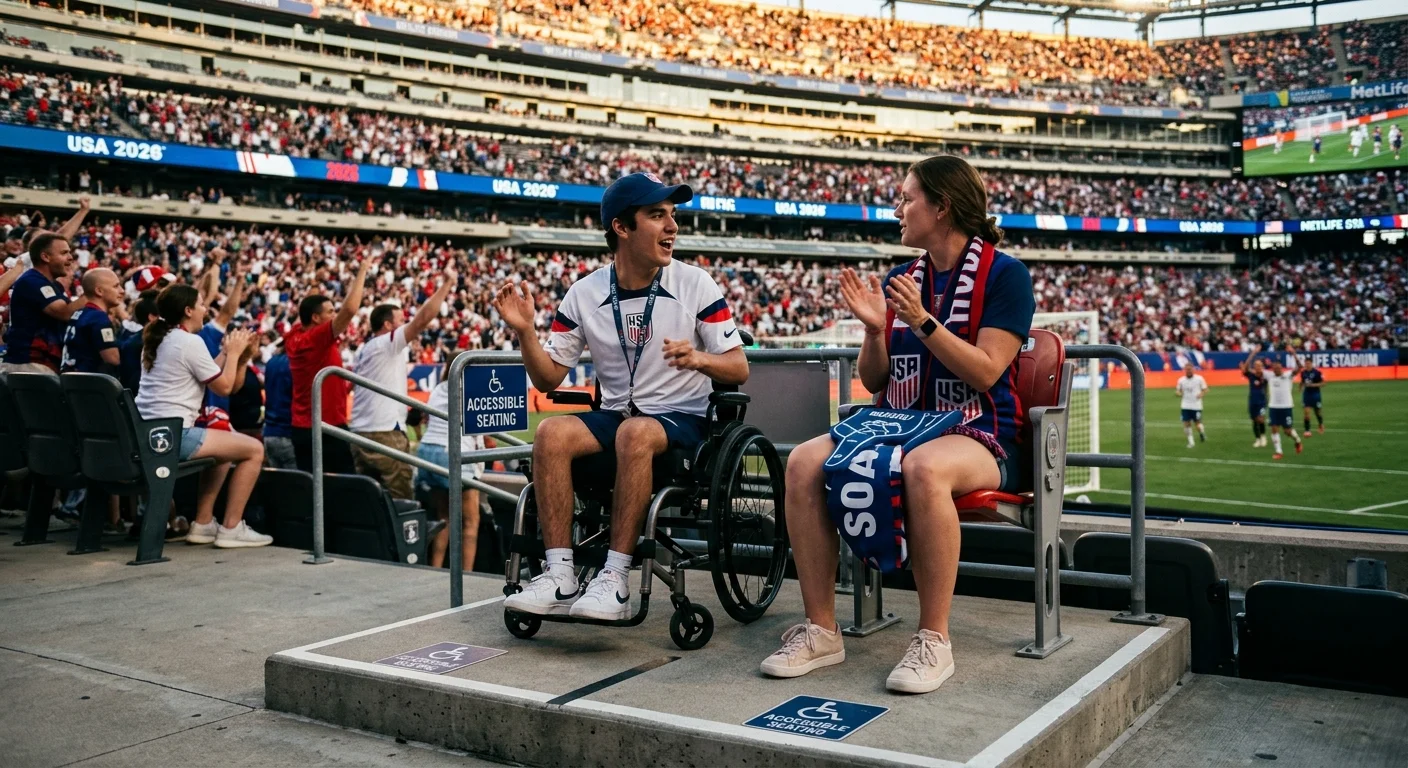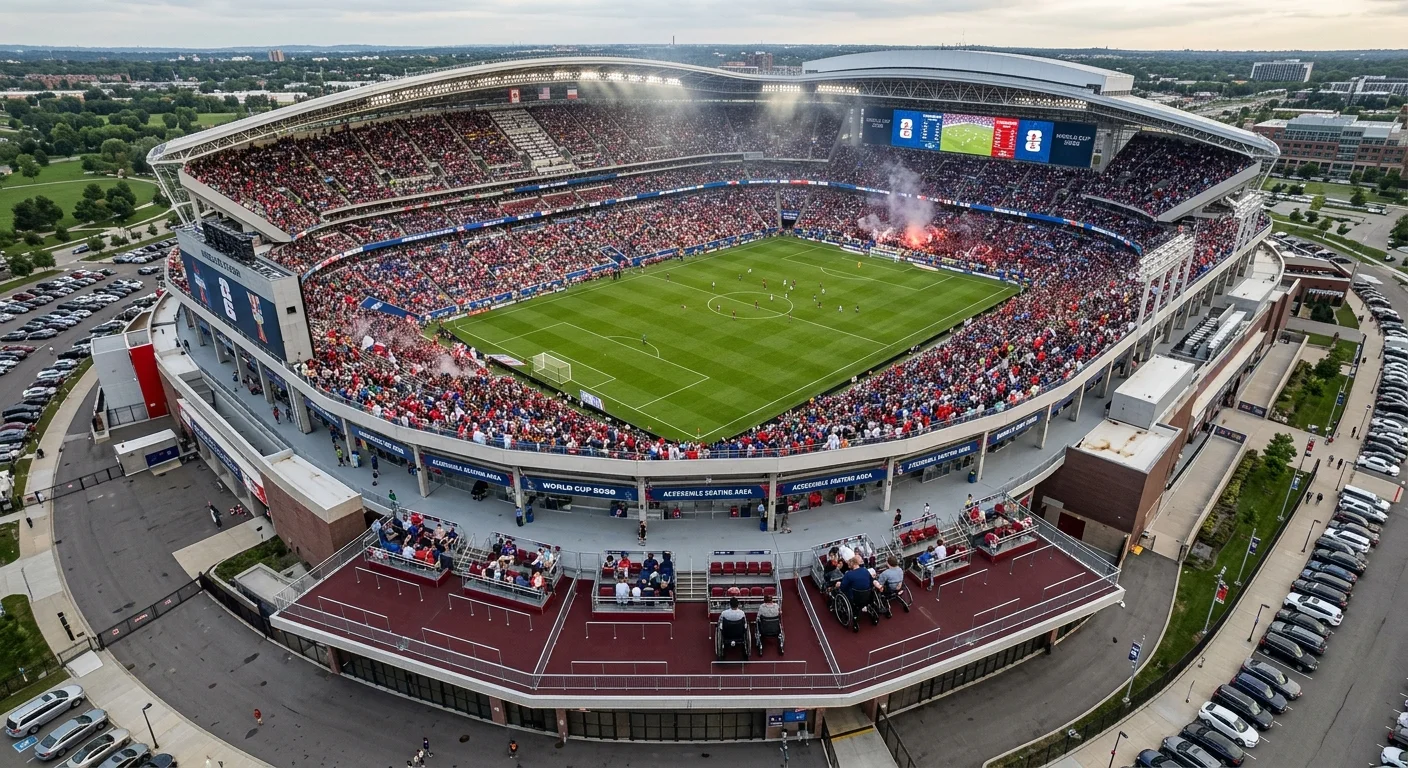
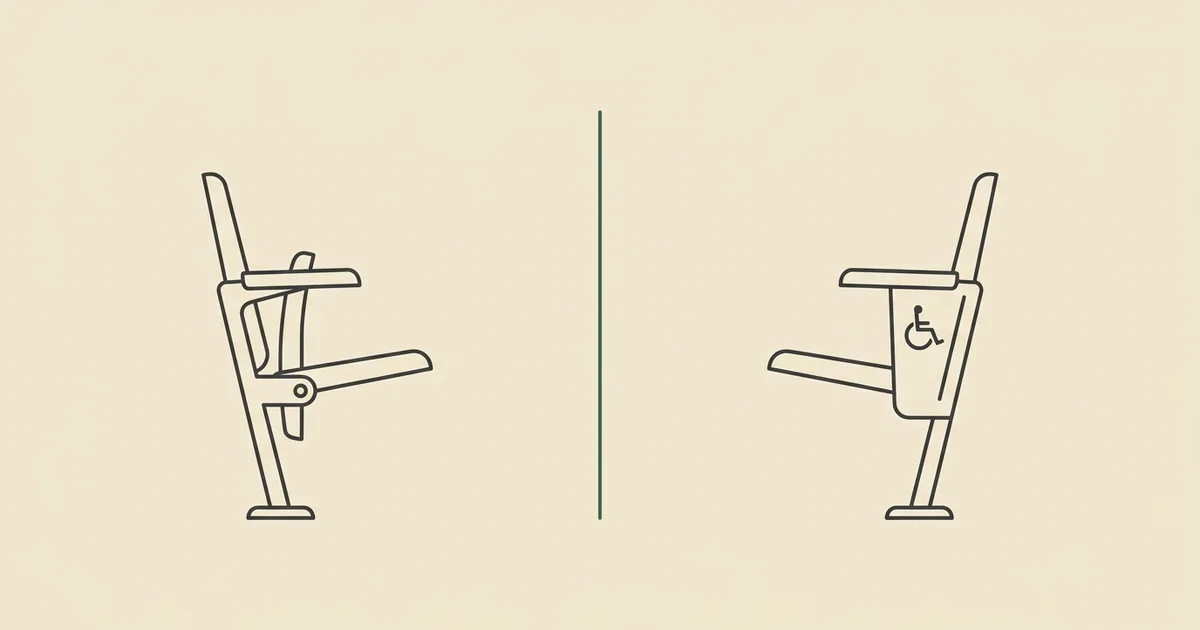
Illustration: FootyGazette (AI-generated concept).
10 min read · 2,119 words
For disabled fans, the 2026 World Cup across the USA, Canada, and Mexico (11 June–19 July, ending at MetLife Stadium) has surfaced a problem that goes far beyond sticker shock. Accessible seating is costing more than ever, and the guarantees that should come with it look thinner than the price tags suggest. The headline numbers are stark, but the structural issue underneath them is what actually decides whether a wheelchair user can attend a match with the person who helps them get there.
This explainer walks through what’s being charged, why the so-called companion-seat trap matters, how accessible booking is supposed to work, and what you can do to protect yourself before, during, and after purchase. We’ve kept the framing general where official policies haven’t been confirmed, because accessibility rules vary by venue and country. When in doubt, the official accessibility page for your specific stadium is the source that counts.
What disabled fans are actually paying
The pricing picture is the part everyone has seen. Group-stage accessible tickets are running between $140 and $450. The cheapest accessible ticket for the final sits at $4,180. According to analysis from the Football Supporters’ Association, that represents a cost increase of up to 38 times more than Qatar 2022, where group-stage tickets started around $10 and included a free companion ticket.
That last detail is the one that reframes everything. At Qatar 2022, the companion came included. For 2026, disabled fans must purchase a separate full-price ticket for a personal assistant, and even after paying twice, FIFA only guarantees that the companion will sit “as close as possible” rather than directly beside the disabled fan. As María Castellano put it in her analysis, “Pay double, and the assistance you paid for might still be a row away.”
The companion-seat trap, explained
Strip away the pricing for a second and the core failure is about function, not cost. A personal assistant is not a luxury add-on. For many disabled fans, that person handles transfers, medication, communication, navigation in a crowd, and dozens of small interventions across a two-hour match. None of that works if the assistant is seated several rows back.
This is the trap. You pay for two tickets on the promise of assistance, but the assistance only exists if the two seats are adjacent. Seat one person in the accessible bay and the other ten rows up, and the disabled fan has effectively paid double for a companion who can’t reach them when it matters. As Castellano notes, “A tournament that can engineer dynamic pricing to the cent can certainly engineer two seats next to each other.” The technical capability plainly exists. What’s missing is the commitment to use it.
There’s a second squeeze worth naming. You can’t simply opt for a cheaper non-accessible seat to save money, because the accessible seat is the reason you can attend at all. “You cannot choose a cheaper non-accessible seat when accessibility is the reason you can attend at all.” The disabled fan has no cheaper alternative to trade down to, which removes the one lever other fans use when prices climb.
How accessible seating is supposed to work
It helps to understand the baseline that accessibility law sets in the United States, because it clarifies how big the gap is between standard practice and what’s being offered here. The Americans with Disabilities Act (ADA) governs spectator venues across the US host cities, and its requirements are fairly specific. Canada and Mexico operate under their own frameworks, so treat the ADA as the US baseline rather than a tournament-wide rule. Policies vary by venue, and the official accessibility page is always the final word.
Under ADA standards for assembly areas, a companion seat must sit immediately next to each wheelchair space, positioned so the companion’s shoulder roughly aligns with the wheelchair user’s. That companion seat is supposed to match the size, comfort, and quality of surrounding seating, not a folding chair wedged into an aisle. The whole point is that a disabled fan and their companion are not isolated from each other or from the rest of the crowd.
ADA rules also require dispersal. Wheelchair spaces should be spread both horizontally around the field and vertically across seating levels, and they should span a variety of price categories rather than being dumped into a single zone. Sightlines matter too: where spectators are likely to stand during play, accessible positions should offer a line of sight over standing fans, with the same variation in viewing angles other patrons get.
On ticketing specifically, ADA guidance is direct. A buyer of an accessible seat may generally purchase up to three additional contiguous companion seats, and venues must offer those seats “as close as possible” only when adjacent ones are genuinely sold out. Accessible tickets are meant to go on sale during the same stages as everything else, including pre-sales, promotions, waitlists, and lotteries, and venues generally can’t charge a premium for accessible seats within a section. Disabled fans can also transfer accessible tickets to anyone, and someone who bought a non-accessible seat on the resale market can usually exchange it for a comparable accessible one if available.
Read against that baseline, the 2026 controversy comes into focus. The “as close as possible” language is meant to be a rare fallback for sold-out rows, not a default policy stated up front. Selling assistant tickets at full price with no included companion runs against the spirit of integrated, affordable accessible seating that the standards describe.
How to book accessible tickets for 2026
If you’re planning to attend, a methodical approach gives you the best shot at seats that actually work. Booking flows differ by platform and host nation, so adapt these steps to whatever the official channel for your match turns out to be.
- Find the accessible-seating option in the official flow. Most ticketing systems hide accessible inventory behind a filter, toggle, or wheelchair icon rather than showing it by default. Look for it before you assume none is available.
- Identify the access category you need. Venues often separate wheelchair-accessible spaces, low-mobility seats, blind and low-vision areas, and deaf and hard-of-hearing positions. Picking the right one early avoids a mismatch later.
- Request companion seats in the same step. Where the system allows it, add the companion ticket alongside the accessible seat rather than buying it separately. Buying them together gives you the strongest claim to adjacency.
- Get the adjacency promise in writing. Before you pay, request written confirmation that your personal assistant will sit immediately next to you, not merely “nearby.” A screenshot or email beats a verbal assurance.
- Document your access requirements early. If a venue needs proof of need or advance notice for specific accommodations, file it as soon as possible. Late requests are where accommodations quietly disappear.
- Use the venue’s accessibility line. Many stadiums run a dedicated phone or email service for disabled supporters. A human on that line can often confirm bay locations, transfer rules, and companion placement that the website won’t.
- Review resale and category rules before paying. Know whether you can transfer or exchange the ticket, and what happens if your needs change, so you’re not locked into a seat that no longer suits you.
- Keep every receipt. Retain all confirmations and correspondence in case you need to pursue a refund or escalate a complaint after the match.
Common pitfalls to watch for
Even careful buyers hit recurring snags. The most damaging is treating “as close as possible” as acceptable when adjacency was what you needed. If the system only offers a separated seat, push back and ask whether truly adjacent inventory exists before you commit.
Another is buying the companion ticket separately in a later session, which can break the link between the two seats entirely. A third is assuming the accessible bay has a sightline over standing fans; in a tournament where crowds stand for goals and big moments, a low bay can leave you staring at backs. Ask about the line of sight specifically. And don’t assume one venue’s policy carries to the next. A fan attending matches in three different host cities may face three different accessibility processes.
Per-venue caveats
The single most important thing to internalise is that there’s no uniform 2026 accessibility policy you can rely on across all sixteen host cities. Stadiums in the United States, Canada, and Mexico sit under different legal regimes and run different operations. A confirmation you secured for one match tells you little about the next.
Bay locations, the number of companion seats sold per space, transfer rules, and the process for requesting accommodations can all shift from venue to venue. Treat each match as its own booking exercise. Check the official accessibility page for that specific stadium, confirm the details that matter to you in writing, and don’t carry assumptions from one host city into another. Where this article describes general practice, it’s a starting point for questions, not a substitute for the venue’s own confirmed policy.
What to check before you pay: a quick checklist
- Is the companion seat confirmed as immediately adjacent, in writing?
- Were the accessible and companion tickets bought in the same transaction?
- Does the accessible position have a sightline over standing spectators?
- Which access category did you book, and does it match your actual needs?
- What are the transfer, exchange, and refund rules for this specific ticket?
- Did you log your access requirements with the venue early enough?
- Have you saved every confirmation, receipt, and message?
- Have you checked the official accessibility page for this exact stadium?
The advocacy response
Disability and supporter groups have been vocal. Level Playing Field flagged allocation uncertainties and seat-positioning concerns. The Football Supporters’ Association published the comparative pricing analysis that produced the 38-times figure. Football Ground Guide went further, characterising the 2026 approach as FIFA’s “aggressive profiteering.”
If your own experience falls short, reporting it to these organisations does real work. Documented cases give advocacy groups the evidence they need to press for change, and they help build a record that can support refund claims or formal complaints. Retain your receipts and write down what happened while it’s fresh.
FAQ
Do I have to buy a separate ticket for my personal assistant? For 2026, yes. Unlike Qatar 2022, which included a free companion ticket, disabled fans must purchase a full-price companion seat. Policies vary, so confirm the exact terms for your match on the official accessibility page.
Will my companion definitely sit next to me? FIFA’s stated guarantee is “as close as possible,” not adjacent. That’s the heart of the companion-seat trap. Always request written confirmation of immediate adjacency before paying, and buy both seats together where the system allows.
Can I choose a cheaper regular seat instead? Not really, if accessibility is the reason you can attend. The accessible seat isn’t an upgrade you can decline, which is why the pricing pressure lands harder on disabled fans.
Are accessibility rules the same at every stadium? No. US venues fall under the ADA, while Canadian and Mexican venues operate under their own frameworks, and individual stadiums set their own operational details. Check each venue separately.
What does the ADA require for companion seats in the US? Broadly, a companion seat next to each wheelchair space, dispersal across price categories and seating levels, sightlines over standing fans, and equal access during all sales stages. The “as close as possible” fallback is meant for genuinely sold-out rows, not as a standard offer. Confirm specifics with the venue.
What should I do if something goes wrong? Keep every receipt and message, report your experience to advocacy groups like Level Playing Field or the Football Supporters’ Association, and review the venue’s refund and complaint process. Documentation is your strongest tool.
The bottom line
The 2026 World Cup can be a landmark tournament for disabled fans or a cautionary tale, and the difference comes down to whether the people who sold these tickets honour the basics: an adjacent companion, a fair price, a clear sightline, and a process that treats access as a right rather than a premium. Until those guarantees are firm and in writing, the smartest move is to verify everything yourself, document as you go, and lean on the official accessibility page for your specific venue. The tools to seat two people side by side clearly exist. Fans are right to insist they’re used.
For more on how the wider ticketing picture fits together, see our explainer on the World Cup 2026 dynamic-pricing controversy and our breakdown of how seat categories work. For the full tournament rundown, our complete 2026 World Cup guide covers everything from venues to travel.