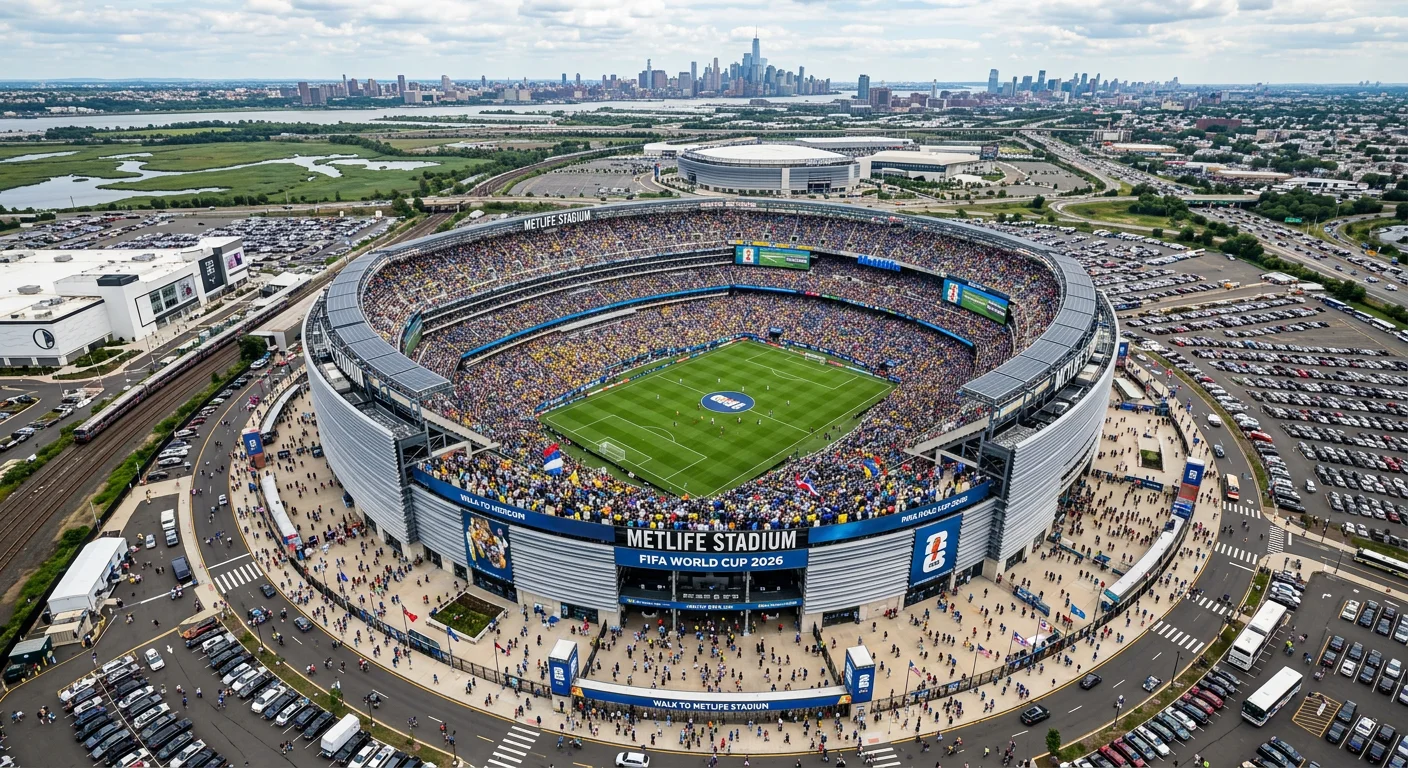
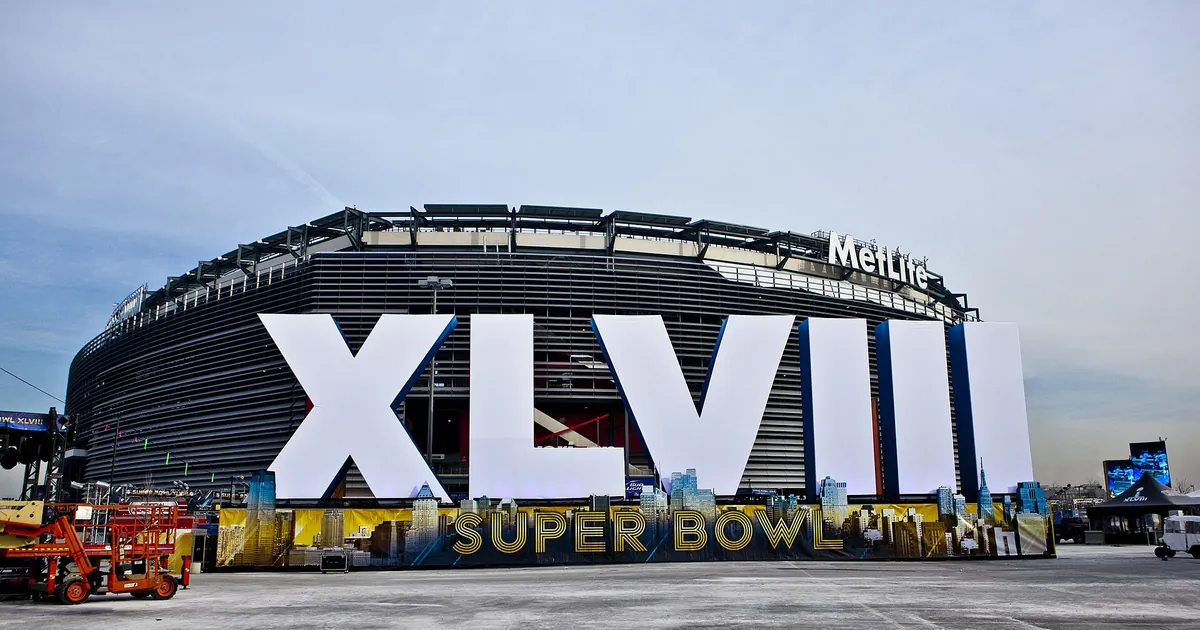
MetLife Stadium in the New Jersey Meadowlands. Photo: Anthony Quintano / Wikimedia Commons, CC BY 2.0
9 min read · 1,911 words
The short answer is no, you cannot walk to MetLife Stadium for the World Cup, and officials are pleading with fans not to try. New York’s Department of Transportation put it plainly: “We would strongly discourage this type of behavior.” The stadium sits inside the Meadowlands Sports Complex, ringed by highways and access ramps that were never built with people on foot in mind. If you turn up imagining a casual stroll from a nearby hotel or train platform, you are going to have a bad night.
That answer surprises a lot of supporters, especially those coming from countries where stadiums sit inside dense neighbourhoods you can reach on foot from a pub or a metro stop. MetLife is different. It was designed around cars, buses and a single rail spur. So before you book anything, it helps to understand exactly where this venue sits, why walking is off the table, and what a realistic plan looks like for getting in and, more importantly, getting out.
Where MetLife Stadium actually sits
MetLife Stadium, branded as New York New Jersey Stadium for the tournament, is in East Rutherford, New Jersey, inside the Meadowlands Sports Complex. It is not in Manhattan, despite the “New York” in its tournament name. The complex is wetland and reclaimed land threaded with major roads, including the spaghetti of ramps tied to the New Jersey Turnpike and Route 3. Those roads are the arteries that feed the place, and they leave almost no room for pedestrians.
This matters because the geography drives every other decision. The stadium holds 82,500 people. There is no surrounding grid of streets, no walkable downtown attached to it, and no pedestrian-friendly approach from the nearest towns. The nearest mall, American Dream, sits across the complex and connects by existing pedestrian bridges, but that is a parking-and-crossing arrangement, not a walk in from the wider area. Everything else arrives by rail, by bus or by car.
Can you actually walk in? The honest reality
People still ask whether they can simply park a mile or two away and hoof it the rest of the distance to save money or skip the queues. The blunt reality is that the surrounding road network makes this dangerous and, in practical terms, prohibited. As the guidance stresses, “no one should walk along any highways outside of designated pedestrian zones.” There are no sidewalks along these high-speed routes, no safe shoulders, and no marked crossings for the kind of foot traffic a World Cup match would generate.
There is one narrow exception that gets confused with walking. Fans can pay around $225 to park at the neighbouring American Dream mall and cross to the stadium over existing pedestrian bridges. That is the only sanctioned on-foot stretch, and it is the tail end of a paid parking arrangement, not a free walk-up route. You buy the premium parking in advance, leave the car at American Dream, then cross the bridges. You do not get to skip the cost by parking elsewhere and walking, because there is no safe “elsewhere” to walk from.
So if your mental model is “I’ll figure out the last mile on foot,” drop it now. The last mile here is a highway, and highways do not work as footpaths.
The train, the fare fight, and the egress problem
Rail is the backbone of getting to MetLife, and it runs through one chokepoint: Secaucus Junction. Under the World Cup plan, fans transfer at Secaucus to a matchday-only connection that runs to the stadium, and that service is reserved for ticket holders. There are about 40,000 rail seats available per match, which is the single largest organised way in.
The fare became a story of its own. NJ Transit originally set a round-trip World Cup fare of $150, well above a normal fare of around $12.90. After public backlash, the authority cut it by 30% to $105. Shuttle buses are offered at roughly $80, running from designated pickup points. Park-and-walk through American Dream lands near $225. Those are the three sanctioned routes: rail at $105 round-trip, shuttle at about $80, and the American Dream parking-and-bridge option at about $225.
Here is the part most fans underestimate. Getting in is the easy half. Arrivals spread across the whole afternoon and early evening as people drift toward the stadium, so the inbound flow is a gradual trickle the system can absorb. The exit is the opposite. A night match sends about 82,500 people to the gates at once, somewhere near 11pm, all wanting to leave in the same twenty-minute window.
Now stack the constraints on top of each other. Walking is banned. Rail capacity is finite, capped near that 40,000 figure. Rideshare gets throttled by gridlock around the complex. So you have tens of thousands of people competing for a limited number of seats and road slots, late at night, after a long day. That is why the journey home is the real bottleneck, not the journey there.
Why MetLife is something close to a worst-case venue
Every World Cup host stadium has its quirks, but MetLife combines several hard problems in one place. It is large, with 82,500 seats to empty. It is isolated, with no walkable surroundings to absorb the crowd. It depends on a single rail spur funnelled through one junction. And it bans the pressure-release valve that walking normally provides at urban grounds.
Compare that with a stadium sitting inside a city, where after the final whistle people scatter on foot in a dozen directions, finding bars, multiple metro lines and side streets. That natural dispersal takes pressure off any single system. MetLife has none of that. The crowd has to leave through the same few channels it arrived by, in a far tighter time window. We dug into how different venues stack up in our look at which host cities are getting fan costs right, and the contrast in access is stark.
What fans should realistically plan
The guiding principle for MetLife is simple: plan the exit before you plan the entrance, and assume the journey home takes far longer than the journey in. Build your whole evening around leaving, because that is the hard part. With that mindset, here is how to think it through.
Pick your route early and lock it in. The matchday rail tickets are sold in advance, capped, and not available to buy on the day. If rail is your plan, treat the ticket as something you secure the moment it goes on sale, not the week of the match. The same urgency applies to American Dream premium parking, which is limited and advance-purchase only.
Arrive early, on purpose. Because inbound flow is spread out, getting there hours before kickoff is genuinely easier and far less stressful than cutting it close. Early arrival also means you are not fighting the densest part of the inbound crush, and you can scout your exit before the match.
Decide your departure strategy in advance. Some fans leave a few minutes early to beat the rush, which is a personal trade-off against missing the end of a match. Others plan to wait it out deliberately, grabbing food or staying in their seats while the first wave clears, rather than standing in a motionless queue for an hour. Both are valid. Drifting out with no plan is the one that ends in misery.
Match your accommodation to your transport. If you are relying on rail through Secaucus, staying somewhere with a clean connection back to Penn Station or your line makes the late return far smoother. NYC-based fans should note that rail travel to the stadium routes through Penn Station, so build your night around that hub.
Treat rideshare as a backup, not a baseline. Rideshare around the complex is supplemental and prone to surge pricing and gridlock, with pickups pushed to designated zones rather than the stadium itself. It can rescue you in a pinch, but planning your whole trip around a late-night rideshare from the Meadowlands is asking for trouble.
Common mistakes that ruin the night
Assuming “New York” means Manhattan. The stadium is in New Jersey, in the Meadowlands. Book hotels and plan routes around that fact, not around a Times Square mental map.
Planning to walk the last stretch. Covered above, but worth repeating because it is the single most dangerous misconception. The roads around MetLife are not walkable, and officials have asked fans directly not to attempt it.
Leaving tickets and transport to the last minute. Matchday rail is capped and advance-only, premium parking is limited, and shuttles fill up. The fans who struggle most are the ones who showed up assuming they could sort transport on the day.
Forgetting that the match ends late. A night kickoff means an exit near 11pm with 82,500 others. If you have an early flight, a long drive, or kids fading fast, plan for a slow exit and pad your timings generously.
Underestimating the cost. Between fares, parking and the temptation of rideshare, the day adds up quickly. The reduced $105 round-trip rail fare is the most capacity-friendly option, but it is still a long way from the everyday $12.90 fare locals are used to.
Putting it together
MetLife rewards fans who respect its constraints and punishes those who wing it. The venue is big, boxed in by highways, and served by a rail spur that funnels everyone through Secaucus Junction. Walking in is not an option, the only on-foot stretch is the paid American Dream bridge crossing, and the genuine challenge is the mass exit after a late finish. Secure your transport early, arrive with time to spare, and have a clear, deliberate plan for leaving. Do that, and a night at the World Cup in the Meadowlands becomes a great memory rather than a three-hour ordeal in a car park.
For the wider picture on how this tournament is being organised, including the trade-offs cities are making, read our look at the logistics and politics of 2026, and our complete guide to the 2026 World Cup for everything else you need before kickoff.
FAQ
Can you walk to MetLife Stadium for the World Cup?
No. Walking is prohibited because the stadium is surrounded by highways with no pedestrian access, and New York’s Department of Transportation has strongly discouraged it. The only sanctioned on-foot option is paying about $225 to park at the American Dream mall and crossing pedestrian bridges to the stadium.
How much is the train to MetLife Stadium for World Cup matches?
NJ Transit originally set a round-trip World Cup fare of $150, versus a normal fare of around $12.90, then cut it by 30% to $105 after public backlash. Shuttle buses are offered at roughly $80, with about 40,000 rail seats available per match.
What is the hardest part of getting to a MetLife World Cup match?
Leaving. Getting in is a gradual trickle across the afternoon, but a night match sends about 82,500 people to the exits at once near 11pm. With walking banned, finite rail capacity and rideshare gridlock, the post-match journey home is the real bottleneck.
Where do trains to the stadium connect?
Through Secaucus Junction. Fans transfer there to a matchday-only service reserved for ticket holders, and rail capacity is capped at around 40,000 seats per match. Tickets are sold in advance and are not available to buy on the day.
Is there parking at MetLife for World Cup matches?
There is no general spectator parking on stadium property on matchdays. The limited premium option is advance-purchase parking at American Dream, which connects to the stadium by pedestrian bridge for roughly $225.