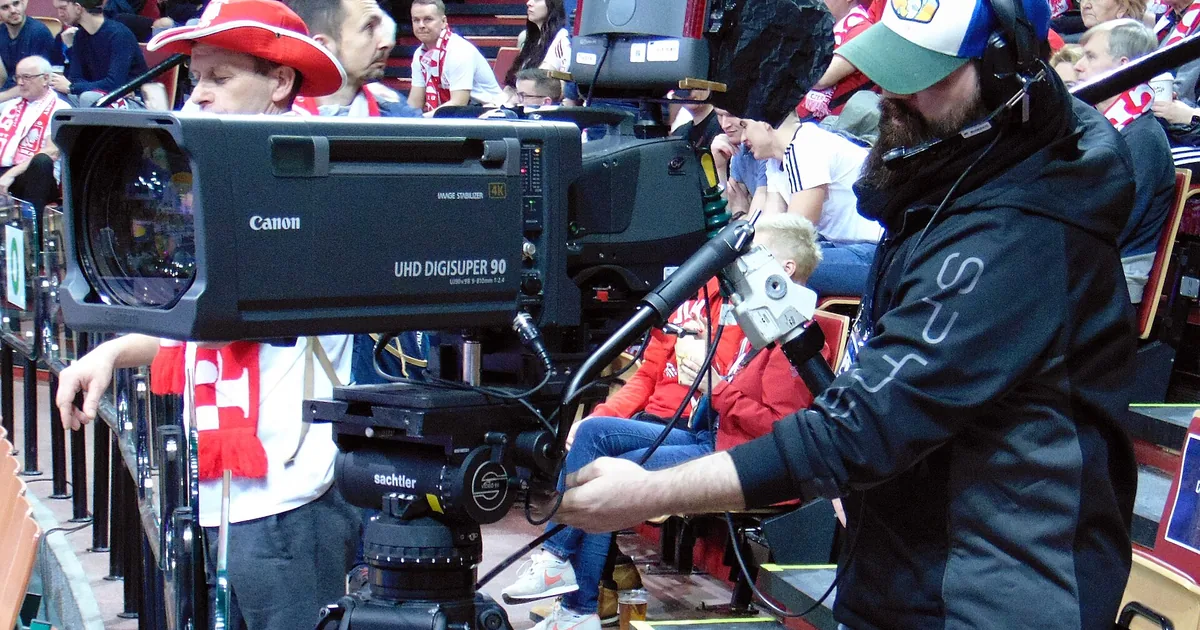
A broadcast camera and long lens at a stadium. Photo: Zalasem1 / Wikimedia Commons, CC BY-SA 4.0
11 min read · 2,384 words
The short version. With weeks to go before kick-off, the two most populous nations on earth, India and China, a combined 2.8 billion people, still have no broadcaster for the 2026 World Cup. FIFA has deals in 175 territories, but the gaps are enormous, and even in the United States the rights are split across so many platforms that watching all 104 matches legally means juggling subscriptions. This is what happens when a governing body treats broadcast rights as a pure auction.
If you are trying to work out how to watch the 2026 World Cup, the honest answer in much of the world right now is: you may not be able to. That is not a streaming-guide quibble. Weeks out from the opening match at Estadio Azteca, the broadcast rights to football’s biggest-ever tournament remain unsold across markets representing well over a billion people, and the reasons are commercial, not technical.
FIFA has confirmed media agreements in 175 territories. That sounds comprehensive until you look at which territories are missing. Sports Illustrated reported that as much as half the planet may have no straightforward legal way to watch, with India and China the two glaring holes. Both are, by any measure, the most valuable growth markets in world sport. Both, with the tournament almost upon us, are dark.
How broadcast rights actually get sold
Before we get to the gaps, it helps to understand the machinery that creates them. FIFA doesn’t sell one global stream. It carves the world into territories and auctions each one separately, market by market. A single company often wins a country, then sub-licenses individual matches out to free-to-air channels, pay-TV networks and digital platforms underneath it. That structure is why your experience of the same tournament depends entirely on which side of a border you happen to be standing on.
Everything downstream of that auction flows from territorial exclusivity. A rights-holder in one country has no legal standing to serve viewers in another, and platforms police the line with geo-blocking that reads your connection and decides what you’re allowed to see, so an app that streams every match at home can simply stop working the moment you cross a frontier. Layered on top of that hard border is a softer kind of variation: the access model itself differs wildly from market to market. One nation might guarantee the opener, its own team’s fixtures and the final on free-to-air television. The country next door might lock the full schedule behind a paid sports tier, an authenticated streaming login or a telecom bundle. Neither arrangement is wrong; they are simply different auctions, settled by different buyers chasing different priorities.
The takeaway for fans is simple and worth repeating throughout any World Cup: rights vary by country, and the only reliable move is to check your local broadcaster. There is no single answer to “where is the match,” because the question was never designed to have one.
How a billion-viewer market goes unsold
The mechanics are instructive. In India, a Reliance-Disney joint venture reportedly offered around $20 million for the rights. FIFA had been seeking $100 million. The bid was rejected, and FIFA has since been reported to have lowered its ask to roughly $60 million, the same figure Reliance paid for the 2022 tournament. The negotiation has dragged so close to kick-off that even a late deal would leave a broadcaster almost no runway to build the promotion, sponsorship and scheduling that a World Cup normally enjoys.
China is arguably stranger. For the last two tournaments, state broadcaster CCTV locked in exclusive rights early, with sponsorship and trailers running months ahead. For 2026, there is still no agreement, a silence industry observers have called genuinely unusual. To put the stakes in context, FIFA’s own broadcast reach figures show the 2022 tournament reached 1.16 billion people in China and 746 million in India through linear, digital and social channels. Those are not rounding errors. They are the audience.
FIFA’s position, broadly, is that it will not undersell the product, and that deals are still being done. That is a defensible negotiating stance for a normal rights cycle. It is a far riskier one for a World Cup expanded to 48 teams and 104 matches, where the commercial case was always built on reaching more people, not fewer.
What a “blackout” really means
The word blackout gets thrown around loosely, so it’s worth pinning down the scenarios fans actually face. A genuine market blackout, the India-and-China case, is when no broadcaster has bought a territory at all, leaving an entire country with no licensed way to watch. That’s the rarest and most severe version, and it’s usually a pricing standoff rather than a technical failure.
Far more common are the softer gaps. A country might have a rights-holder, but one that only puts the marquee fixtures on free-to-air and buries the rest behind a subscription, so a fan who won’t pay effectively experiences a partial blackout. Another frequent pattern is the split-rights maze, where coverage exists but is scattered across several platforms, none of which carries the whole tournament. And then there’s the cross-border trap: a service you already pay for at home goes dark the moment you travel, because the rights that made it work stop at the border. Many countries also maintain “listed” or protected events, rules that keep nationally important matches on free channels, but those lists differ by country and rarely cover all 104 games. Each of these is a different problem with a different fix, which is why a generic streaming guide tends to mislead and the only dependable step is checking your own national broadcaster.
Even where the rights sold, watching is a maze
The blackout risk is the headline, but the fragmentation problem is the one most readers will actually feel. Take the United States, the tournament’s primary host market, where rights very much did sell. English-language coverage is split between Fox and FS1; Spanish-language sits with Telemundo; and cord-cutters are left to assemble their own solution. As one fan put it bluntly on r/cordcutters the choice comes down to “Fox One for the 34 FS1 games or just an antenna to pick up the rest of the 70 Fox games.”
That is the lived reality of modern rights deals: even when a tournament is fully licensed in your country, “watching the World Cup” can mean a broadcast subscription, a streaming add-on, an over-the-air antenna and a second-language channel, then cancelling it all in July. Another US viewer described the plan with weary precision: subscribe to a streaming tier “for the duration of the tournament and then cancelling.” The product fans actually want, every match, one place, one price, does not exist, because the rights were never sold that way.
A general map of how markets tend to differ
Specific deals shift right up to kick-off, so treat what follows as shape rather than a fixed schedule, and confirm everything against your own national broadcaster. Broadly, markets fall into a few families. Some countries lean heavily free-to-air, putting most or all matches on public channels with no subscription required, which historically has been the World Cup’s calling card. Others run a hybrid, free-to-air for the big games and a paid sports tier or streaming service for full coverage. A third group is streaming-first, where a digital platform or telecom partner holds the rights and a login or app subscription is the main route in. And the smallest, hardest group is the unsold market, where the auction simply hasn’t closed.
Where your country sits in that spread determines your whole experience, and it can change between tournaments as rights move between buyers. The constant across all of them is that the schedule is decided locally. If you want certainty about kick-off channels, the only authority is the rights-holder for your territory, not a global guide that can’t account for 175 separate deals.
The analysis: this is a pricing failure, not a piracy problem
Here is the part the official channels will not say out loud. The instinct, when a billion people cannot legally watch, is to talk about piracy, illegal streams, VPNs, the usual moral panic. That instinct gets the causation exactly the wrong way round. When the legitimate product is unavailable or unaffordable across an entire country, the illegal viewing that follows is best understood as the market routing around a supply failure that FIFA itself created.
FIFA’s revenue model has shifted the risk of that failure onto fans. By holding out for record fees in a compressed timeline, it has converted “near-universal free-to-air reach”, historically the World Cup’s single greatest asset and the foundation of its sponsorship value, into a bargaining chip. If India and China go dark, the people who lose are not FIFA’s negotiators. They are the hundreds of millions of viewers who simply will not see Messi’s last tournament, and the sponsors who paid for an audience that did not materialise. A governing body that genuinely prioritised the global game would treat sub-$100m reach in a 1.4-billion-person market as a strategic win worth taking.
The deeper point is that broadcast access and ticket pricing are the same story told twice. In both, FIFA has discovered that demand for the World Cup is so vast it can be auctioned to the highest bidder, and in both, it has learned that maximising the auction price means leaving ordinary fans on the outside. We have written about the ticketing side of that equation in our look at which host cities are getting fan costs right; the broadcast story is the away leg of the same fixture.
There is also a compounding cost that FIFA’s negotiators seem unwilling to price: an audience is not a tap you can turn off for one cycle and reopen the next. A World Cup that goes dark in a market does not merely lose that summer’s viewers, it interrupts the generational handover by which the tournament recruits its next supporters. The child in Mumbai or Chengdu who never watches Messi’s farewell does not arrive in 2030 as a paying fan, a shirt buyer or a subscriber; they arrive indifferent. A nine-figure rights cheque is banked once, but the habit of watching is built, or broken, for a decade. Set against that arithmetic, the gap between FIFA’s $100m ask and the $20m on the table in India looks less like hard bargaining and more like an organisation mispricing its own future: defending this cycle’s revenue line by quietly liquidating the next one. Rights-holders call that discipline. An economist would call it eating the seed corn.
What fans can actually do
If you are in one of the 175 covered territories, the practical advice is unglamorous: identify your national rights-holder early, work out which matches sit behind which platform, and budget for a one-month stack of services you will cancel afterwards. If you are in India, China or another uncovered market, watch the next fortnight closely, late deals do happen, and a broadcaster signing in June will move fast to publicise it. For the format and scheduling that determines which games matter, our 48-team format explainer lays out the maths, and the full picture lives in our complete guide to the 2026 World Cup.
A few habits help in any market. Map your group-stage fixtures first, since those are the games you’ll plan your month around, and note which platform carries each one before you commit to a subscription. If your country splits coverage between free-to-air and pay tiers, you may catch the matches you care about most without paying anything, so check the free channels before you reach for the wallet. If you’ll be travelling during the tournament, remember that a home subscription can stop working abroad thanks to territorial rights, so plan for the country you’ll actually be in. And if your market is still unsold, keep an eye on the rights-holder you’d expect to win it, because publicity follows a late signing within days.
But the broader lesson is for FIFA, and it will outlast this tournament. A World Cup that a billion people cannot watch is not a more valuable World Cup. It is a smaller one, whatever the rights cheque eventually says.
Frequently asked questions
How can I watch the 2026 World Cup?
It depends entirely on your country. FIFA has licensed broadcast rights in 175 territories, each with its own rights-holder, in the United States that means Fox and FS1 in English and Telemundo in Spanish, often requiring a mix of cable, streaming and an over-the-air antenna to catch all 104 matches. Identify your national broadcaster first, then map which matches sit on which platform.
Why might fans in India and China not be able to watch?
Neither country had an agreed broadcaster in the weeks before kick-off. In India a reported $20m bid fell far short of FIFA’s $100m asking price, later cut to around $60m; in China, state broadcaster CCTV, which locked in the last two tournaments early, had still not signed. Together the two markets account for roughly 2.8 billion people.
Will the broadcast rights deals still be signed before the tournament?
Possibly. Late deals are common in rights negotiations, and a broadcaster signing in June would publicise it quickly. But a deal struck days before kick-off leaves almost no time to build the scheduling, promotion and sponsorship that normally surround a World Cup, so even a resolution would be a diminished one.
Why does the World Cup look different in every country?
Because FIFA sells rights territory by territory rather than as one global package. Each market is its own auction with its own winner, so one country gets every match free-to-air while another splits the schedule across pay-TV and streaming. Rights vary by country, which is why the safest move is always to check your local broadcaster rather than rely on a one-size-fits-all guide.
Can I just use a service from another country?
Generally no. Broadcast rights are territorial and platforms enforce that with geo-blocking tied to your location, so a service licensed elsewhere is not meant to work outside its market and a home subscription can go dark when you travel. The dependable route is the legitimate rights-holder for the country you’re actually in.