
8 min read · 1,718 words
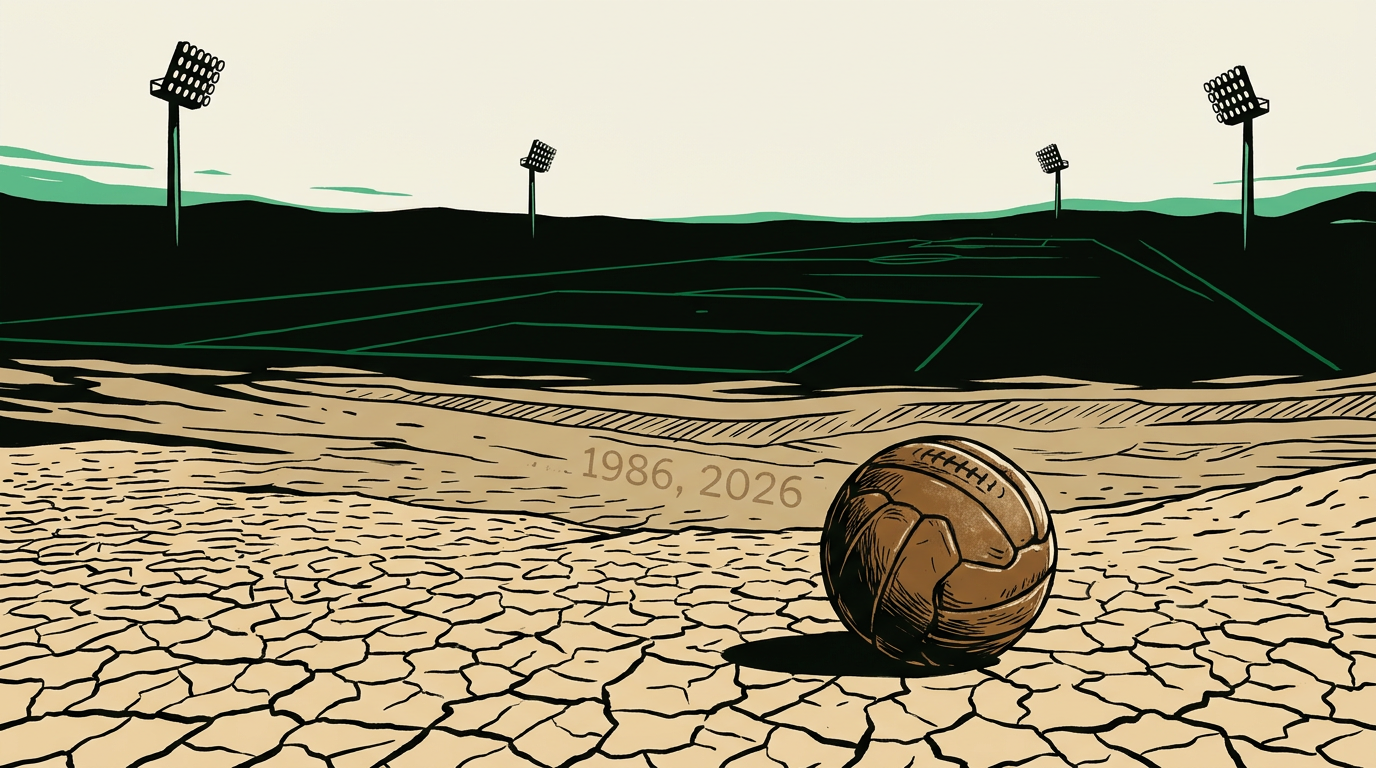
Forty years is a long time in football. Empires rise and crumble. Formats change. Entire generations of supporters are born, grow up, and grow old without ever watching their country compete on the grandest stage. For Iraq, the gap between their only previous World Cup appearance, Mexico 1986, and the tournament that kicks off in North America this summer is not merely a statistic. It is a chronicle of war, international isolation, sporting sanctions and, finally, cautious, hard-won renewal.
When Iraq take to the pitch at the 2026 World Cup they will do so as one of the most emotionally loaded stories of the entire tournament. And the squad selected to carry that weight is, in its own quiet way, a reflection of how dramatically the world, and Iraqi society, has changed since Adnan Dirjal’s side lost all three group games in Guadalajara nearly four decades ago.
A History Written in Absences
To understand what this qualification means, you have to understand what stood in the way of it for so long. As BBC Sport’s long-form feature on Iraq’s 40-year wait makes clear, the country’s footballing journey has been shaped almost entirely by forces outside the sport itself. The Gulf War, the subsequent UN sanctions regime of the 1990s, the 2003 invasion and its aftermath, and a period of FIFA suspension following government interference in the football federation, each episode carved years off a potential World Cup return that always seemed to be just around the corner.
The sanctions era was particularly devastating for football infrastructure. Clubs could not import equipment. International fixtures dried up. The national programme, which had been genuinely competitive in Asian football during the late 1970s and early 1980s, effectively stalled. Iraq won the AFC Asian Cup in 2007, a moment of extraordinary national catharsis played out against the backdrop of ongoing civil conflict, but World Cup qualification remained elusive, thwarted by the structural damage those decades of isolation had inflicted on the game’s grassroots.
What has changed now is partly tactical and partly generational. Iraq’s current squad blends experienced domestic professionals with a cohort of diaspora players raised in Europe and carrying dual identities that would have been inconceivable to the 1986 generation. That blend is where the real story of 2026 lies.
Al-Hamadi, Iqbal and the Diaspora Factor
The most high-profile names in the squad, as confirmed in the BBC Sport squad announcement are Ipswich Town forward Ali Al-Hamadi and Manchester United academy product Zidane Iqbal. Both players represent a phenomenon that has quietly reshaped international football across Asia and the Middle East: the European-raised second-generation player choosing to represent their heritage nation rather than the country of their birth.
Al-Hamadi’s journey is particularly instructive. Born in Sweden to Iraqi parents, he came through non-league football in England before Ipswich took a chance on him. His rise to the Premier League, and now to a World Cup squad, is the kind of story that resonates far beyond the touchline. For Iraqi supporters in Stockholm, in London, in Detroit, he is proof that the diaspora can feed back into the national project in tangible, competitive ways.
Iqbal’s path is different but equally symbolic. The Manchester United youth product, whose father is Pakistani and whose mother is Iraqi, chose Iraq over any other national allegiance. In an era when eligibility rules are frequently tested and occasionally gamed, his commitment felt genuine, the product of a considered identity choice rather than a calculation about playing time. He has become one of the more technically accomplished midfielders in the squad, and his ability to operate in tight spaces will matter enormously if Iraq are to avoid the heavy group-stage defeats that defined 1986.
Together, these players represent something broader than their individual talents. They are evidence that the Iraqi football federation has, in recent years, invested seriously in identifying and recruiting eligible diaspora talent, a strategy that mirrors what Morocco did so effectively in reaching the semi-finals of the 2022 World Cup, and what several other nations across Africa and Asia have pursued with increasing sophistication.
What 1986 Actually Looked Like, and Why It Matters
Iraq’s only previous World Cup appearance ended with three defeats, no goals scored, and four conceded. On paper, it looks like a forgettable campaign. In context, it was anything but. The team had qualified through the Asian zone during a period when the continent received fewer automatic berths, meaning the achievement of getting there at all was considerable. The squad was drawn almost entirely from domestic clubs, many of them operating under the patronage of Uday Hussein, Saddam’s son, whose involvement in Iraqi sport was as brutal as it was distorting.
Players from that era have spoken in subsequent years about the psychological pressure they operated under, the threat of punishment for poor performances, the absence of any genuine coaching autonomy, the impossibility of making football decisions in a purely sporting context. That the 1986 squad performed as composedly as they did, given those circumstances, is arguably more remarkable than the results suggest.
The 2026 squad operates in an entirely different environment. Iraq’s football federation, whatever its ongoing challenges, functions without the direct political terror that defined the Saddam era. The coach has genuine tactical latitude. Players can speak to the media without fear. These are not small things. They are the basic preconditions for competitive football, and Iraq has only recently been able to take them for granted.
Group Stage Prospects and Tactical Realities
Realism is important here. Iraq are not arriving at the expanded 48-team tournament as dark horses in the way that, say, Morocco or Japan have been framed in recent cycles. The AFC’s additional berths under the new format have made qualification somewhat more achievable for Asian nations, but the gap between Iraq’s best players and the elite of European and South American football remains significant.
What Iraq can realistically target is competitive performances, matches that are close, that require opponents to work, that demonstrate the programme’s progress. The 2007 Asian Cup victory showed that Iraqi football, at its best, can produce tactically disciplined, emotionally motivated performances that exceed the sum of their parts. Replicating that on a World Cup stage, against opposition of a different calibre, is the challenge facing the coaching staff.
Al-Hamadi’s physicality and movement in behind defensive lines gives Iraq an outlet that the 1986 squad simply did not have. Iqbal’s ability to circulate the ball in midfield provides a technical foundation. Whether the squad has sufficient depth to sustain those qualities across three group games, potentially against very different styles of opposition, is the open question.
For context on how the broader World Cup landscape is shaping up, the 48-team format means more Asian and African nations are present, which changes the group-stage calculus considerably. Iraq will not necessarily face the same wall of European quality that confronted them in 1986. That is not a reason for complacency, but it is a reason for measured optimism.
The Cultural Weight of a Return
There is a dimension to this story that purely sporting analysis tends to undervalue. Football in Iraq is not simply entertainment. It is one of the few genuinely unifying cultural forces in a society that has been fractured along sectarian, ethnic and regional lines by decades of conflict and political dysfunction. The 2007 Asian Cup triumph, won during some of the worst sectarian violence of the post-invasion period, demonstrated football’s capacity to provide, however briefly, a shared national experience that transcended those divisions.
A World Cup appearance carries that weight multiplied. For the Iraqi diaspora spread across Europe, North America and Australia, many of whom fled the country during the worst years of the 1990s and 2000s, watching their national team compete in a World Cup on North American soil carries a particular resonance. Some of them live in the host nations. Some will be in the stands. The emotional geography of this tournament, for that community, is unlike anything a purely sporting framework can capture.
This is the cultural depth that tends to get lost when Anglo-American football coverage reduces Iraq’s story to a footnote about qualification routes and squad rankings. The 40-year wait is not an abstract number. It maps onto specific historical catastrophes, the Iran-Iraq War, the Gulf War, the sanctions, the invasion, that shaped the lives of millions of people. Football did not cause any of those things, but it absorbed their consequences, and the return to the World Cup is, in a real sense, a partial reckoning with all of them.
FAQ
When did Iraq last appear at the World Cup?
Iraq’s only previous World Cup appearance was at Mexico 1986, where they lost all three group-stage matches without scoring a goal. The 2026 tournament marks their return after a 40-year absence shaped by wars, sanctions and periods of FIFA suspension.
Who are the key players in Iraq’s 2026 World Cup squad?
Ipswich Town forward Ali Al-Hamadi and Manchester United academy product Zidane Iqbal are among the most prominent names, as confirmed in the official squad announcement covered by BBC Sport. Both are diaspora players who chose to represent Iraq despite growing up in Europe.
Why did Iraq miss so many World Cups between 1986 and 2026?
A combination of factors kept Iraq away from the tournament for four decades: the devastation of the Iran-Iraq War and Gulf War, UN sanctions that crippled football infrastructure, the 2003 invasion and subsequent instability, and a period of FIFA suspension following government interference in the football federation.
How does the expanded 48-team format affect Iraq’s chances?
The new 48-team format allocates more berths to the AFC, making qualification more achievable for Asian nations. In the group stage, Iraq may face a more varied mix of opposition than the purely European-heavy groups of previous tournaments, which could work in their favour.
What is the significance of diaspora players for Iraq’s football programme?
Players like Al-Hamadi and Iqbal represent a deliberate federation strategy to recruit European-raised players of Iraqi heritage. This mirrors approaches taken successfully by Morocco and other nations, and brings technical quality developed in elite European academies into a national programme that domestic football alone could not produce.
Where can I watch Iraq’s World Cup matches?
For information on how to follow Iraq and the rest of the tournament’s action, visit our guide to watching football online and check our dedicated World Cup 2026 broadcast guide for full coverage details.
