
7 min read · 1,503 words
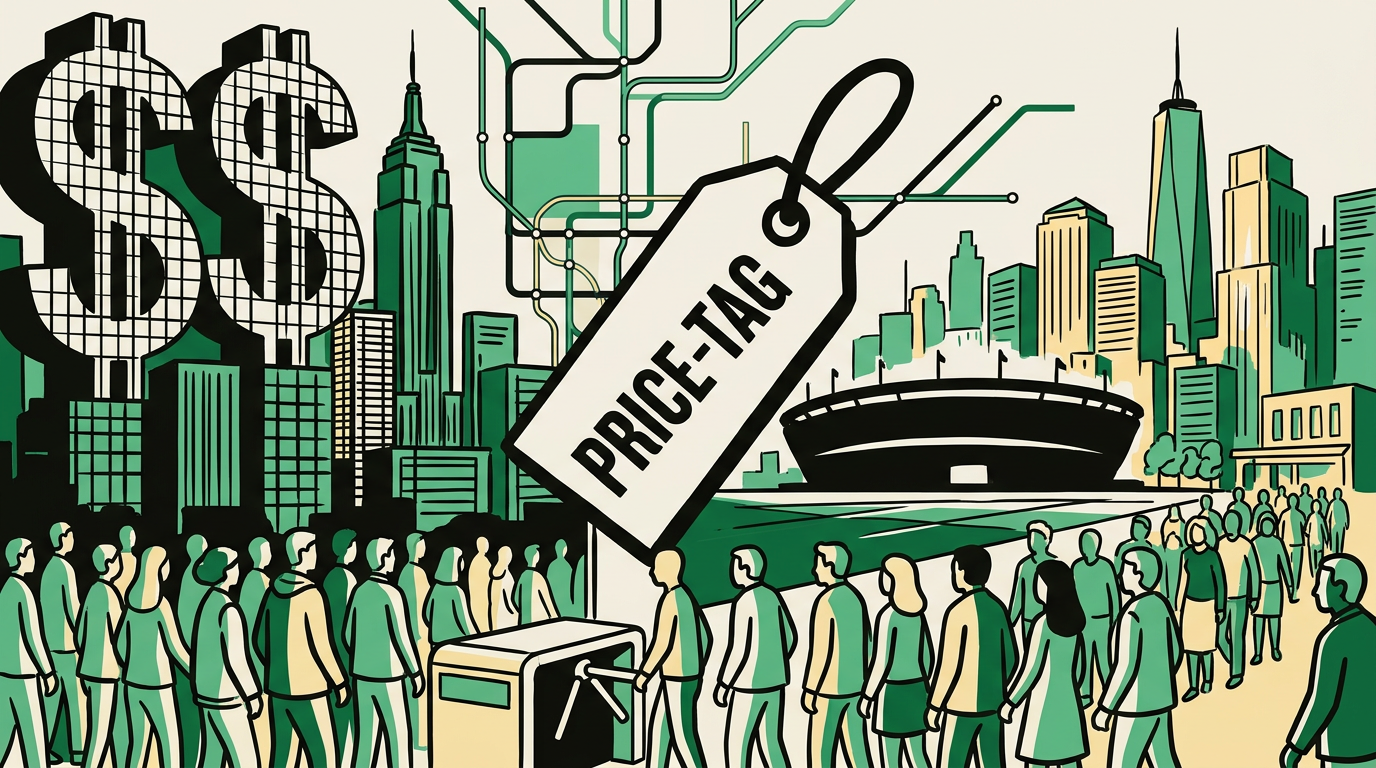
The 2026 FIFA World Cup arrives in North America this summer carrying the usual commercial apparatus: corporate hospitality tiers, secondary-market ticket inflation, and hotel rates that would make a central banker wince. Yet a handful of host cities are doing something quietly radical, treating supporters as guests rather than revenue units. The numbers, where they exist, are instructive.
The Philadelphia Model: Cheap Transit, Falling Resale Prices
Start with the most striking data point. Public transport to Lincoln Financial Field, rebranded Philadelphia Stadium for the tournament under FIFA’s sponsorship protocols, will cost fans $2.90 per journey according to the Guardian’s reporting on host-city pricing. That is not a subsidised World Cup fare. That is simply what Philadelphia’s transit system charges.
More telling still: resale ticket prices for matches at the venue have fallen roughly 16% over the past month, bucking the speculative upward pressure that typically grips secondary markets as a major tournament approaches. Fan festivals in the city will remain free throughout the tournament. There will be no tiered shade pricing, a practice the Guardian notes is already in evidence in Los Angeles, where premium cover reportedly commands three times the standard rate.
Philadelphia’s approach is partly structural and partly deliberate. The city has invested in its public-transport links, its hotel stock is not artificially constrained, and local organisers appear to have made a conscious decision to compete on hospitality rather than extraction. Whether that calculus holds once the tournament actually begins is another matter, but the early indicators are encouraging.
Kansas City and Atlanta: The Broader Pattern
Philadelphia is not alone. Kansas City and Atlanta are among the other host cities flagged by the Guardian as demonstrating that fan-friendly pricing is, ultimately, a choice rather than an inevitability. The specific mechanisms differ, Atlanta’s transport infrastructure is considerably more car-dependent than Philadelphia’s, for instance, but the common thread is civic intent. Organisers in both cities have, to varying degrees, resisted the temptation to treat a once-in-a-generation event as a pure extraction opportunity.
This matters because the alternative is well-documented. Major tournaments hosted in cities with constrained hotel supply, weak public transport, and minimal regulatory appetite for price oversight have consistently produced stories of fans priced out of attending matches they have waited years to see. The 2026 tournament’s 48-team format means more matches, more cities, and more pressure points across a longer period, which makes the variance in host-city approaches all the more consequential.
The Secondary Market: Colombia and the $2,000 Threshold
Not all the pricing news is benign. The Independent reports that while some resale tickets can be found for a few hundred dollars at the lower end, seeing certain high-demand teams, Colombia are the cited example, will still cost supporters upwards of $2,000 on the secondary market. That figure sits alongside transport, accommodation, and subsistence costs in a country where many fans will need to travel internationally to attend.
The gap between the cheapest available resale ticket and the cost of attending a marquee fixture illustrates the structural inequality baked into how FIFA allocates and prices tickets. Official allocations are weighted towards corporate partners and national associations, leaving general supporters to compete in a secondary market where prices are set by speculation rather than need. The $2,000-plus threshold for Colombia matches is not an anomaly, it is the predictable output of a system designed to monetise scarcity.
What Does a Realistic Fan Budget Look Like?
For a supporter attending a single group-stage match in Philadelphia, the arithmetic is relatively manageable: a resale ticket at current declining prices, $2.90 transit, a reasonably priced hotel room, and a free fan festival. For someone following Colombia through the knockout rounds, potentially across multiple cities, the cumulative cost could reach five figures before flights are factored in. The tournament is simultaneously the most accessible and least accessible World Cup in recent memory, depending entirely on which team you support and which city you are travelling to.
Is Price-Gouging Actually Illegal at These Events?
In the United States, price-gouging legislation typically applies to essential goods during declared emergencies, not to sporting events. Secondary ticket markets operate legally in most US states, and hotel dynamic pricing is entirely unregulated. The cities that are keeping costs down are doing so voluntarily, not under legal compulsion, which is precisely why the Guardian frames it as a choice. There is no federal mechanism to compel host cities to price fairly, and FIFA’s own commercial agreements actively encourage premium extraction at the venue level.
The Squads Are Named: Does Talent Distribution Affect Demand?
The pricing picture intersects with the football itself. The Independent’s squad tracker confirms that all 48 nations have begun finalising their 26-man rosters, with England’s preparations including the addition of Arsenal’s Ethan Nwaneri to a pre-tournament training camp alongside Bournemouth’s Alex Scott, Fulham’s Josh King, and Liverpool’s Rio Ngumoha, per a separate Independent report.
The presence of high-profile squads from South America, Brazil, Argentina, Colombia, in specific city groupings will drive secondary-market demand in those venues regardless of host-city intent. A Philadelphia that has done everything right on transit and festival pricing will still see resale inflation if Argentina are scheduled there for a knockout fixture. The host-city model can soften the blow but cannot neutralise the underlying demand dynamics.
For context on how England’s squad is shaping up ahead of the tournament, our Premier League 2026-27 season preview tracks the domestic form of the players involved, while the 48-team format explainer sets out the structural changes that make this edition categorically different from its predecessors.
What the Numbers Actually Tell Us
Strip away the boosterism and the complaints and the picture is this: a small number of host cities have made deliberate, measurable decisions to keep the cost of attendance within reach of ordinary supporters. Philadelphia’s $2.90 transit fare and falling resale prices are real. Kansas City and Atlanta’s relative affordability is real. The $2,000-plus secondary-market price for Colombia matches is also real. These facts coexist within the same tournament.
The lesson for future hosts, and for FIFA, if it is ever minded to learn one, is that fan-friendly pricing does not require subsidy or regulatory intervention. It requires civic leadership that values reputation over short-term extraction, and tournament organisers willing to enforce basic standards on accommodation and secondary ticketing. The 2026 edition will not achieve that consistently across all 16 host cities. But the evidence from Philadelphia, Kansas City, and Atlanta suggests it is achievable where the will exists.
Looking Ahead: Will the Good Examples Scale?
The tournament runs from June into July, and the pricing environment will shift as it progresses. Early group-stage matches in less glamorous fixtures will remain accessible; late knockout rounds in major cities will not. The question is whether the cities that have made fan-friendly choices in the run-up will maintain that posture under the commercial pressure of the knockout phase, when the global audience is largest and the incentive to extract is greatest.
For fans planning their attendance, the practical advice is to move quickly on Philadelphia and Kansas City fixtures while the secondary market remains soft, and to budget conservatively for anything involving South American giants in the later rounds. Our World Cup 2026 viewing guide covers broadcast and streaming options for those who cannot make the trip in person. For those who can, the gap between the cheapest and most expensive World Cup experiences on offer this summer is wider than it has any right to be, and that gap is, as the Guardian correctly identifies, a choice.
FAQ
How much does public transport to World Cup matches in Philadelphia cost?
Philadelphia’s standard public transport fare to Lincoln Financial Field, the venue hosting six World Cup matches, is $2.90, unchanged from the city’s regular network pricing. No tournament surcharge has been applied.
Are World Cup 2026 ticket prices rising or falling on the secondary market?
It depends on the fixture and the city. Resale prices for matches in Philadelphia have fallen approximately 16% over the past month. However, tickets for high-demand matches involving teams such as Colombia remain above $2,000 on secondary platforms, per Independent reporting.
Which World Cup 2026 host cities are considered the most affordable for fans?
Philadelphia, Kansas City, and Atlanta have been identified as among the more fan-friendly host cities, based on transit costs, hotel pricing, and free fan-festival access. Los Angeles has attracted criticism for premium pricing on in-venue amenities including shaded seating areas.
How many teams are competing at World Cup 2026?
Forty-eight nations are competing, up from 32 at the 2022 edition. All 48 squads have begun announcing their 26-man rosters ahead of the tournament, which is hosted across the United States, Canada, and Mexico.
Where can I watch World Cup 2026 matches if I cannot attend in person?
Broadcast rights vary by territory. For streaming options available to FootyGazette readers, visit our watch page for current details.
Is Ethan Nwaneri in England’s World Cup 2026 squad?
Arsenal’s Ethan Nwaneri has been added to England’s pre-tournament training camp, alongside Bournemouth’s Alex Scott, Fulham’s Josh King, and Liverpool’s Rio Ngumoha. Inclusion in the training camp does not guarantee a place in the final 26-man squad.
