
8 min read · 1,640 words
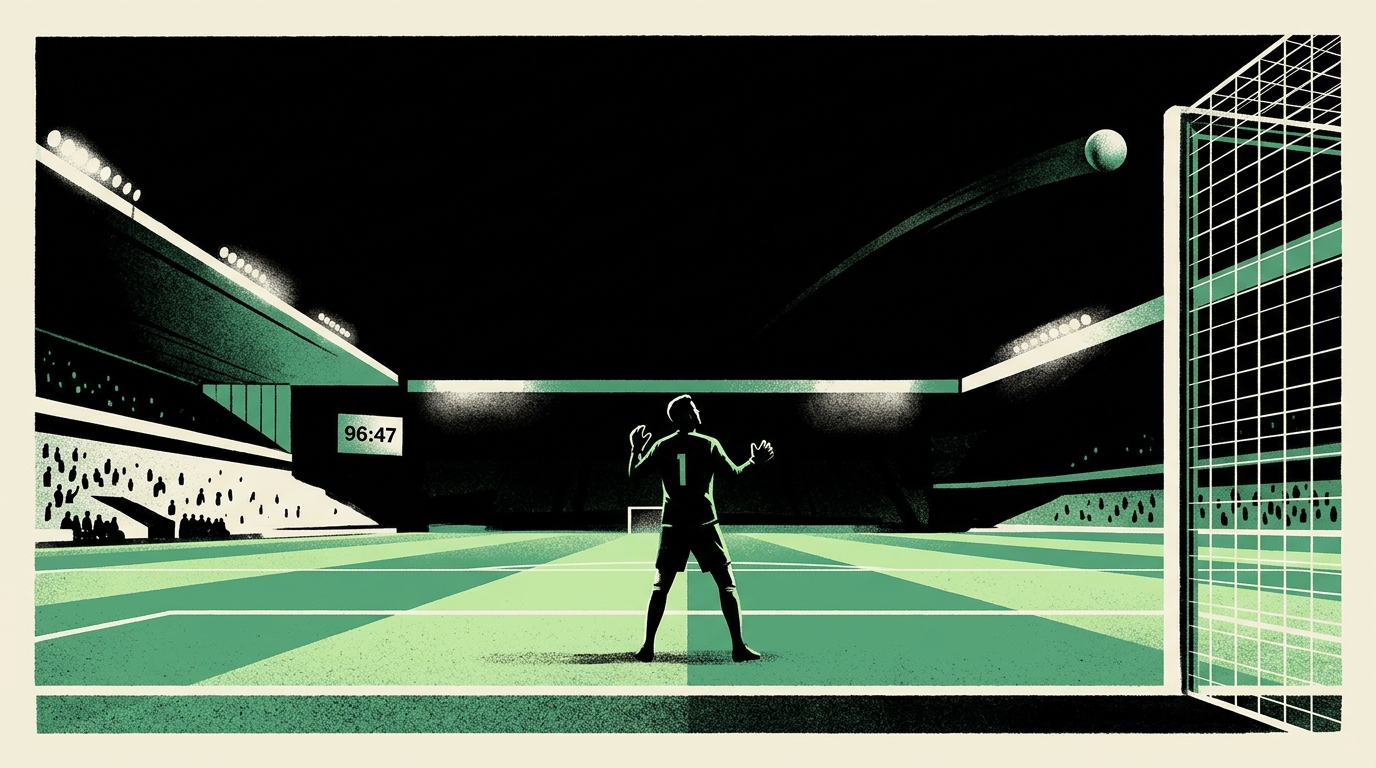
There is a particular kind of agony reserved for the manager who watches his side concede in the ninety-third minute. It is the agony of a plan that held for eighty-nine minutes and then, quietly, didn’t. At World Cup 2026, that agony is being distributed with unusual generosity. Goals in added time, goals in the final quarter, goals that arrive just when a team believed it had done enough: they are the defining statistical signature of this tournament so far, and they deserve more than a shrug.
BBC Sport’s analysis of the phenomenon points to three structural causes: the extended stoppage-time protocols introduced after Qatar 2022, the tactical use of substitutions to manage tempo in the final stages, and the hydration breaks mandated by the North American summer heat. Each of those factors is worth unpacking individually, because together they amount to a fundamental reshaping of how a football match ends.
The Stoppage-Time Effect
FIFA’s directive to referees after Qatar 2022 was blunt: account properly for time lost to substitutions, goal celebrations, VAR checks and the general theatre of modern football. The result in Qatar was a tournament average that crept past ten minutes of added time in several matches. The directive has carried forward into 2026, and the effect on goal distribution is measurable. When a match that once effectively ended at ninety-two minutes now runs to ninety-six or ninety-seven, you are adding a meaningful window in which tired legs and stretched defensive lines can be punished.
Scotland’s 1-0 defeat to Morocco on day nine illustrated the point neatly. The Guardian’s live coverage noted that Morocco went ahead within two minutes and thoroughly outplayed Scotland in the opening stages, yet Scotland had two significant penalty appeals rejected and remained in the contest deep into the second half. The scoreline stayed at 1-0, but the extended added time meant Scotland were defending under pressure for longer than they would have been at any previous World Cup. One goal conceded early, one clean sheet preserved by the narrowest of margins, and yet the sense throughout was that the match could have tilted at almost any moment in those final minutes.
Substitutions as a Double-Edged Weapon
Why do tactical substitutions increase late-goal risk?
The five-substitute rule, now a permanent fixture at international level, was introduced partly to protect player welfare. The unintended consequence is that it has made the closing stages of matches considerably more chaotic. A manager who brings on three fresh legs between the seventy-fifth and eighty-fifth minutes is gambling that the disruption to his own team’s shape is worth the energy boost. Sometimes it is. Sometimes the new arrivals haven’t quite settled into the defensive structure when the opposition plays through it.
How does the North American heat change substitution strategy?
The summer conditions across the United States, Canada and Mexico add a layer of urgency to that calculation. Hydration breaks, which BBC Sport identifies as a contributing factor to the late-goal surge, interrupt the rhythm of a match in ways that are difficult to quantify but easy to observe. A team that has spent eighty minutes building a defensive shape finds that shape disrupted by a break, and the restart requires a brief period of reorganisation. In those moments, the opposition’s freshest substitutes are at their most dangerous. The heat, in other words, is not merely a logistical inconvenience. It is a tactical variable.
Scotland, Morocco and the Qualification Arithmetic
Scotland’s situation after two group games is the kind that requires a spreadsheet and a certain tolerance for ambiguity. A win over Haiti in their opener, a defeat to Morocco, and now a final group game that will determine whether they advance. The Independent’s report from Boston captured the mood of the Scotland support with characteristic warmth: charmed locals, good-natured supporters who have made a city their own, and the lingering possibility of a return to Boston in the round of 32. The expanded 48-team format, which you can read about in detail in our guide to the 2026 structure, means that third-place finishes can still yield qualification. Scotland are not out. They are, however, in the position of needing results to go their way, which is not where any manager wants to be.
The tactical picture against Morocco was not entirely bleak for Steve Clarke’s side. The two penalty appeals that were turned down, referenced in the Guardian’s live blog, suggest Scotland created moments of genuine danger even after going behind. Whether those moments translate into goals in the final group game is a different question, and one that the late-goal data makes slightly more interesting. If this tournament is producing more goals in the final quarter than any previous World Cup, Scotland’s opponents will be aware that a lead is not safe until the referee’s whistle. That cuts both ways.
The Wider Tournament Picture
What does Turkey’s early exit tell us about this World Cup?
Turkey’s elimination after two defeats, the second of which came against Paraguay, was the result that most surprised the tactical community on day nine. Paraguay are not without quality, but Turkey arrived in North America as genuine dark-horse candidates in several pre-tournament assessments. The Guardian’s live coverage also noted the first use of the new sanction for concealing speech from officials, applied to Paraguay’s Miguel Almirón after remarks directed at Mert Muldur. That is a footnote in isolation, but it speaks to the broader regulatory ambition of this tournament: FIFA is using 2026 to test and embed several rule changes simultaneously, and the cumulative effect on match dynamics is not trivial.
How has the USA’s performance changed the domestic football conversation?
The United States progressing to the round of 32 after their performance in Seattle is the storyline that the tournament’s commercial architects most wanted. The Guardian’s World Cup Daily podcast covered the USA’s progress alongside Morocco’s result, and the tone was of a tournament that is beginning to find its identity. The Guardian’s first-impressions piece from its writers on the ground noted that football is now being discussed at school pickups and on bar televisions in cities that would previously have been indifferent. Whether that converts into long-term structural growth for the sport in the United States is a question for another day, but the short-term cultural penetration is real.
Are the spaceship stadiums actually any good?
The Guardian’s writers’ first-impressions piece offered a mixed verdict on the infrastructure. Logistics have sometimes been challenging, the media-centre water costs have attracted predictable criticism, and the sheer volume of matches in the expanded format creates genuine scheduling complexity. The stadiums themselves, several of which have been described in terms that suggest architects were briefed to make them look like they landed from orbit, have generally received positive reviews for the playing surfaces and sightlines. Whether a 48-team World Cup can sustain the quality of football that the opening round produced is the structural question that will define how this tournament is remembered.
What Comes Next
The late-goal phenomenon is not going away. The structural conditions that produce it, extended stoppage time, five substitutes, hydration breaks, summer heat, are fixed for the duration of the tournament. Teams that have built their tactical identity around defending a lead will need to adapt, or they will find themselves on the wrong end of the data. The back-three systems that several European sides have deployed offer one potential answer, providing defensive width and numerical security in the final stages, but they require the right personnel and a manager willing to sacrifice attacking width.
For Scotland, the immediate priority is simpler: win the final group game and hope the arithmetic resolves in their favour. For the tournament as a whole, the late-goal trend is producing exactly the kind of drama that a 48-team format needs to justify itself. Empty final-group-stage matches are the format’s great vulnerability. If every match is live until the ninety-seventh minute, that vulnerability diminishes considerably.
The World Cup has a habit of producing tactical lessons that filter down into club football over the following seasons. The lesson from 2026’s first nine days may be the most straightforward one in years: the match isn’t over when you think it is. Plan accordingly.
FAQ
Why are there so many late goals at World Cup 2026?
Extended stoppage-time protocols, mandatory hydration breaks in the North American heat, and the tactical disruption caused by five-substitute windows are the three main structural factors identified by analysts. Together they add meaningful minutes of live play to the end of each match, during which tired defensive lines are at their most vulnerable.
Can Scotland still qualify from their World Cup group?
Yes. After one win and one defeat, Scotland’s fate depends on their final group game and results elsewhere. The expanded 48-team format means third-place finishes can still advance, giving Scotland a route to the round of 32 even without a win, though a positive result would make the arithmetic considerably simpler.
What is the new rule about covering your mouth on the pitch?
FIFA introduced a sanction for players who conceal their speech from officials by covering their mouth, designed to reduce the use of abusive or offensive language that cannot be lip-read by referees. Paraguay’s Miguel Almirón became the first player to receive this sanction at World Cup 2026, during the match against Turkey.
How does the 48-team World Cup format affect group-stage matches?
The expanded format splits teams into 12 groups of four, with the top two and the best eight third-placed sides advancing. This means more teams remain in contention for longer, reducing the number of dead-rubber final group games that plagued previous 32-team tournaments. Our full breakdown of the format covers the bracket structure in detail.
Where can I watch World Cup 2026 matches?
Coverage varies by territory. For a full guide to legal broadcast options and how to watch matches online, visit our how-to-watch page.
